










Striders Impex Limited H1 revenue rose 50% as EBITDA fell 36%
Key highlights
- Striders reported H1 FY27 revenue of Rs 39.2 crore, up 50.5% from Rs 26.0 crore.
- H1 FY27 EBITDA fell 35.9% to Rs 1.6 crore and EBITDA margin declined to 4.1% from 9.7%.
- PAT declined to Rs 80 lakh in H1 FY27 from Rs 1.4 crore in H1 FY26.
- Striders added five international customer accounts and Striders FZ LLC generated Rs 9.4 crore in H1 FY27.
powered by IRIS
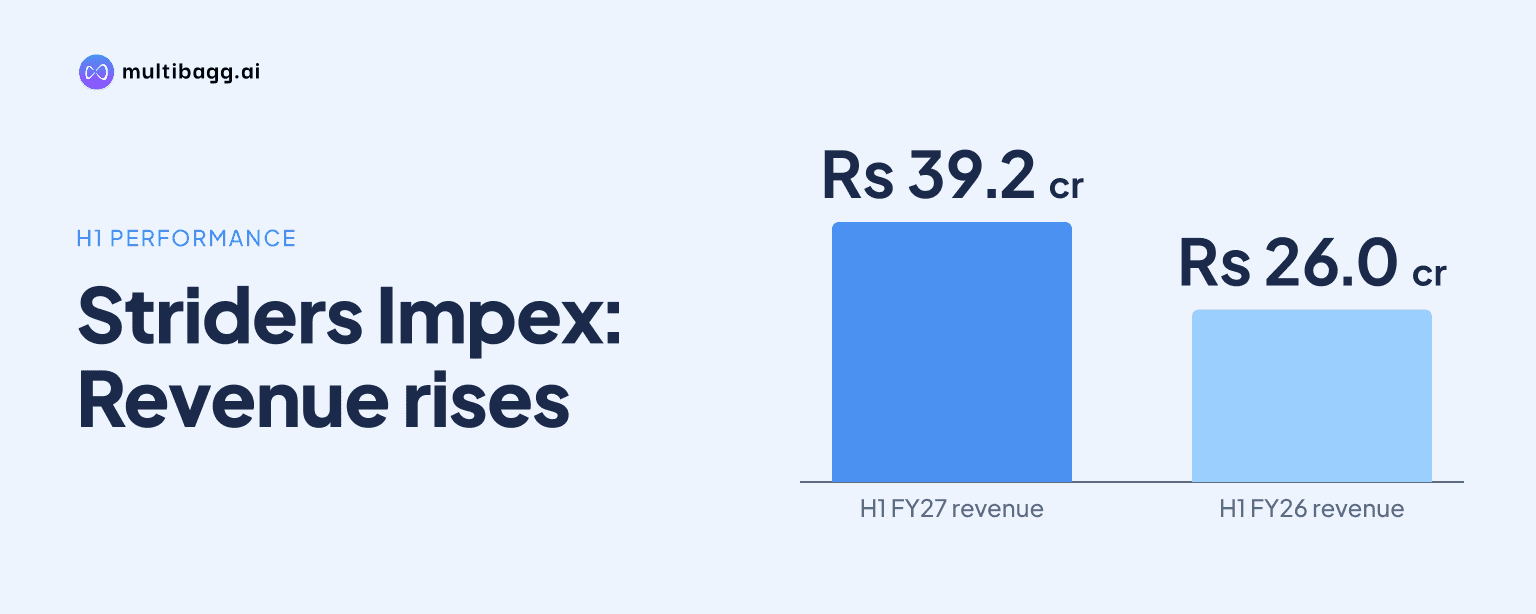
For the half year ended September 30, 2026, Striders Impex Limited reported Rs 39.2 crore of revenue, up 50.5% year on year, but earnings before interest, tax, depreciation and amortisation (EBITDA) fell 35.9% to Rs 1.6 crore as input, freight, licensing and capability-building costs increased.
Know Striders Impex inside out
Results, valuation, peers and who's buying, in one view.
How did Striders perform in H1 FY27?
Striders increased consolidated revenue to Rs 39.2 crore in H1 FY27 from Rs 26.0 crore in H1 FY26, an increase of 50.5%. EBITDA declined from Rs 2.5 crore to Rs 1.6 crore over the same periods. Profit after tax (PAT) was Rs 80 lakh in H1 FY27, while PAT in H1 FY26 was Rs 1.4 crore.
The comparison shows that earnings moved differently from sales in the six months ended September 30, 2026. Revenue increased by Rs 13.2 crore year on year, while EBITDA decreased by Rs 90 lakh. EBITDA margin fell 558 basis points to 4.1% from 9.7%, while PAT margin declined 360 basis points to 2.0% from 5.6%.
Striders attributed the H1 FY27 sales increase to expanded operations, international customer engagement and opportunities across its product portfolio. Its international entity, Striders FZ LLC, generated Rs 9.4 crore of revenue in the six-month period, which Striders said was about 75% of that entity’s full-year FY26 revenue.
Why did Striders’ profitability decline despite revenue growth?
Striders said H1 FY27 profitability was affected by increased raw-material input costs, higher freight expenses, licensing commitments and spending to strengthen operating capabilities. The company did not disclose a rupee-by-rupee split for these categories, but EBITDA margin declined to 4.1% in H1 FY27 from 9.7% a year earlier.
The margin movement extended from operating profit to final profit in the half year ended September 30, 2026. PAT margin was 2.0%, down from 5.6% in H1 FY26, alongside the decline in PAT to Rs 80 lakh. This meant Striders converted a smaller share of revenue into both EBITDA and PAT than in the corresponding prior period.
Striders also linked its cost base to investments in people, international distribution infrastructure and technology. These initiatives are intended to improve operational visibility, inventory management and working-capital efficiency, but they coincided with EBITDA falling by Rs 90 lakh in H1 FY27.
Got a follow-up? Ask IRIS
Which international expansion steps shaped H1 FY27?
Striders expanded activity across North America, Europe, Southeast Asia and the Middle East in H1 FY27, adding five international customer accounts. In the United States, it established a distribution partnership, completed product-safety testing and started preparations for entry into the Amazon US marketplace.
In Southeast Asia, Striders developed commercial relationships in Malaysia, Vietnam, the Philippines and Indonesia. In Europe, it established a distribution partnership in the Netherlands while continuing to explore opportunities beyond existing markets. The release did not provide separate revenue, profit or order figures for the United States, Europe or Southeast Asia.
The Middle East plan centred on Striders Hub LLC in the United Arab Emirates. Striders said it had established regional warehousing and inventory infrastructure, developed relationships with retail chains and marketplaces, and appointed distribution partners across key Gulf Cooperation Council markets. The UAE platform has a portfolio of more than 200 stock-keeping units (SKUs) across licensed brands.
Striders also disclosed that geopolitical disruptions affected the anticipated pace of Middle East business development. Management said its focus is on converting established commercial relationships into recurring orders, so the future contribution of the UAE platform remains dependent on execution and external conditions rather than reported H1 FY27 revenue.
How is Striders building its product and distribution platform?
Striders is combining licensed properties with proprietary brands as it seeks to move beyond a conventional distribution model. Its disclosed licensed portfolio includes Disney, Marvel, Barbie, Hot Wheels, Paw Patrol, Hello Kitty and Harry Potter, alongside other entertainment and consumer properties. Its stated strategy is to build distribution reach, launch value products under its own brands and use licensing relationships.
The product strategy is tied to a wider geographic distribution plan rather than disclosed segment-level financial contributions. Striders identified four strategic regions in H1 FY27, while the Rs 9.4 crore revenue reported by Striders FZ LLC was the only separately quantified international business measure in the release.
Management identified sourcing efficiencies, product-mix optimisation, disciplined inventory management, improved utilisation of distribution infrastructure and tighter working-capital controls as priorities. These measures address the cost and operating mechanisms behind the EBITDA-margin decline to 4.1%, while expansion of proprietary brands and conversion of distribution relationships are intended to support future revenue.
Conclusion
Striders’ H1 FY27 results show that a 50.5% increase in revenue to Rs 39.2 crore came with lower earnings, as EBITDA fell 35.9% to Rs 1.6 crore and PAT declined to Rs 80 lakh. The reported outcome reflects higher input, freight and licensing costs, alongside spending on people, distribution infrastructure and technology during international expansion.
The next point to watch is execution in the second half of FY27. Management’s disclosed plan is to convert distribution relationships into recurring business, scale international operations and improve operating efficiency through sourcing, product mix, inventory discipline, distribution utilisation and working-capital controls, while geopolitical disruption remains a factor for the UAE business.