










Paytm expects AI-agent monetisation within about one year
Key highlights
- Paytm said on October 27, 2026, that AI-agent monetisation should begin picking up about one year after development began.
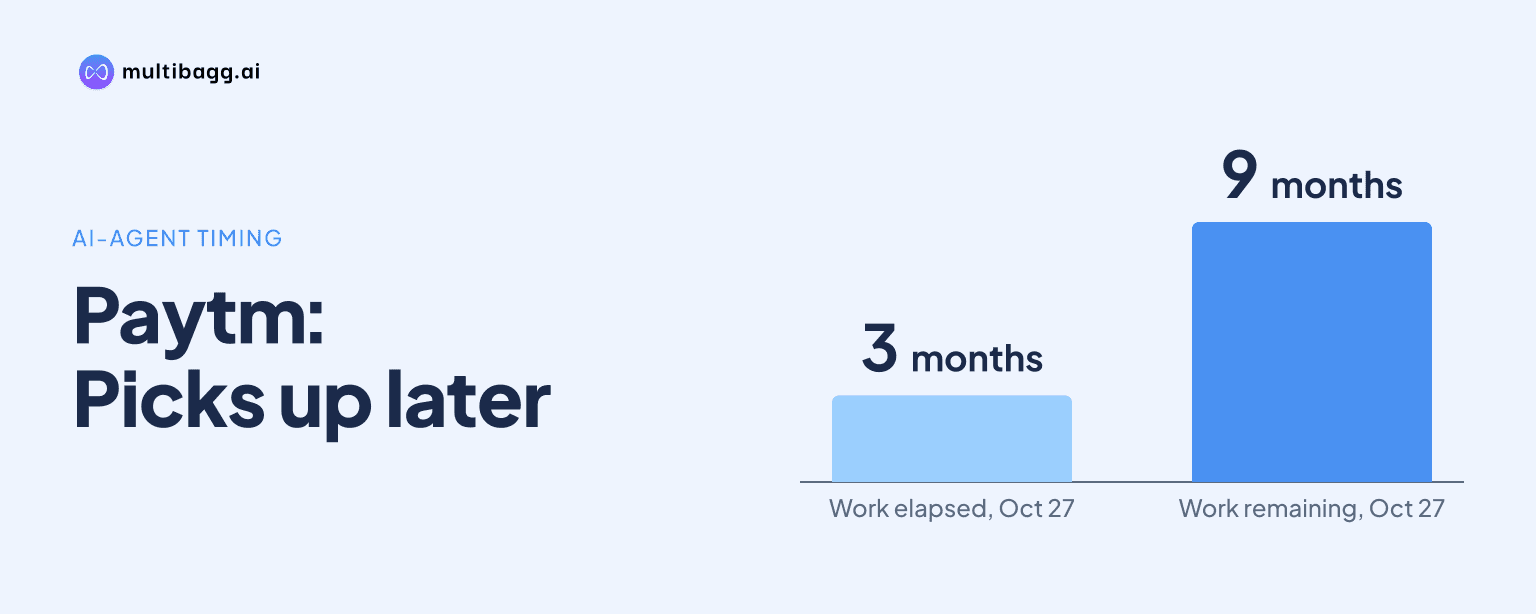
- Management said three months of work had already passed, implying roughly nine months remained from the October 27 call.
- Paytm may charge small businesses subscription fees, transaction fees or both for AI-agent services.
- Paytm’s Meta-linked marketing service combines a monthly platform fee with a percentage of merchant marketing spend.
powered by IRIS
One 97 Communications Limited, which operates as Paytm, expects monetisation from artificial-intelligence, or AI, agents for small businesses to begin picking up about one year after work started. In its October 27, 2026 earnings call, management said the services could generate subscription fees, transaction fees or both, while citing a merchant marketing model that combines a monthly platform fee with a share of spend.
Know One 97 Communications inside out
Results, valuation, peers and who's buying, in one view.
What AI agents is Paytm building for small merchants?
Paytm is building AI agents to operate business functions for small merchants that do not have dedicated staff for those tasks. Founder and Chief Executive Officer Vijay Shekhar Sharma described the initiative on October 27 as an AI stack intended to give small businesses capabilities that larger companies can run internally.
The proposed service is part of Paytm’s merchant strategy rather than a standalone consumer AI product. Sharma said the company acquires businesses through payments, uses payment flows to support credit underwriting, then expands into insurance and wealth; in that sequence, AI is intended to connect, or “bind”, the broader merchant relationship.
Paytm did not list individual agent products, adoption figures or a separate revenue line for the platform in the October 27 call. Management did say AI is already used in merchant onboarding, customer-related work and sales decisions, including identifying which merchants to acquire, where yields are higher and which merchants should be retained.
How will Paytm charge for AI agents?
Paytm expects to charge merchants through subscriptions, transaction fees or a combination of the two. Sharma gave this answer when asked how the small-business offering could be monetised, but management did not disclose subscription prices, transaction take rates, service tiers or a revenue target.
The clearest existing commercial example discussed on October 27 was a merchant marketing offering linked to Meta. Paytm said it has started acquiring customers for that service, charging a monthly platform fee and receiving a percentage of a merchant’s marketing spend. Sharma initially mentioned Meta and Google, then clarified that the active work he was describing was with Meta.
Management positioned the potential AI customer base within Paytm’s merchant network, rather than specifying a new addressable market. Sharma said analysts could consider a portion of Paytm customers described as “glass-door merchants” and estimate how many might buy another AI service, but he did not define the term or provide an eligible-merchant count.
When will Paytm AI-agent revenue start to pick up?
Paytm expects broader AI-agent monetisation to start picking up about one year after the work began. When asked on October 27 whether monetisation could emerge in six to nine months, Sharma replied that it would be one year and added that three months had already passed, implying roughly nine further months from the call date.
This is a management expectation, not formal financial guidance. Sharma said some revenue from the work was already beginning to show up, while also saying the wider opportunity would take time and represented future upside beyond financial services. Paytm gave no quarterly AI revenue forecast, profitability target or launch date.
The timing distinguishes the existing Meta-linked marketing arrangement from the broader agent platform. The marketing service has a disclosed fee structure, while Paytm described the small-merchant agents as a platform still being created; management did not say whether individual functions would be separately priced or bundled into a single subscription.
Got a follow-up? Ask IRIS
How does the AI plan fit Paytm’s merchant business?
Paytm sees AI as an additional merchant service built on its payments-led relationship model. Sharma said small businesses are Paytm’s core focus and described payments as the entry point, credit as the major earning service, and insurance and wealth as products that deepen relationships with merchants, their families and their shops.
The company also uses AI internally in its sales model. Sharma said machine-led processes, rather than individual judgement alone, help determine the right merchant to acquire, the locations with higher yield and the merchants that are important to retain. That operating use is separate from the planned external AI-agent fees, although both concern the same small-business customer segment.
Paytm’s current focus is explicitly small businesses, not large enterprises. Sharma said the company has “something more brewing up” for large businesses and hopes to announce it later, but did not provide a product description or date. The one-year monetisation expectation discussed on October 27 therefore relates to the small-merchant AI initiative.
What remains undisclosed about Paytm’s AI-agent opportunity?
Paytm has not disclosed the scale of the AI-agent opportunity in merchant numbers or rupees. The October 27 call did not provide the number of merchants using AI agents, the expected conversion rate from its merchant base, average subscription value, transaction volume, or the cost of providing the services.
Management also did not give a separate view of how much early revenue comes from the Meta-linked marketing product versus other AI work. Sharma said the company is creating agents for small businesses and that some revenue has started to show up, but the transcript does not establish that all current AI-related revenue is generated by the broader agent platform.
Conclusion
Paytm is outlining a potential merchant revenue stream beyond payments and financial services distribution. Its disclosed model combines recurring subscription-style fees with transaction-linked fees, and the Meta-linked marketing service provides an example of a monthly platform fee plus a share of customer spend. However, the broader AI-agent platform has no disclosed financial target or adoption data.
The next point to watch is whether the roughly nine-month period implied by management’s October 27, 2026 comments produces disclosed pricing, merchant adoption or revenue figures. Management also said it hopes to announce a separate offering for large businesses later, leaving the scope and timetable of that enterprise plan unresolved.