










Paytm Says More Than 10 Million Merchants Are Creditworthy
Key highlights
- Paytm believes more than 10 million of its 16 million device merchants are good-quality and creditworthy.
- The potential lending pool represents more than two-thirds of Paytm’s device-merchant base.
- Paytm has more than a dozen lending partners, with many relationships lasting 3, 4 or 5 years.
- A lender may resume default loss guarantees from the next quarter after pausing them at the beginning of FY26.
powered by IRIS
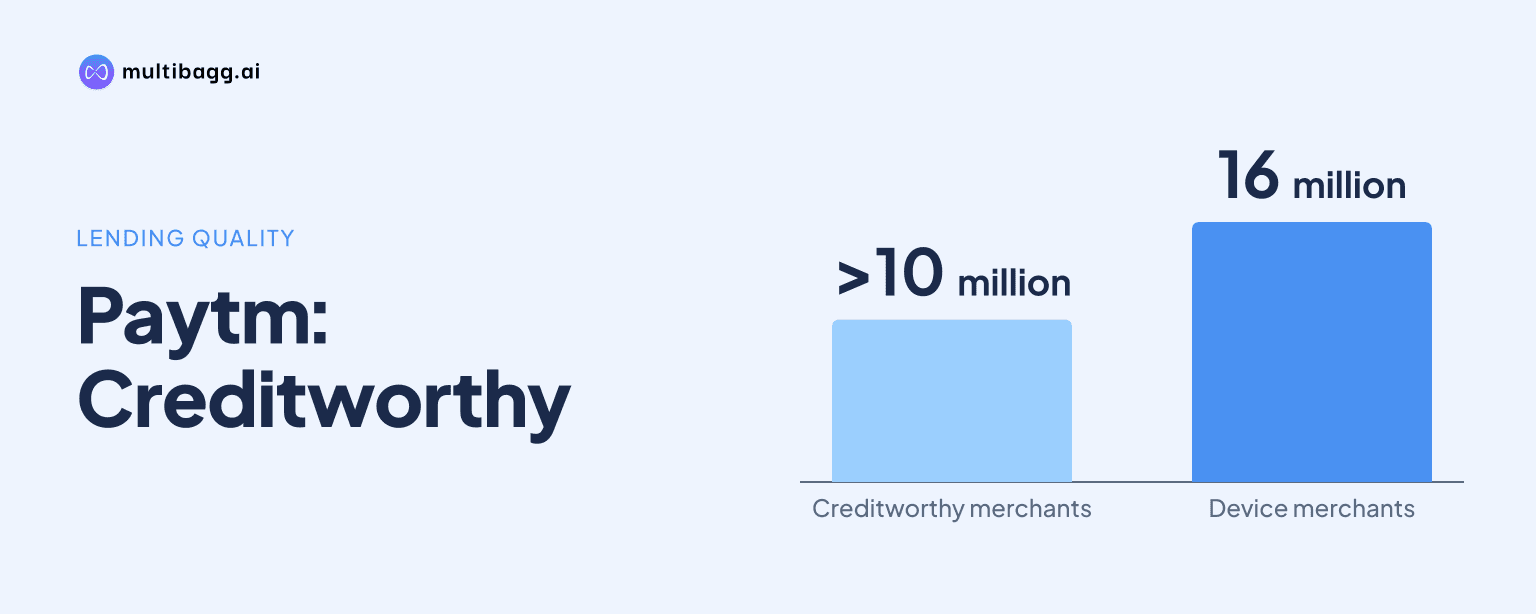
Paytm said it believes more than 10 million of its 16 million device merchants are good-quality and creditworthy, creating a potential lending funnel exceeding two-thirds of its device base. Management said merchant retention, relationship ageing and transaction activity matter more than gross sign-ups because retained merchants can support payment revenue and later financial-services distribution.
Know One 97 Communications inside out
Results, valuation, peers and who's buying, in one view.
How many Paytm device merchants are creditworthy?
Paytm believes upwards of 10 million of its 16 million device merchants are good-quality merchants suitable for its lending funnel. Vijay Shekhar Sharma gave the estimate when asked how many device merchants could be considered lendable, saying the company internally tracks a lendable-merchant measure and sees more value in retaining such merchants than in simply acquiring new ones.
The estimate implies that more than two-thirds of Paytm's device-merchant base is considered creditworthy by management. Paytm did not disclose how many of these merchants have taken loans, received lender approval or meet a particular underwriting threshold. The figure is management's assessment of merchant quality, rather than a commitment by a lending partner to extend credit.
Paytm said lender partners retain responsibility for their loan books, while its role includes loan distribution and collections. The 10 million-plus group therefore describes the potential pool for financial-services cross-selling, not a reported loan book or a measure of outstanding merchant credit.
Why is Paytm prioritising retained merchants over sign-ups?
Paytm is prioritising retained merchants because management believes relationship ageing raises the probability that lender partners can offer a merchant credit. Sharma said a shopkeeper may accept cash or use other payment methods, but remaining on Paytm's platform preserves a relationship that can be relevant to later credit distribution.
The company said it removes merchants that are not active or transacting, meaning its reported net active merchant number is lower than the gross active population. Paytm nevertheless expects its reported net active monthly merchant count to grow. That approach distinguishes its reported merchant base from gross acquisition, because an existing merchant with a longer platform history can be more relevant to the lending funnel.
Management described Paytm's model as payments followed by credit, rather than payments measured only by gross merchandise value, or GMV. Sharma said merchant quality is connected to financial-services revenue, which he described as having a larger bottom-line contribution than merchant discount rate, or MDR, and subscription revenue. The company is therefore directing sales efforts toward merchant quality and retention alongside device deployment.
What makes a Paytm merchant lendable?
Paytm said merchant lendability depends on both the relationship's ageing and GMV, rather than a single transaction-volume or income threshold. Sharma said a merchant earning Rs 100 a day would not receive term credit, while a lower-value customer could potentially receive postpaid instead of a term loan or merchant cash advance.
Management gave an illustration involving an average ticket size of Rs 2 lakh and payment capacity of Rs 500 a day over 365 days. It did not present that calculation as a formal approval rule, nor did it confirm that two-thirds of device merchants earn Rs 1,000 a day or more. Sharma specifically declined to disclose that earnings figure while confirming that Paytm tracks the lendable-merchant measure.
The distinction among postpaid, term loans and merchant cash advances indicates that Paytm's distribution funnel can serve different merchant profiles. The call did not disclose product-level merchant counts, loan disbursements, approval rates or minimum relationship-age requirements for these forms of credit.
Got a follow-up? Ask IRIS
How is Paytm using its sales team to retain merchants?
Paytm said newly hired sales executives are being deployed in the same merchant category, but first work on retention and market revisits before moving to device deployment. Sharma said recruits are trained and sequenced through retention work, with the company expecting the process to rejuvenate merchant relationships and subsequently support more Soundbox additions.
The sales approach is tied to Paytm's 16 million device merchants because it directs field capacity toward existing relationships before focusing solely on new acquisition. Sharma said Paytm had been waiting to recruit for some time while quick-commerce businesses were taking a large number of workers in this category. Management did not disclose a target for sales hiring or Soundbox additions.
Paytm said gross active merchant numbers are larger than its reported net active number because inactive and non-transacting merchants are removed from the reported base. A retained merchant can consequently be more valuable to the company's payments-and-credit model than a newly signed merchant without sufficient activity or relationship history.
What does Paytm's lending model mean for risk and growth?
Paytm said merchant lending is part of its payments-and-credit model, while personal loans are a distribution-only business. Management said it provides expected credit loss, or ECL, data for merchant loans and that the range has been largely unchanged, but it did not disclose an ECL percentage, portfolio balance or period-by-period loss figure during this discussion.
Management said Paytm has more than a dozen lending partners, with many relationships spanning three, four or five years. Madhur Deora said the company intends to grow the lending funnel by improving the lendable base, collections and technology rather than by loosening credit policies. He described the objective as scaling cautiously with partners over a longer time horizon.
Paytm also discussed default loss guarantees, or DLGs, which can affect reported expenses. Management said one lender that paused DLGs at the beginning of FY26 after using them in FY25 may resume them from the next quarter. Deora said the lender had not taken DLGs for six quarters and that DLG was not among Paytm's top five considerations in lender discussions.
Conclusion
Paytm has put a numerical estimate around its merchant-lending opportunity, saying more than 10 million of its 16 million device merchants are good-quality and creditworthy. The disclosure explains why Paytm is focusing sales resources on retaining active merchants and building relationship age, rather than treating gross merchant sign-ups or GMV alone as the central measure of progress.
The next indicators are whether Paytm's reported net active monthly merchant base grows as management expects and whether retention-led sales activity translates into more Soundbox merchants and lending distribution. Management also flagged that a lender may resume DLGs from the next quarter, while saying it expects absolute earnings before interest, tax, depreciation and amortisation, or EBITDA, to continue increasing quarter on quarter despite that potential drag.