










Paytm lifts payment margin by shedding low-yield enterprise GMV
Key highlights
- Paytm’s net payment margin rose to 9 basis points from 8.5 basis points sequentially.
- Person-to-merchant GMV was flat quarter on quarter as late-Diwali seasonality and enterprise pricing discipline offset growth.
- Paytm has about 16 million device merchants, including more than 10 million it classifies as good-quality merchants.
- Paytm expects device capital expenditure of about Rs 400 crore and rolled out roughly 700,000 devices in the quarter.6
powered by IRIS
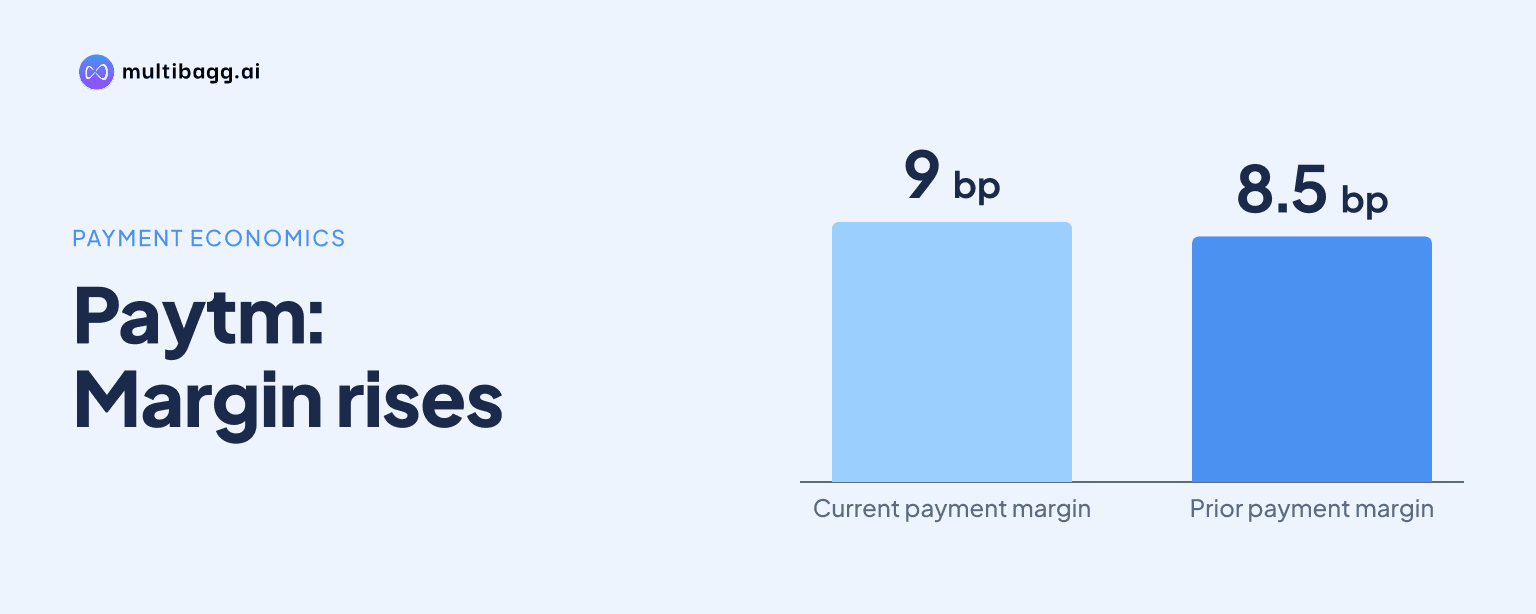
One 97 Communications Limited, which operates Paytm, is prioritising payment margins and free-cash-flow-generating merchant relationships over low-priced enterprise gross merchandise value (GMV). Paytm’s net payment margin rose to 9 basis points from 8.5 basis points even as person-to-merchant GMV was flat quarter on quarter, partly because it let inadequately priced and negative-contribution business leave.
Know One 97 Communications inside out
Results, valuation, peers and who's buying, in one view.
Why was Paytm’s merchant GMV flat quarter on quarter?
Paytm’s merchant GMV was flat sequentially because of late-Diwali seasonality and a deliberate decision to reject enterprise pricing that did not meet its margin thresholds. Management said the second quarter is usually more subdued than the first, depending on festive timing, and that this year’s late Diwali put almost the entire festive season into the third quarter.
The more specific factor was enterprise pricing discipline. Management said Paytm has a threshold for the margin it seeks from each customer type, including large enterprises, and that two or three customers were affected by this policy. One large customer’s long-term contract expired, and Paytm was discussing a renewal at a different price rather than accepting the previous commercial terms.
Management described the expired relationship as materially large in GMV but negative in contribution margin. It said GMV growth would have been visible if that customer had remained, but the account had reduced profitability. Paytm did not quantify the account’s GMV share, saying only that it was significant but not a double-digit percentage.
How is Paytm increasing payment margins?
Paytm is increasing payment margins through tighter customer pricing and greater contribution from selected payment products. Management attributed the move to 9 basis points from 8.5 basis points partly to more discipline over merchant types and the prices Paytm accepts. A basis point is one-hundredth of a percentage point, making the reported sequential increase 0.5 basis points.
Management also cited momentum in equated monthly instalments, dynamic currency conversion and enterprise payments. These products, together with pricing controls, contributed to the reported margin movement, but Paytm did not disclose the individual contribution from each driver. The transcript therefore does not establish how much of the 0.5-basis-point increase came from the enterprise exit.
Vijay Shekhar Sharma contrasted this approach with large online merchants seeking rates below Paytm’s sourcing cost. He said Paytm would not participate in such pricing, particularly during the festive period when some merchants were negotiating harder. Management defined good-quality GMV as volume that creates bottom-line contribution rather than all transaction volume available in the market.
Is Paytm changing how it acquires merchants?
Paytm says its small-merchant model remains payments-led acquisition followed by financial-services monetisation, rather than a model dependent on merchant discount rate (MDR) revenue. Management called MDR on the Unified Payments Interface (UPI) an upside to the business model, not a fundamental driver. At current penetration rates, it said financial-services revenue from small merchants is significantly larger than the relevant funding and MDR opportunity.
Paytm uses artificial-intelligence models for Acquisition, Retention, Monetization and Service, which management calls ARMS. The models can direct more sales or service effort to particular pincodes and factor in small-merchant funding, MDR and RuPay credit card on UPI. Management said these factors refine resource allocation but do not fundamentally change its small-merchant strategy.
The company is focusing spending on engagement and retention of high-quality, high-potential merchants because those merchants can enter its financial-services funnel. Management said Paytm has about 16 million device merchants and that more than 10 million are, in its view, good-quality merchants. It also said reported net active merchants can look lower than gross active merchants because inactive or non-transacting merchants are removed from the active base.
Got a follow-up? Ask IRIS
What does free-cash-flow-generating merchant growth mean for Paytm?
For Paytm, free-cash-flow-generating growth means retaining merchants that can use payment options and cross-sold financial services without payment pricing falling below sourcing cost. Management said the business is no longer about adding customers regardless of economics. It is instead focused on revenue and GMV that generate bottom-line contribution.
This approach puts merchant retention and credit potential ahead of GMV alone. Management said a merchant’s age on Paytm’s platform matters more than transaction value by itself for lending decisions, since a shopkeeper may accept cash or another payment method while remaining engaged with Paytm. Continued retention can increase the likelihood of receiving a loan from a lending partner.
Management gave an illustrative daily repayment threshold of Rs 500 while explaining that credit selection uses both merchant age and GMV. It said a merchant earning Rs 100 a day would not receive a term loan or merchant cash advance, though postpaid credit could be relevant. Financial services, management said, offer a larger bottom-line opportunity than MDR or device-subscription revenue.
How much is Paytm spending to support merchant retention?
Paytm expects device capital expenditure of about Rs 400 crore, measured on an inward device-count basis, to remain at that level. Management said the amount is higher than before and is intended to support engagement and retention of merchants that may progress into financial services. Paytm rolled out about 700,000 devices in the quarter discussed on the call.
Management also disclosed an enabling resolution to invest up to Rs 500 crore over 12 months in Paytm Cloud Technologies Limited or an international subsidiary. It said this was not a commitment to deploy Rs 500 crore and was not a specific device-capital-expenditure plan. Funding into Paytm Cloud Technologies Limited’s Singapore subsidiary could support seed investments in international markets, although management said it had no concrete plan to use the full amount.
Conclusion
Paytm’s flat sequential merchant GMV reflected both late-Diwali timing and its stated willingness to leave low-margin or negative-contribution enterprise business behind. The measurable outcome was a rise in net payment margin to 9 basis points from 8.5 basis points, while its small-merchant strategy remained centred on payments acquisition and financial-services monetisation.
The next measure will be whether third-quarter festive activity lifts GMV while retaining the 9-basis-point payment margin. Management has also said device capital expenditure should remain about Rs 400 crore, while any deployment under the up-to-Rs 500 crore, 12-month investment approval would be disclosed when funds are infused or investments are made.