










Paytm says proposed UPI MDR could add over Rs 700 crore
Key highlights
- Paytm said a 2.5-basis-point UPI payments-margin improvement could generate slightly more than Rs 700 crore at current GMV of Rs 28 lakh crore.
- Paytm described potential UPI MDR income as bottom-line accretive upside that is not included in its business model or consumer-acquisition assumptions.
- The potential MDR opportunity would apply to UPI transactions above Rs 2,000, with a 40-basis-point cap discussed on the earnings call.
- Paytm reported two consecutive quarters of 28% growth, with comparable growth in the 30% range after excluding PIDF.
powered by IRIS
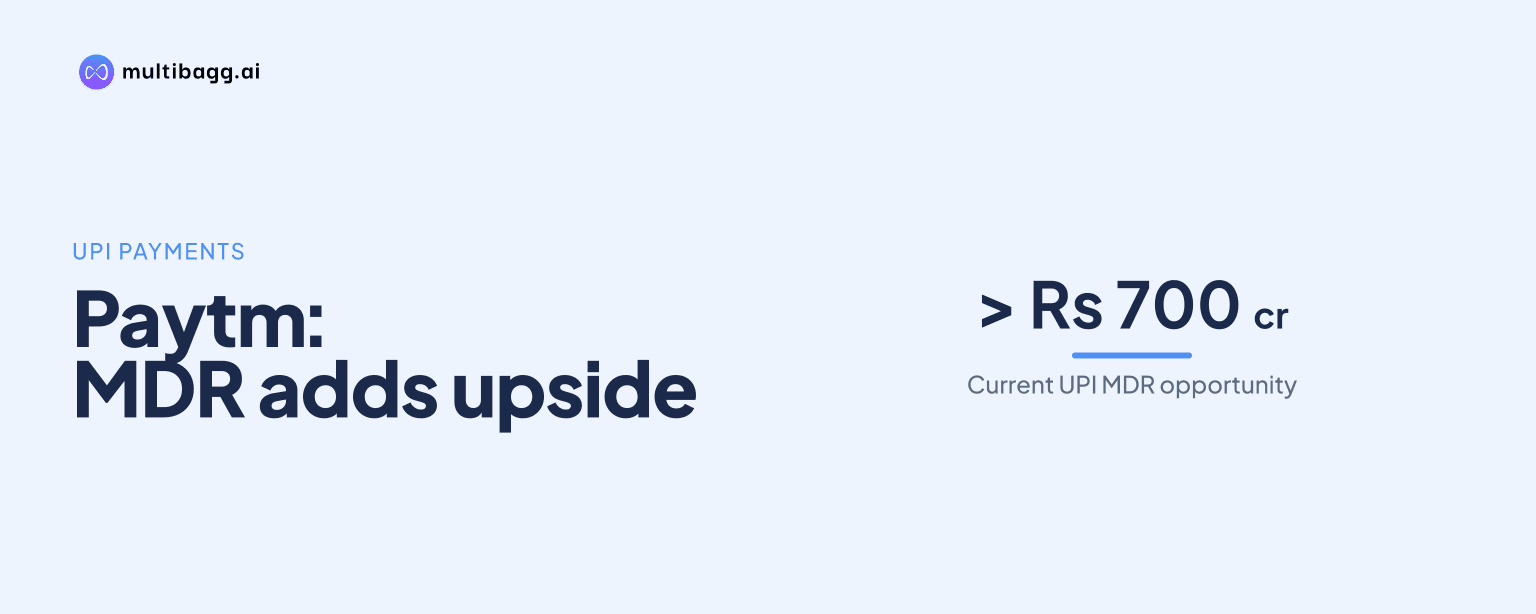
One 97 Communications Limited (Paytm) said a proposed Unified Payments Interface (UPI) merchant discount rate (MDR) could lift its payments processing margin by 2.5 basis points and generate slightly more than Rs 700 crore at its current gross merchandise value (GMV) of Rs 28 lakh crore. Management described the potential income as bottom-line accretive upside rather than a requirement for its acquisition plan.
Know One 97 Communications inside out
Results, valuation, peers and who's buying, in one view.
How much could proposed UPI MDR add to Paytm's earnings?
Paytm said 2.5 basis points, or 0.025 percentage points, of additional payments processing margin would be worth slightly more than Rs 700 crore at its present GMV of Rs 28 lakh crore. President and Group Chief Financial Officer Madhur Deora gave that calculation during the October 27, 2026 earnings call, while responding to an analyst's estimate of close to Rs 900 crore of incremental earnings before interest, tax, depreciation and amortisation (EBITDA) in FY28.
The Rs 700 crore figure is based on current transaction scale, not on a future GMV forecast. Deora said Paytm expects GMV to grow faster than the market on both consumer and merchant sides, which could create further upside if MDR is implemented. However, that is management's expectation, and the call did not provide a GMV target, an implementation date or a confirmed final MDR framework.
Would the proposed UPI MDR revenue reach Paytm's bottom line?
Paytm said the 2.5-basis-point opportunity would be bottom-line accretive, meaning management expects it to add to profitability rather than require matching expenditure. Founder and Chief Executive Officer Vijay Shekhar Sharma said the company has not included MDR in its business model or in the assumptions behind consumer acquisition, which positions the potential payment revenue as incremental to its existing plan.
Management also said it would not reduce consumer acquisition efforts if MDR were introduced. Sharma said Paytm remains committed to acquiring more consumers and has made consumer market share a primary key performance indicator, or KPI, for the team. The company intends to pursue that growth through products, features, collaborative partnerships and marketing, rather than treating MDR revenue as the funding source or condition for that activity.
The stated margin improvement also excludes possible platform-side fees, according to Sharma. He said consumer applications typically charge platform fees and that acquiring-side platform fees can also exist, especially where large merchants negotiate low margins. Therefore, Paytm presented 2.5 basis points as its known current best-case calculation without potential additional platform-fee revenue, rather than as a total ceiling on possible payment monetisation.
Which Paytm transactions could be affected by UPI MDR?
Paytm indicated that the relevant MDR opportunity would apply to transactions above Rs 2,000, with a 40-basis-point cap discussed by an analyst on the call. Sharma agreed that most of Paytm's GMV transactions should be closer to that cap than to a much lower rate, while adding the threshold condition that the transaction must exceed Rs 2,000.
Management differentiated its merchant base from large enterprises that may have more negotiating leverage. Sharma said Paytm works principally with small businesses and described activation for small merchants as straightforward, whereas large merchants may seek lower prices once another provider offers them. This distinction matters because the company linked the operational simplicity of any MDR switch-on to its small-merchant business, rather than claiming uniform realised pricing across every merchant category.
When asked whether implementation would require bilateral merchant negotiations, Sharma said it could occur through a “flip of a switch on day one.” That response was framed around the proposed operational process, not as confirmation that the policy has taken effect. Paytm's management said it did not know whether the National Payments Corporation of India, or NPCI, would implement MDR in December, stressing that the company is a recipient of the decision rather than its maker.
Got a follow-up? Ask IRIS
Is Paytm changing its growth plan because of MDR?
Paytm said its consumer and merchant market-share push is separate from the MDR proposal. Sharma said the company would go “all in” on market share across consumers and merchants, although he clarified that references to market-share caps specifically concern consumers. On merchants, he said Paytm is already fully committed and that losing share would be awkward for the business.
The company reported two consecutive quarters of 28% growth, according to Deora. He added that, excluding the Payments Infrastructure Development Fund, or PIDF, from the comparable prior-year quarters, growth was in the 30% range. Management cited momentum in consumer and merchant activity, payments and financial services, while emphasising that this commentary excluded MDR.
Paytm also identified lending as a source of existing growth independent of a payments policy change. Deora said personal-loan distribution was improving as the credit cycle normalised, while merchant lending continued to perform well and had opportunities at both smaller and larger ticket sizes. Sharma said consumer lending has shifted towards distribution without a default loss guarantee, or DLG, while merchant lending can use DLG where a lending partner wants it.
What does Paytm say about the timing and certainty of UPI MDR?
Paytm did not provide a confirmed UPI MDR launch date, rate schedule or final regulatory decision. An analyst referred to implementation being moved from October 15 to after Diwali, but management did not validate a timetable. Sharma's answer on a possible December implementation was simply that NPCI may have the answer and that Paytm does not decide the policy.
That uncertainty is central to interpreting the Rs 700 crore calculation. It is a scale-based estimate of the value of 2.5 basis points on Rs 28 lakh crore of GMV, not reported revenue or guidance for FY27 or FY28. Management called it an upside and said its consumer-acquisition plan would remain unchanged whether MDR materialises or not.
Conclusion
Paytm has put a clear number on a possible UPI monetisation change: 2.5 basis points of payments processing margin would produce slightly more than Rs 700 crore at current GMV of Rs 28 lakh crore. Management's central message was that this would be incremental, potentially bottom-line accretive income alongside growth already reported in payments, lending and other financial services.
The next item to watch is NPCI's decision on whether, when and how UPI MDR would be implemented, including the treatment of transactions above Rs 2,000 and the 40-basis-point cap discussed on the call. Separately, Paytm said it intends to maintain consumer and merchant acquisition efforts regardless of MDR, while management expects GMV to grow faster than the market.