










PTC India Financial Services Limited says renewables are 45% of loans
Key highlights
- Renewable energy represented approximately 45% of PFS’s loan book in Q2 FY27.
- PFS sanctioned Rs 3,098 crore and disbursed Rs 1,595 crore in Q2 FY27.
- Loan assets increased approximately 25% sequentially to Rs 3,684 crore as of September 30, 2026.
- Gross Stage 3 assets declined to Rs 126 crore from Rs 190 crore in the previous quarter.
powered by IRIS
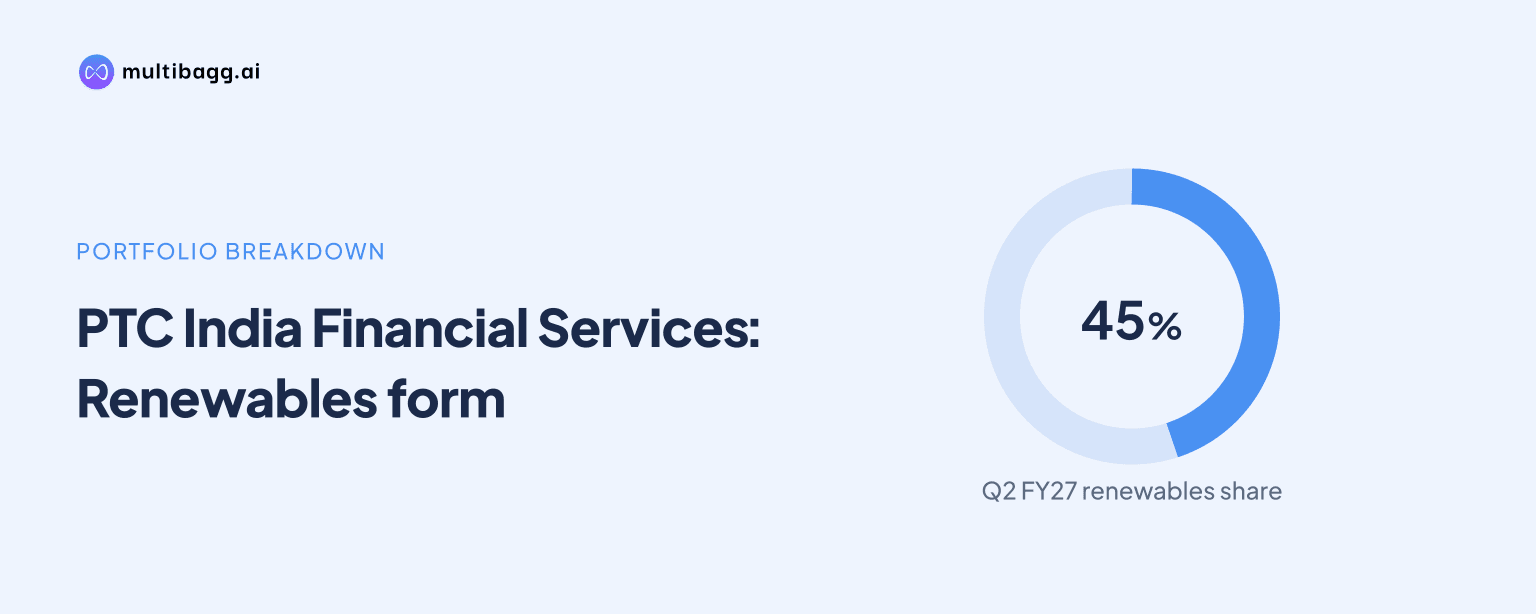
PTC India Financial Services Limited said its renewable energy portfolio represented approximately 45% of its loan book in Q2 FY27. PFS sanctioned Rs 3,098 crore and disbursed Rs 1,595 crore during the quarter, lifting loan assets 25% sequentially to Rs 3,684 crore as of September 30, 2026.
Know PTC India Financial Services inside out
Results, valuation, peers and who's buying, in one view.
What does PFS’s 45% renewable-energy share mean?
PFS said renewable energy accounted for approximately 45% of its loan book in Q2 FY27, making it a substantial part of the Rs 3,684 crore loan-assets base reported on September 30, 2026. Management said the portfolio includes renewable-energy opportunities as well as newer opportunities in the energy-transition ecosystem, but did not disclose its rupee value or the comparable share in earlier periods.
The increase in renewable exposure formed part of PFS’s stated focus on selected infrastructure sectors with sustainable growth opportunities. Management said the intended role of this sector mix is to support portfolio diversification, portfolio quality, risk-adjusted returns and the net interest margin, or NIM, rather than concentrating origination in one infrastructure segment.
PFS said its lending process assesses the borrower’s underlying business and cash flows, followed by loan structuring and underwriting. That approach is relevant as the renewable portfolio expanded during Q2 FY27, although the call did not provide renewable-specific sanctions, disbursements, defaults or yield data.
How quickly did PFS’s loan assets grow in Q2 FY27?
PFS’s loan assets rose approximately 25% sequentially, to Rs 3,684 crore on September 30, 2026 from Rs 2,946 crore on June 30, 2026. Management said this was the first upward movement after a gap of 10 quarters, reversing the recent direction of the outstanding loan book.
The Rs 3,098 crore of sanctions was a 36-quarter high, while Rs 1,595 crore of disbursements was a 19-quarter high, according to management. Sanctions are approved lending commitments and disbursements are funds released to borrowers, so neither measure automatically equals the increase in loan assets after repayments and prepayments.
An analyst noted that Q2 FY27 disbursements included roughly Rs 800 crore of repayments or prepayments, leaving net loan-book growth of about Rs 700 crore to Rs 800 crore. Management accepted that the 25% increase reflected a low base, but said the Rs 1,595 crore of quarterly disbursements was the highest in four years and that it did not expect repayments at the same level going forward.
What is PFS’s plan for rebuilding infrastructure lending?
PFS plans to rebuild its infrastructure book through lending across large, medium and small ticket sizes, serving both private-sector and public-sector undertaking borrowers. Management said it is using existing client relationships, more than two decades of sector experience and faster evaluation and execution to support origination through the rest of FY27.
Management described origination as diversified across the infrastructure value chain rather than concentrated in a single segment. It said deepening existing relationships remains central to the strategy alongside developing new relationships, while the 45% renewable-energy share in Q2 FY27 gives the company exposure to one selected sector within that wider infrastructure approach.
In response to an analyst, management set a target for the net loan book of approximately Rs 5,000 crore by the end of FY27. It also said the average borrower ticket size was between Rs 100 crore and Rs 150 crore per account, with a possible level of Rs 150 crore or more by the end of the year; average loan seasoning was about four years.
Got a follow-up? Ask IRIS
What changed in PFS’s earnings, asset quality and funding?
PFS reported total income of Rs 114 crore and profit after tax of Rs 44 crore in Q2 FY27. Annualised return on assets was 3.65%, annualised return on net worth was 5.64%, and interest spread improved to 1.18%; management attributed the spread movement to improved lending spreads during the quarter.
Gross Stage 3 assets declined to Rs 126 crore in Q2 FY27 from Rs 190 crore in Q1 FY27. Management said three assets were involved: Kundli Manesar, Varam Bio and Danu Wind Parks, with Danu Wind Parks technically written off after a 75% provision had already been made.
The Kundli Manesar account, a pre-2020 road-project loan, slipped into non-performing asset status during the quarter, management said. Against exposure at default of Rs 124 crore, PFS created a Rs 19 crore provision; management added that the annuity project has a Haryana State Industrial and Infrastructure Development Corporation guarantee and that recovery is expected.
PFS also received a fresh Rs 200 crore sanction from Central Bank of India, adding a new bank to its lender base. Management said another bank had granted an in-principle sanction and that it expected a formal sanction letter soon, while reporting positive cumulative net cash flow across all disclosed asset-liability management maturity buckets.
Can PFS maintain growth while protecting spreads?
PFS said it has a strong disbursement pipeline for the current quarter and is building a quality pipeline for medium-term growth, but management cautioned that spreads could tighten for a couple of quarters during the portfolio-building phase. That qualification places the Q2 FY27 interest spread of 1.18% alongside management’s expectation that new lending and balance-sheet growth will affect reported metrics.
Management told an analyst it expects loan growth of at least 25% in coming years, after the Rs 3,684 crore book recorded a 25% sequential increase in Q2 FY27. It also said borrowing costs should decline gradually as the balance sheet grows, targeting lending at prevailing market rates within a year, though this was management’s expectation rather than formal guidance.
On leverage, management said an optimum equity leverage of around four to 4.5 times may emerge after three to four years of book growth. It also said it expects future NIM to remain above 2%, while recognising that the current capital mix would change as the loan book expands.
Conclusion
PFS’s Q2 FY27 results show that renewable energy has become a major component of an infrastructure-lending rebuild, at approximately 45% of the loan book. The sector focus coincided with Rs 3,098 crore of sanctions, Rs 1,595 crore of disbursements and a 25% sequential increase in loan assets to Rs 3,684 crore, while gross Stage 3 assets fell from Rs 190 crore to Rs 126 crore.
The next test is whether PFS can convert its current pipeline while moving towards management’s approximately Rs 5,000 crore FY27 year-end net loan-book target. Readers should also watch the expected formal bank sanction, the pace of repayments, and whether the interest spread remains near the 1.18% reported in Q2 FY27 as management expects temporary tightening during portfolio building.