










Tata Power keeps 2.5 GW renewable build plan despite 11% curtailment
Key highlights
- Tata Power reported renewable curtailment of 11% in Q2 FY27, up from 8.8% in Q1 FY27.
- Tata Power retained its target to add 2.5 GW of renewable capacity this year.
- Tata Power expects some delayed evacuation lines by December or January.
- Tata Power reported Rs 2,231 crore of year-to-date renewable-generation EBITDA and indicated Rs 4,500 crore annually for 7.1 GW.
powered by IRIS
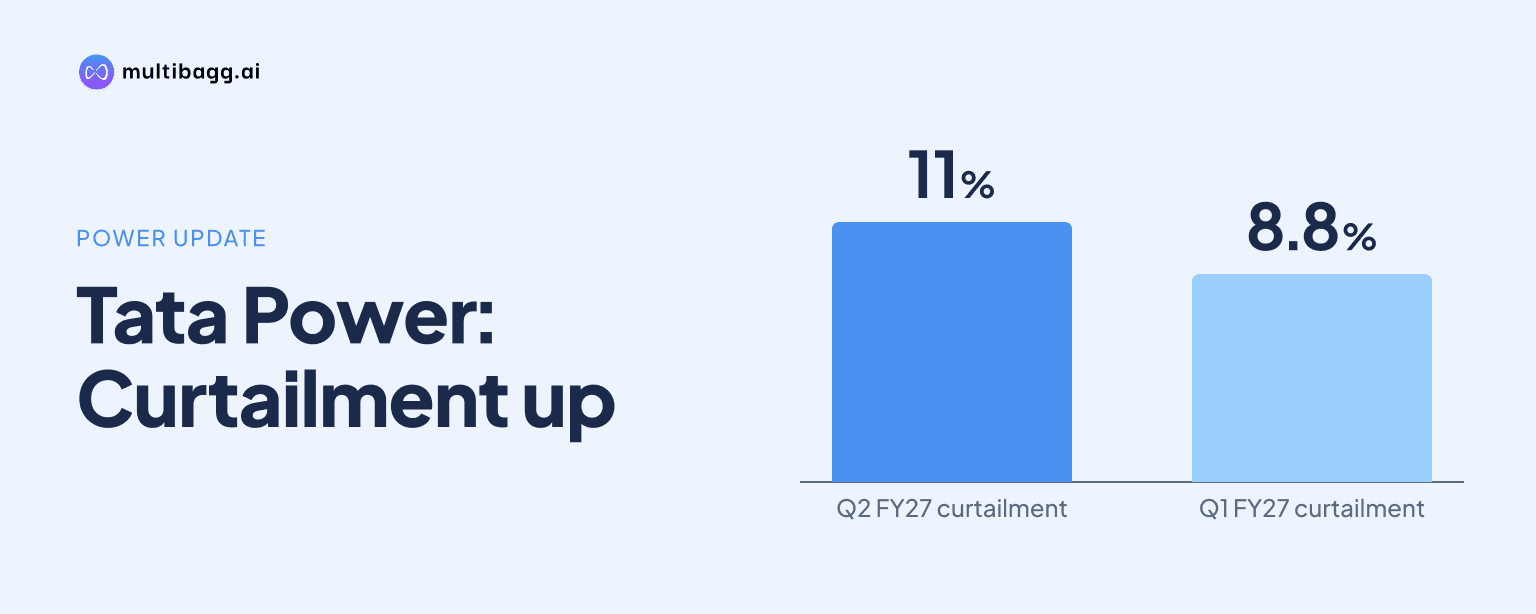
Tata Power maintained its target to add 2.5 gigawatts (GW) of renewable capacity this year despite curtailment reaching 11% in Q2 FY27, up from 8.8% in Q1 FY27. Management said projects were ready, delayed evacuation lines were expected by December or January, and battery energy storage system deployment should help reduce the constraint.
Know Tata Power Company inside out
Results, valuation, peers and who's buying, in one view.
Can Tata Power still add 2.5 GW this year?
Yes. Tata Power said it had missed renewable capacity-addition targets in the first and second quarters but still expected to meet its 2.5-GW target for the year. Management said many projects were ready and linked its confidence to delayed evacuation lines expected to arrive in December or January.
The company said the second half is typically better than the first half because monsoon and other factors can delay project completion in the first half. Tata Power had completed Rs 10,000 crore of capital expenditure by the Q2 FY27 call and said it remained on track for about Rs 25,000 crore for the year across renewables, transmission, distribution and other projects under implementation.
Management did not identify the renewable projects awaiting evacuation lines, their individual locations or their commissioning dates. Its stated case is that the first-half miss resulted from delayed grid connectivity even though projects were ready, rather than from a change to the 2.5-GW annual addition plan.
How did Tata Power's renewable curtailment change in Q2?
Tata Power's renewable curtailment rose to about 11% in Q2 FY27 from about 8.8% in Q1 FY27, an increase of 2.2 percentage points. Chief Financial Officer Sanjeev Churiwala said the company was facing the issue alongside the wider industry.
Tata Power did not quantify the generation or revenue affected by the 11% Q2 FY27 curtailment. Management said it had a “good line of sight” on connectivity projects in the pipeline and expected curtailment to improve in subsequent quarters, but did not provide a target rate for the rest of FY27 or FY28.
The constraint is relevant to the renewable-generation business because management gave a Rs 4,500 crore annual earnings before interest, tax, depreciation and amortisation, or EBITDA, indication for 7.1 GW of capacity. Renewable-generation EBITDA was Rs 2,231 crore year to date at the time of the Q2 FY27 call.
What is Tata Power doing to reduce curtailment?
Tata Power said it is working on connectivity and expects delayed evacuation lines to reduce curtailment in subsequent quarters. Management specifically said some lines were expected by December or January, which it also cited when reiterating the 2.5-GW renewable capacity-addition objective.
Tata Power also said battery energy storage system, or BESS, deployment was coming through and would help bring curtailment down. The call did not disclose the BESS capacity, investment, location or planned commissioning date, so it did not quantify how much of the 11% Q2 FY27 curtailment storage could address.
The company is separately pursuing longer-duration storage through pumped hydro. Tata Power's board approved an 1,800-megawatt pumped-hydro project at Shirwata near Lonavala with gross investment of Rs 11,871 crore, funded with 75% debt and 25% equity. Management said Shirwata could be bundled with renewable projects for renewable-energy round-the-clock supply to distribution companies, industrial customers and data centres.
Tata Power expects Shirwata to be commissioned in calendar year 2031, so it is not part of the December or January evacuation-line timeline for the current annual capacity target. Management also said work was under way on its first 1,000-megawatt pumped-hydro project, while the transcript did not provide a commissioning date for that project in this discussion.
Got a follow-up? Ask IRIS
What does the 7.1-GW portfolio imply for renewable earnings?
Tata Power said 7.1 GW of renewable capacity at a normalised plant load factor should generate about Rs 4,500 crore of annual EBITDA. Management said this would be a little more than twice the Rs 2,231 crore of year-to-date renewable-generation EBITDA because several plants had been commissioned only in the previous three or six months.
The earnings indication relies on a fuller-period contribution from those recently commissioned plants. Management said the full impact would be visible in subsequent quarters, but it did not issue a quarterly renewable EBITDA forecast or disclose the proportion of the 7.1-GW portfolio that was affected by the 11% Q2 FY27 curtailment.
At the group level, Tata Power reported Q2 FY27 profit after tax of Rs 1,652 crore, up 33% from Rs 1,245 crore a year earlier. Revenue rose 26% to Rs 19,886 crore from Rs 15,769 crore, while first-half EBITDA increased 7% to Rs 8,494 crore from Rs 7,961 crore; these figures cover businesses beyond renewable generation.
The wider capital programme also includes network investment. Tata Power said its disclosures separately cover Mumbai transmission and tariff-based competitive bidding projects, alongside distribution operations in Odisha, Delhi and Mumbai. That structure places renewable additions and grid-related work within the same approximately Rs 25,000 crore annual capital-expenditure plan.
Why are evacuation lines central to Tata Power's plan?
Evacuation lines are central because Tata Power said delayed lines had held back projects that were otherwise ready and contributed to the first- and second-quarter capacity-target misses. Management expects some of these lines by December or January and directly tied that expected timing to its confidence in achieving the 2.5-GW target this year.
The Q2 FY27 curtailment trend shows why the timetable matters: the rate increased from 8.8% in Q1 FY27 to 11% in Q2 FY27 while the company was waiting for connectivity. Tata Power said the situation was not specific to it, but its own ability to convert ready projects into capacity additions and receive output from operating assets depends on the planned improvement.
Tata Power did not provide the line capacities, counterparties or regulatory approvals involved in the connectivity programme. It also did not set out an alternative renewable-addition target if lines expected by December or January are delayed further, leaving delivery against the 2.5-GW target dependent on the stated second-half execution plan.
Conclusion
Tata Power's Q2 FY27 position is that an 11% renewable curtailment rate and two missed quarterly addition targets have not changed its 2.5-GW annual build objective. The increase from 8.8% in Q1 FY27 shows the grid constraint worsened during the first half, while management's Rs 4,500 crore annual EBITDA indication for 7.1 GW assumes growing contribution from recently commissioned assets.
The next milestones are the expected arrival of some evacuation lines in December or January and the resulting progress on capacity additions and curtailment. Investors can also watch BESS deployment details, renewable-generation EBITDA after newly commissioned plants complete a full period, and development of the Rs 11,871 crore Shirwata pumped-hydro project targeted for commissioning in calendar year 2031.