










Tata Power posts record ₹1,652 crore Q2 FY27 PAT, up 33%
Key highlights
- Tata Power reported record Q2 FY27 PAT of ₹1,652 crore, up 33% year on year.
- Q2 FY27 revenue rose nearly 26% to ₹19,886 crore from ₹15,769 crore.
- H1 FY27 PAT increased 22% year on year to ₹3,053 crore.
- Tata Power spent close to ₹10,000 crore in H1 FY27 against annual capex guidance of nearly ₹25,000 crore.
powered by IRIS
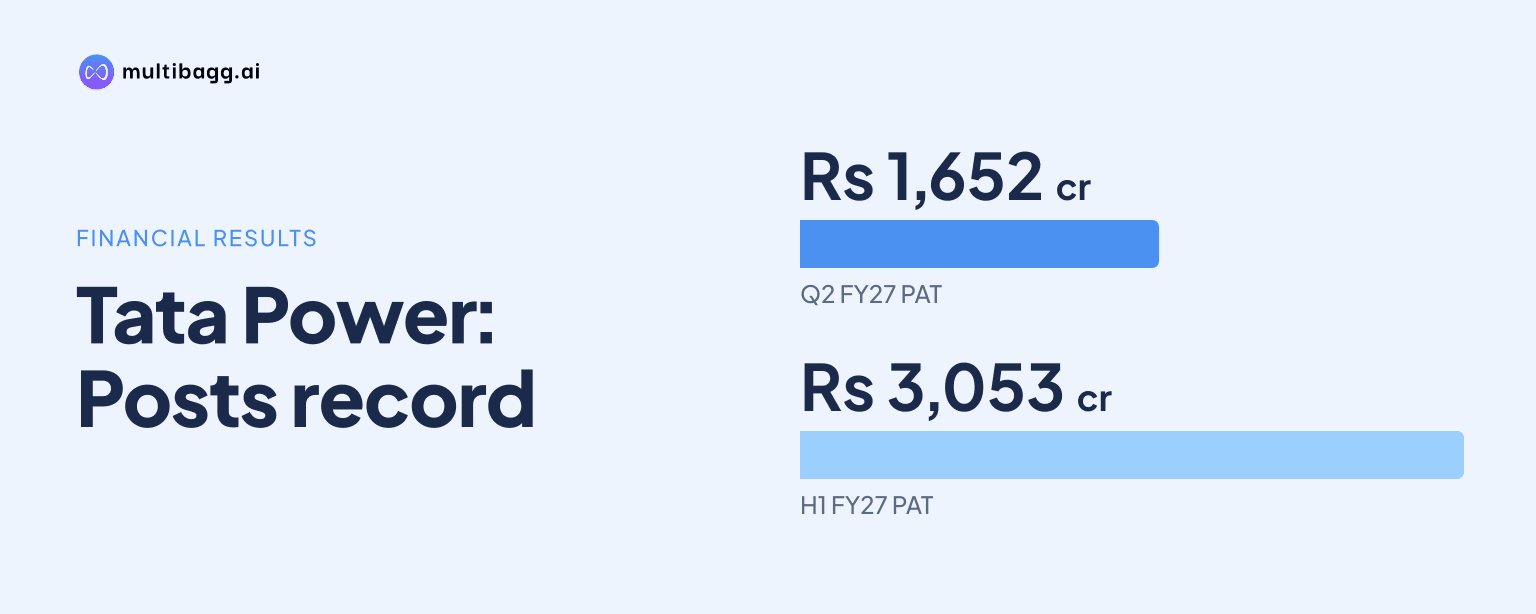
Tata Power Company Limited reported its highest-ever quarterly profit after tax of ₹1,652 crore in Q2 FY27, a 33% increase from ₹1,245 crore a year earlier, supported by growth across its businesses and revenue of ₹19,886 crore, up nearly 26% year on year.
Know Tata Power Company inside out
Results, valuation, peers and who's buying, in one view.
What did Tata Power report for Q2 FY27?
Tata Power reported record quarterly PAT of ₹1,652 crore for Q2 FY27, while revenue increased from ₹15,769 crore in the year-ago quarter to ₹19,886 crore. The company said its performance reflected contributions from across its diversified energy portfolio.
Chief Executive Officer and Managing Director Dr. Praveer Sinha said on the November 11 earnings call that all businesses had performed well during the quarter. EBITDA rose 5% year on year, according to his remarks. The company did not provide management commentary in the initially available quarterly material, but the subsequent earnings-call transcript contained operating and financial updates.
For the first half of FY27, PAT rose 22% year on year to ₹3,053 crore. Revenue for the six months reached ₹38,784 crore, compared with ₹33,233 crore in the corresponding period of the previous year. EBITDA for H1 FY27 rose 7% to ₹8,494 crore from ₹7,961 crore.
What drove Tata Power's quarterly performance?
Tata Power attributed the record profit to strong performance across its businesses, including generation, renewables, solar manufacturing, and transmission and distribution. The earnings summary stated that Q2 operating income increased 26% year on year and reported EBITDA was ₹4,245 crore, compared with ₹4,032 crore in Q2 FY26.
The company also reported that EBITDA excluding a ₹267 crore prior-period regulatory deferral movement grew 12.8% year on year. PAT before exceptional items was ₹1,521 crore, up 22% year on year on the financial-table basis cited in the earnings summary. These disclosed adjustments show that reported quarterly earnings included a regulatory accounting movement.
Renewable generation was identified as an important contributor to the quarter. Management also highlighted the addition of an 1,800 MW pumped hydro project at Shirvata, which is intended to strengthen the company's long-term energy-storage capability as renewable capacity expands.
How much is Tata Power investing in clean energy and grids?
Tata Power spent close to ₹10,000 crore on capital expenditure during H1 FY27 and said it remained on track to meet its annual capex guidance of nearly ₹25,000 crore. About ₹6,000 crore of the first-half expenditure was directed towards renewable energy projects.
The investment programme is linked to India's clean-energy and grid-infrastructure build-out. Tata Power operates across generation, renewables, transmission and distribution, making capital deployment relevant not only to new generation capacity but also to the networks required to deliver electricity to customers.
Management said delayed and recently implemented projects could progress in the second half. The company did not disclose a revised annual capex target during the available call material, so the stated reference point remains the nearly ₹25,000 crore full-year plan.
Got a follow-up? Ask IRIS
What operational and regulatory issues did management identify?
Tata Power said it had signed a supplementary power purchase agreement with Gujarat for its Mundra plant and was in advanced discussions with other states. Management expected the related resolution to conclude by December, according to the earnings-call summary.
The company also faces regulatory-asset challenges in its distribution business. Regulatory assets rose 28% year on year to ₹8,310 crore, mainly because of delays in true-up orders in Delhi and Odisha. Regulatory assets can affect the timing of recovery of costs permitted by regulators, making their movement relevant for cash flows and distribution operations.
Renewable-energy curtailment was about 11% in Q2 FY27, compared with 8.8% in Q1, according to the call summary. This is an operational factor for renewable generators because curtailment reduces the electricity that can be supplied even when generation capacity is available.
Why do Tata Power's results matter to investors and the power sector?
Tata Power's results matter because the company is investing heavily while maintaining profit growth across multiple parts of the electricity value chain. The H1 FY27 operating cash flow was ₹6,137 crore, compared with an outflow of ₹399 crore in H1 FY26, according to the earnings summary. This improvement is relevant alongside the company's large capital-spending programme.
For investors, the quarterly record PAT and higher revenue provide evidence of earnings growth, while regulatory assets, renewable curtailment, and the unresolved state-level arrangements for Mundra remain significant operating disclosures. The company's announced renewable and pumped-hydro investments also place it within the broader need for generation, storage, and grid capacity in India's energy transition.
Conclusion
Tata Power delivered record Q2 FY27 PAT of ₹1,652 crore, supported by nearly 26% revenue growth and contributions across generation, renewables, solar manufacturing, and transmission and distribution. Its H1 results also showed higher profit and a material improvement in operating cash flow while capital spending approached ₹10,000 crore.
Investors will watch progress toward the nearly ₹25,000 crore FY27 capex target, execution of renewable and storage projects, and the expected December resolution of power purchase arrangements for the Mundra plant. Developments in Delhi and Odisha true-up orders, as well as renewable curtailment levels, will remain relevant to the company's distribution and renewable operations.