










PI Industries expects biologicals losses for up to three years
Key highlights
- PI Industries expects its global biologicals platform to lose more than $10 million in FY27.
- PI Industries reported more than 250% year-on-year global biologicals revenue growth in Q2 FY27.
- PI Industries said global biologicals revenue was around Rs 60 crore in Q2 FY27.
- PI Industries expanded biologicals distribution width threefold across Brazil, Mexico, Spain and the US.
powered by IRIS
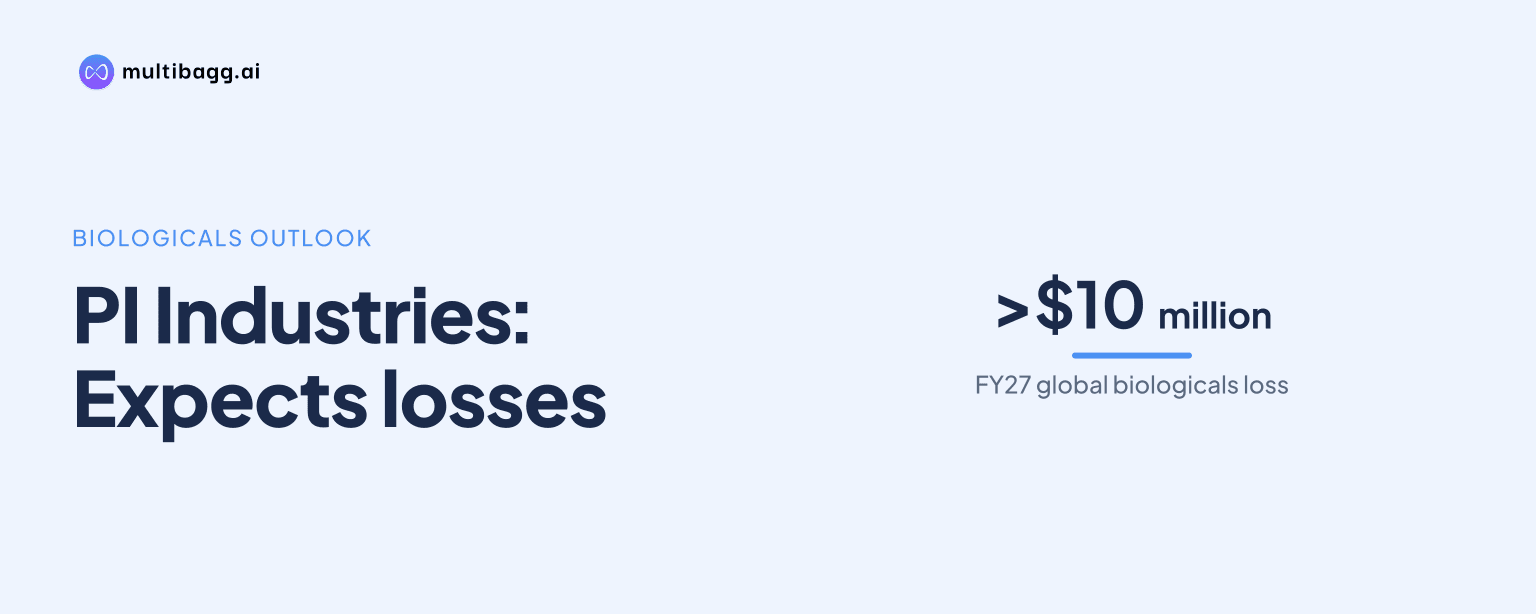
PI Industries Limited expects its global biologicals platform to remain loss-making for up to three years, with management forecasting a full-year FY27 loss of more than $10 million despite revenue growth of more than 250% year on year in Q2 FY27. The company is funding overseas distribution, personnel, registrations and product development before seeking profitability at scale.
Know P I Industries inside out
Results, valuation, peers and who's buying, in one view.
Why will PI Industries' global biologicals business remain loss-making?
PI Industries expects global biologicals losses because the platform is still in its build-out phase, and management forecast a loss of more than $10 million for the full FY27 year. Management said the most aggressive investment is being directed towards creating an international footprint for biologicals, including people, market development and product expansion.
The company identified the United States, Brazil and Mexico as the three geographies where expansion requires substantial spending. Its reported distribution programme also includes Spain, meaning the platform is being developed across four overseas markets rather than being concentrated in one country or crop-protection channel.
Management said start-up costs in the newer businesses typically last two to three years. It expects the biologicals losses to flatten within that period before the business turns positive, though it did not disclose a specific break-even quarter, revenue threshold or segment-level operating margin.
The spending sits alongside investments in pharma contract research, development and manufacturing organisation, or CRDMO, and electronic and specialty chemicals. In Q2 FY27, management said new-business development increased overhead costs by 6% year on year, with pharma and biologicals the main contributors to that increase.
How fast is PI Industries growing global biologicals revenue?
PI Industries grew global biologicals revenue by more than 250% year on year in Q2 FY27, supported by registrations, commercial expansion and field activities in overseas markets. Management also said distribution width across Brazil, Mexico, Spain and the US rose threefold, showing that revenue growth coincided with a wider route to market.
Management put Q2 FY27 global biologicals revenue at around Rs 60 crore, within the export revenue discussed during the call. Pharma revenue was around Rs 75 crore, so global biologicals remained smaller than pharma in absolute quarterly revenue even after its 250%-plus growth rate.
PI Industries' domestic biologicals portfolio grew 45% year on year in Q2 FY27 and accounted for 18% of its domestic Agri portfolio. The contrast is important: domestic biologicals is growing through an existing Indian crop-protection franchise, while the global business is simultaneously funding entry and expansion costs in four foreign markets.
The international growth rate also comes from a comparatively small revenue base of around Rs 60 crore. Management attributed the increase to commercial activity and registrations, but did not provide country-level sales, customer numbers, biological-product volumes or the contribution from individual markets such as Brazil or the US.
How is the biologicals build-out affecting PI Industries' earnings?
PI Industries reported consolidated revenue of Rs 1,701.8 crore for Q2 FY27, down 9% year on year, while gross margin was 49% and earnings before interest, tax, depreciation and amortisation, or EBITDA, was 14%. Management attributed the broader margin pressure primarily to 5% higher input costs and pricing pressure linked to El Nino conditions and genericisation.
The global biologicals investment was therefore not presented as the sole reason for lower group profitability. Management said the 6% year-on-year rise in new-business development expenses was principally related to pharma and biologicals, while energy costs rose 3% and research and development, or R&D, costs rose 2%.
During the question session, management compared Q2 FY27 costs of Rs 609 crore with Rs 530 crore a year earlier, a rise of around Rs 70 crore. It said roughly Rs 36 crore of the increase related primarily to new-business development, energy costs and R&D, without providing a separate biologicals expense figure.
PI Industries also spends 3% to 4% of revenue on R&D, which is fully charged to the profit and loss account. That programme produced Pioxazon, its first new chemical entity, but the product's Indian launch for rice, corn and Bengal gram is separate from the global biologicals platform and its expected FY27 loss.
Got a follow-up? Ask IRIS
Can PI Industries finance biologicals losses during the expansion?
PI Industries ended Q2 FY27 with net cash of Rs 3,600 crore, which management said would support investment across its strategic growth platforms. Operating cash flow was Rs 910 crore, compared with Rs 230 crore a year earlier, with the improvement supported by working-capital management.
The company reduced net working capital by 18 days and released Rs 298 crore of cash at the quarter end. These measures provide the disclosed funding context for biologicals expansion, although management did not state a separate capital-expenditure budget, cumulative investment amount or cash-loss target for the platform.
PI Industries' operating approach is to build capabilities first, add customers alongside them and scale when economics are proven. For global biologicals, that means continuing investment in registrations, field demonstrations, commercial teams and distribution while product adoption develops in Brazil, Mexico, Spain and the US.
The funding position also needs to be considered against pressure in the core export business. Ag Chem exports declined 18% year on year in Q2 FY27, with management saying volumes fell by around 3% to 4% and the remaining decline reflected pricing and costs. Management is pursuing biologicals as a newer growth platform while managing that export cycle.
What would show that PI Industries is nearing biologicals profitability?
PI Industries said the key requirement for profitability is operating leverage from greater scale, and management expects the platform to reach an inflection point in the next two to three years. The disclosed indicators are continued revenue growth, broader distribution, registrations, product development and expanding commercial activity rather than a stated profit target.
The threefold increase in distribution width and more than 250% Q2 FY27 revenue growth indicate that the company is adding reach and sales activity. They do not, however, establish how quickly the business can absorb its more than $10 million expected FY27 loss, because PI Industries did not disclose revenue by geography or a target margin.
Management said it will assess the platform after it becomes EBITDA-positive and growth reaches a stable state before deciding what more can be done with it. That wording makes the next two to three years a management planning horizon, not a guaranteed profitability date, and leaves execution dependent on overseas product adoption and cost control.
Conclusion
PI Industries is accepting a full-year FY27 global biologicals loss of more than $10 million to establish distribution, registrations and commercial capacity in overseas markets. The business is expanding quickly, with revenue up more than 250% year on year and distribution width up threefold, but its Rs 60 crore quarterly revenue base remains insufficient to offset the current build-out costs.
The next measure to watch is management's stated two-to-three-year plan to flatten losses and turn the platform positive. Progress in registrations, distribution across Brazil, Mexico, Spain and the US, and whether revenue growth continues as new-business spending stabilises will show whether operating leverage is emerging on the timetable management has outlined.