










PI Retains ₹500-600 Crore Pharma Target Despite Slippage
Key highlights
- PI reaffirmed its ₹500-600 crore pharma CDMO revenue target and EBITDA-breakeven objective in Q2 FY27.
- PI’s pharma revenue was about ₹75 crore in Q2 FY27, up 20% year on year.
- PI expects its pharma kilo laboratory to be completed by the end of the year.
- PI ended Q2 FY27 with net cash of ₹3,600 crore and operating cash flow of ₹910 crore.
powered by IRIS
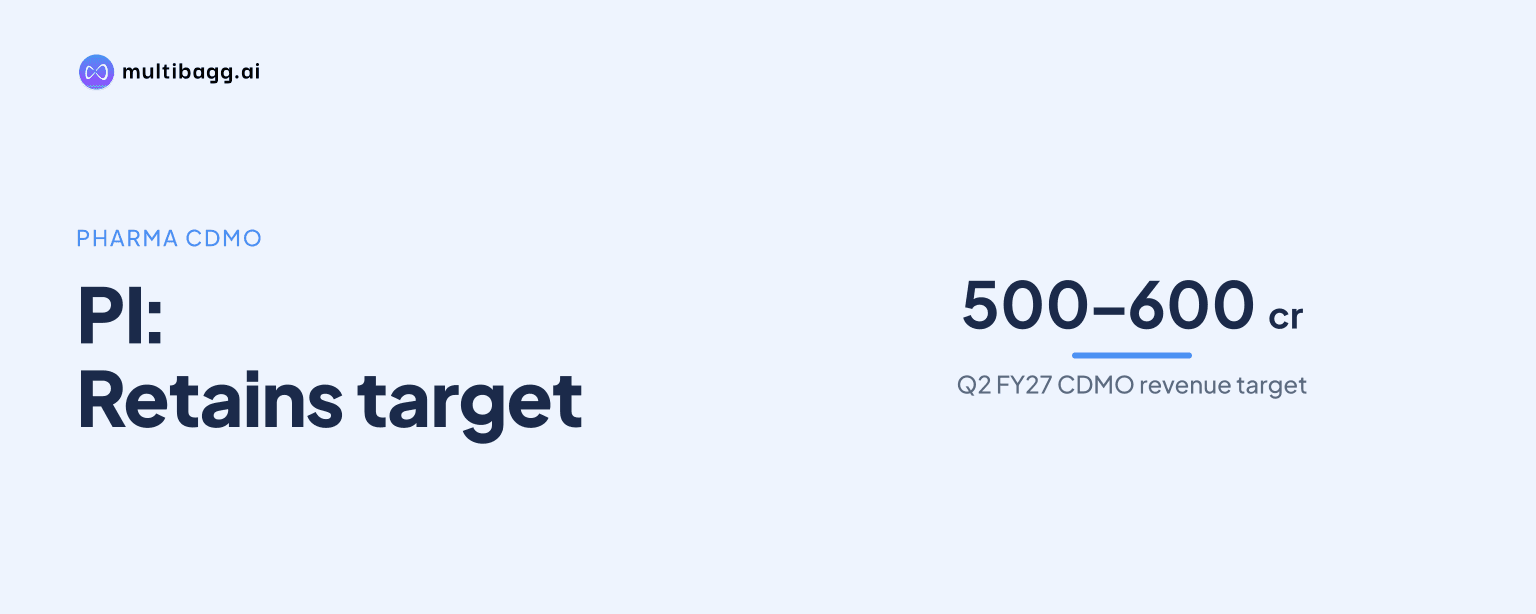
PI retained its ₹500-600 crore pharma contract development and manufacturing organisation (CDMO) revenue target and earnings before interest, tax, depreciation and amortisation (EBITDA) breakeven objective in Q2 FY27, although an analyst cited a previously disclosed contract slippage. Pharma revenue rose 20% year on year to about ₹75 crore, while management said capability building and customer engagement were producing early progress.
Know P I Industries inside out
Results, valuation, peers and who's buying, in one view.
Does PI still expect ₹500-600 crore from pharma CDMO?
Yes, PI still targets ₹500-600 crore of pharma CDMO revenue and EBITDA breakeven. In the Q2 FY27 call, management gave that answer when asked whether the earlier contract slippage altered the two-to-three-year revenue and profitability objective. PI did not give a revised annual revenue milestone or a specific date for breakeven.
The target remains a management objective rather than a new earnings forecast. Management said the business is taking time because PI is seeking a differentiated model through co-created business arrangements with partners, rather than only conventional manufacturing assignments. It said a couple of pipeline deals could fructify as small initial steps toward larger work.
PI’s Q2 FY27 pharma revenue of about ₹75 crore is the current disclosed scale against the ₹500-600 crore ambition. The call did not provide the prior-year pharma revenue in rupees, but management reported 20% year-on-year growth. That comparison indicates that customer engagement is creating revenue, while substantial scale-up remains necessary to meet the stated target.
What has PI built for its pharma CDMO business?
PI has established drug-discovery and manufacturing-support infrastructure, including a Hyderabad centre of excellence, a commissioned and certified quality-control laboratory in Lodi, and a pharma kilo laboratory due for completion by the end of the year. Management presented these facilities as elements of the capability base required for development and manufacturing assignments.
The Hyderabad centre is intended to support drug discovery, while the Lodi laboratory adds quality-control capability. PI said the kilo laboratory would be completed by year-end, providing kilogram-scale development capacity. The company described this capability-first sequence as part of its approach to newer platforms before pursuing larger commercial scale.
PI said it is engaging customers of different sizes and co-developing business models in several cases. Management said this is how long-term CDMO relationships are built, but it did not disclose customer names, signed contract values, molecule categories or committed manufacturing volumes. Pharma revenue of about ₹75 crore was included within PI’s Q2 FY27 export revenue.
Why is PI’s pharma CDMO ramp taking longer?
PI said the longer ramp reflects the gestation period involved in building a differentiated CDMO offering, although management rejected the suggestion that the business was lagging. It said PI had spent the past three to four years building internal and external capabilities, customer intimacy and systems to serve customers.
The financial effect of the contract slippage remains undisclosed. An analyst asked whether Q2 FY27 growth fully reflected the slippage, but PI neither quantified the contract nor said whether the quarter captured its full impact. Management instead pointed to a couple of potential pipeline deals, describing them as small steps that could set up subsequent work.
PI also linked the pace of profitability to start-up spending across its newer businesses. Management said start-up costs in these platforms take about two to three years and expected investment levels to flatten over the next two to three years before turning positive. That statement applied to the wider new-business portfolio, not to a standalone pharma profitability timetable.
Got a follow-up? Ask IRIS
How is PI funding its pharma CDMO build-out?
PI is funding pharma alongside biologicals, research and development, and electronic and specialty chemicals from its operating base and net cash position. It ended Q2 FY27 with net cash of ₹3,600 crore and operating cash flow of ₹910 crore, compared with ₹230 crore a year earlier, after reducing net working capital by 18 days.
Management identified pharma and biologicals as the primary drivers of new-business development spending. It said overhead increased to ₹609 crore in Q2 FY27 from ₹530 crore a year earlier, with development of new businesses, energy costs and research and development contributing to the increase. PI did not provide a separate quarterly cost or loss figure for pharma.
PI said it fully charges research and development spending to the profit and loss account and spends 3% to 4% of revenue on research and development. This means spending on future platforms affects current reported profitability. Management expects operating leverage to improve profitability once the businesses reach scale, but gave no standalone pharma margin target.
How does PI’s pharma business compare with newer platforms?
Pharma’s 20% year-on-year growth in Q2 FY27 was lower than the more than 250% growth reported for global biologicals, although both businesses have different revenue bases. PI disclosed quarterly global biologicals revenue of about ₹60 crore, compared with pharma revenue of about ₹75 crore.
PI said global biologicals had expanded its distribution width threefold across Brazil, Mexico, Spain and the United States. The business is receiving investment in people, distribution and field activity, while pharma is adding development and quality-control infrastructure. Management identified both as platforms intended to widen PI’s sources of growth beyond established agrochemical exports.
The contrast with core operations was marked in Q2 FY27. Domestic agri revenue grew 19% year on year and domestic biologicals grew 45%, while agrochemical exports declined 18%. PI attributed export pressure to pricing, higher input costs and genericisation, and said it was prioritising volumes and market share through price optimisation.
Conclusion
PI has retained its ₹500-600 crore pharma CDMO revenue and EBITDA-breakeven objective despite the contract slippage cited in the Q2 FY27 discussion. Revenue growth of 20% to about ₹75 crore, plus the Hyderabad centre, Lodi laboratory and planned kilo laboratory, show that commercial activity and capability creation are progressing together, but customer conversion and profitable scale remain incomplete.
The next points to watch are completion of the pharma kilo laboratory by year-end, whether the couple of pipeline deals identified by management convert, and any disclosure on the financial effect of the slipped contract. Management also expects start-up spending in newer businesses to flatten over the next two to three years before turning positive, making revenue scale and operating leverage the key measures of progress.