










PI Industries export revenue drops 18% as pricing protects volume
Key highlights
- PI Industries’ agchem exports fell 18% year-on-year in Q2 FY27, while export volume declined only about 3% to 4%.
- Q2 FY27 consolidated revenue was Rs 1,701.8 crore, down 9% year-on-year, with a 49% gross margin and 14% EBITDA margin.
- Domestic agri grew 19% year-on-year, domestic biologicals grew 45%, and global biologicals revenue increased by more than 250%.
- PI Industries reduced net working capital by 18 days, released Rs 298 crore of cash and ended Q2 FY27 with Rs 3,600 crore of net cash.
powered by IRIS
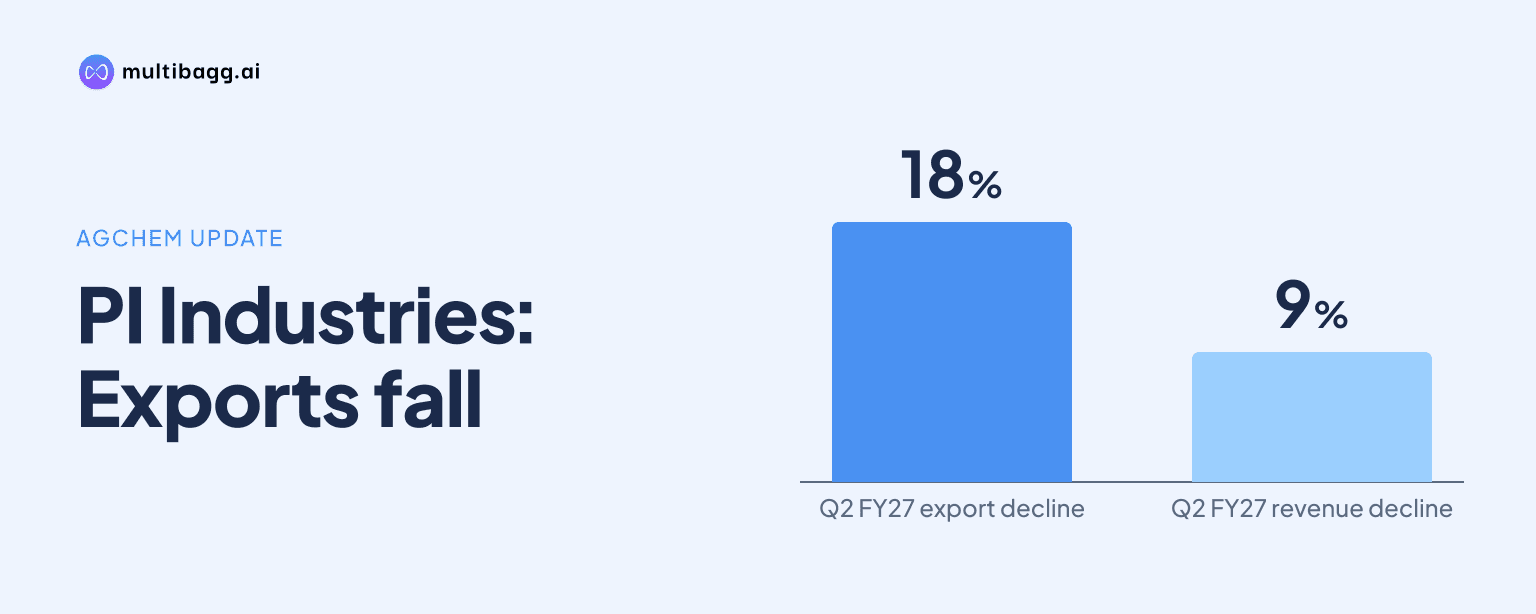
PI Industries Limited reported an 18% year-on-year fall in agchem exports in Q2 FY27, while export volume declined only about 3% to 4%, showing that lower prices and higher costs caused most of the revenue setback. PI Industries said it used pragmatic pricing to protect volume and market share after genericisation intensified.
Know P I Industries inside out
Results, valuation, peers and who's buying, in one view.
Why did PI Industries’ agchem exports fall 18%?
PI Industries’ agchem exports fell 18% year-on-year in Q2 FY27 because pricing and cost pressure outweighed a relatively limited volume decline. Management said volume fell about 3% to 4%, leaving the larger part of the export revenue decline attributable to price and cost effects. It described the weakness as spread across the portfolio rather than linked to one molecule.
Management cited subdued crop economics, elevated input costs and faster-than-expected genericisation as the main export-market pressures. It also said uneven weather, tight channel credit and higher input costs had led growers in key markets to buy later, buy less and buy cheaper. Channel stocks had returned to normal levels, according to management, but crop-protection demand conditions remained difficult.
The export decline contrasted with PI Industries’ domestic agri business, which grew 19% year-on-year in Q2 FY27. Management attributed domestic growth to crop reach, differentiated products and key brands, despite a weak monsoon, delayed sowing and lower pest pressure in India. The different outcomes show that export pricing conditions, rather than a company-wide fall in agricultural demand, drove the quarter’s main setback.
How did PI Industries use pricing to retain export volume?
PI Industries reduced prices to compete for genericised-product volume, accepting near-term pressure on margins to retain market share. Management said it and its global partners had taken pricing decisions to preserve an opportunity that would be harder to rebuild if volumes were surrendered. Its stated approach is to maximise and optimise volume through price decisions that respond to market conditions.
Management said the pricing issue was not limited to a single product and described price discounting as occurring across the crop portfolio in domestic and global markets. It added that agchem pricing is not a simple cost-plus mechanism because crop economics, weather, consumption patterns, competitive intensity and raw-material costs all affect what customers can pay.
PI Industries said higher input costs could not be fully passed through in the current market. Management said a fall in raw-material pressure could improve margins, but it did not set a timing or a product-price floor. It also said the benefit from a favourable change in input costs would take a lag of roughly two quarters to affect reported margins.
Management expects pressure over the next couple of quarters and said generic-product pricing will remain market- and opportunity-led. It characterised export volumes as somewhat depressed but still positive, while explaining that its current priority is volume retention rather than recovering every element of input-cost inflation immediately.
What happened to PI Industries’ margins and costs?
PI Industries reported a 49% gross margin and a 14% earnings before interest, tax, depreciation and amortisation, or EBITDA, margin in Q2 FY27. Management said gross-margin moderation reflected input costs that were 5% higher as well as pricing pressure associated with El Nino conditions and genericisation. It described those pressures as cyclical rather than structural.
Management is planning around a 49% gross margin for the next two to three quarters, compared with its earlier guidance of 52% to 53%. It also said its broad gross-margin objective is about 50% to 52%, but stressed that results depend on oil prices, currency movements, crop economics and other market variables. The revised near-term view therefore reflects a lower margin expectation than the earlier guidance.
Quarterly overheads rose to Rs 609 crore from Rs 530 crore a year earlier, an increase of Rs 79 crore. Management said about Rs 36 crore of the increase was primarily related to development of new businesses, with energy costs and research and development, or R&D, also contributing. PI Industries continues to expense R&D spending equal to 3% to 4% of revenue.
The company reduced net working capital by 18 days, releasing Rs 298 crore of cash at the quarter end. Operating cash flow was Rs 910 crore, compared with Rs 230 crore a year earlier, and PI Industries ended Q2 FY27 with net cash of Rs 3,600 crore. Management said the cash position supports investments across biologicals, pharma and specialty chemicals.
Got a follow-up? Ask IRIS
Which businesses are offsetting PI Industries’ export pressure?
PI Industries’ domestic biologicals business grew 45% year-on-year in Q2 FY27 and accounted for 18% of the domestic agri portfolio. Management linked the growth to new products and focused go-to-market execution. The domestic agri segment’s 19% growth provided an offset to the 18% decline in agchem exports, although management did not disclose domestic agri revenue in rupees.
Global biologicals revenue increased by more than 250% year-on-year, supported by registrations, commercial expansion and field activities. PI Industries said it expanded distribution across Brazil, Mexico, Spain and the United States, increasing distribution width threefold. Global biologicals contributed about Rs 60 crore of export revenue in Q2 FY27.
Pharma revenue grew 20% year-on-year and was about Rs 75 crore in the quarter. Management said the company is building development and manufacturing capabilities and expects operating leverage when newer businesses reach scale. It also said Plant Healthcare is expected to take another two to three years to flatten start-up costs before moving positive, reflecting continued spending on international commercial infrastructure.
Can PI Industries’ new molecules rebuild export growth?
PI Industries added three new contract synthesis and manufacturing, or CSM, molecules to commercialisation during Q2 FY27. The company said molecules commercialised over the past three to five years contribute about 16% to 18% of annual agchem export revenue. Management expects that share to increase when farm economics and global demand conditions improve, but did not give a revenue target.
The company has commercialised more than 20 molecules in recent years, with differentiated process technology and innovator margins at different life-cycle stages. Management said the present market has slowed adoption of newer products, even though the products are contracted with partners. It expects demand pressure for the next couple of quarters but said it is seeing some early signs of volume pickup from partners.
PI Industries also launched Pioxazon, its brand for pioxaniliprole, after receiving Indian registration for the new chemical entity. The insecticide targets pests in rice, corn and Bengal gram, and the company is pursuing label expansion beyond those crops. Management said regulatory filings are progressing in other geographies and expects two to three chemical and biological molecules to enter global markets over the next few years.
Management said existing agchem capacity should meet requirements for the next two to three years. It expects future capital expenditure to focus on newer growth engines, including biologicals, pharma and electronic and specialty chemicals. The company also said its electronic and specialty-chemicals business is targeted to become a US$100 million business in three to four years, although that remains a management target.
Conclusion
PI Industries’ Q2 FY27 figures show an export downturn led principally by pricing and cost pressure, not a comparable collapse in volume. The 18% decline in agchem exports exceeded the 3% to 4% volume fall, while domestic agri growth of 19%, domestic biologicals growth of 45%, global biologicals growth above 250% and pharma growth of 20% broadened the company’s revenue base.
Next, management’s plan calls for protecting a roughly 49% gross margin over the next two to three quarters while holding export volumes through dynamic pricing. Investors can watch for the effect of any raw-material changes after the stated two-quarter lag, the first commercial assessment of Pioxazon, progress on overseas regulatory filings and whether new CSM molecules rise above their current 16% to 18% share of annual agchem exports.