










PI launches Pioxaniliprole after 1,200-plus field trials
Key highlights
- PI launched Pioxaniliprole in India as Pioxazon, a 20% suspension concentrate insecticide.
- Pioxazon underwent more than 1,200 large plot trials and 5,400 large plot demonstrations before launch.
- PI identifies rice, maize and Bengal gram as initial Pioxazon crops for three disclosed pests.
- PI reports more than 50 R&D projects and two to three advanced chemical and biological molecules.
powered by IRIS
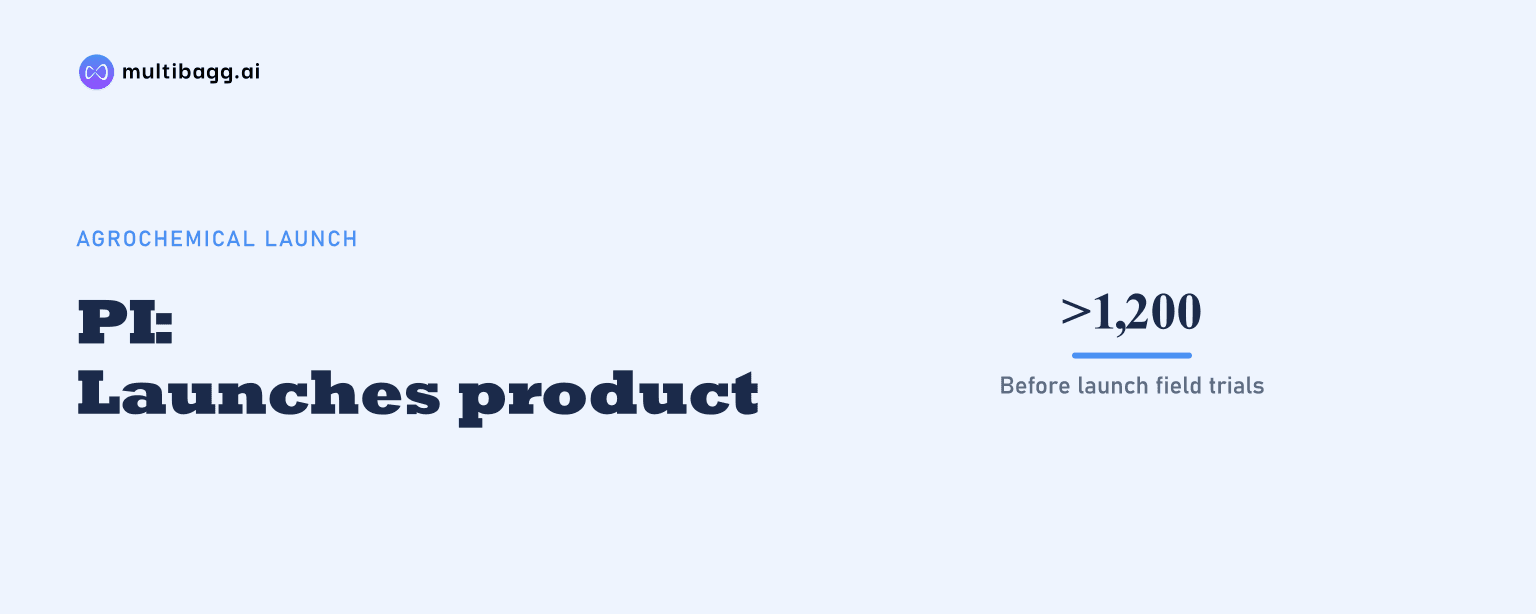
PI Industries launched Pioxaniliprole in India as Pioxazon after more than 1,200 large plot trials and 5,400 large plot demonstrations, according to its presentation. The insecticide is PI’s first disclosed in-house discovered molecule launched domestically, with rice, maize and Bengal gram as its initial target crops.
Know P I Industries inside out
Results, valuation, peers and who's buying, in one view.
What did PI launch in India?
PI launched Pioxaniliprole under the Pioxazon brand as a 20% SC, or suspension concentrate, insecticide formulation in India. The presentation describes Pioxazon as India’s first discovered molecule and separately calls PI the first Indian company to innovate Pioxaniliprole. It classifies the product in IRAC Group 28 and identifies RRA alongside that classification.
PI presents four product-positioning claims for Pioxazon: highest efficacy against target pests, the longest duration of control, absorption within 30 minutes, and safety for beneficial insects. PI links its duration claim to maximum availability in the plant system. The presentation does not provide yield data, pest-control percentages, application rates, pricing or comparative results against other products.
How extensively did PI test Pioxazon before launch?
PI says it tested Pioxazon through more than 1,200 large plot trials and more than 5,400 large plot demonstrations before the India launch. It describes the trials as scientific testing and the demonstrations as testing across India under farmer-practice conditions. The presentation does not disclose the timing of the programme or trial outcomes by crop.
PI also reports that more than 1 lakh progressive farmers approved and tested Pioxazon. Its field programme recorded more than 1,700 channel-partner visits at Pioxazon fields and involved more than 200 scientists from Krishi Vigyan Kendras, state agricultural universities and central institutes. These figures cover pre-development engagement rather than reported commercial sales.
PI says it is making development investments in Pioxazon to build farmer confidence on performance in the short term and enable mid-term scale and market acceptance. That plan distinguishes the completed pre-development activity from the company’s stated next objective of adoption. PI does not disclose a Pioxazon sales target, market value, revenue contribution or launch volume.
Which crops and pests does PI target with Pioxazon?
PI initially targets yellow stem borer in rice, FAW in maize and pod borer in Bengal gram with Pioxazon. The three disclosed crops span cereals and pulses, while the product remains positioned as an insecticide in a 20% SC formulation. PI does not expand FAW in the presentation or provide pest-incidence figures for the target crops.
PI says more crops are being targeted for label expansion, but it does not name those crops or set out an approval timetable. The presentation also does not specify crop-wise dosage, application timing or commercial availability by state. Its disclosed 30-minute absorption claim is therefore the product mechanism PI highlights across the initial uses, rather than crop-specific performance data.
PI’s domestic plan identifies portfolio diversification, crop reach and new launches as drivers of growth. It says major crop prices had firmed up and biological products continued to gain traction, while extreme climate conditions were creating uncertainty in outcomes. Pioxazon is the disclosed new chemical crop-protection product within that domestic portfolio plan.
Got a follow-up? Ask IRIS
What is PI’s pipeline after Pioxaniliprole?
PI reports more than 50 projects at different development stages and identifies two to three chemical and biological molecules in advanced stages as its next wave. Management says those candidates offer an opportunity for global partnership. Pioxaniliprole is the only molecule in this roadmap specifically identified as launched in India.
PI’s roadmap also refers to a global launch in focused geographies after regulatory approvals. This is a conditional plan, not a disclosed overseas launch date, because the presentation does not identify countries, approvals or commercial timing. Regulatory clearance is the stated step between the India launch and any international launch of the innovation.
The broader research platform comprises laboratories at four locations, more than 700 scientists and more than 200 doctorates. PI reports more than 265 patents to date, including 13 added in H1 FY27. It also lists NABL ISO17025 and GLP certification, a new ICP-OES instrument and UPLC-CAD, or Charged Aerosol Detector, among its research capabilities.
How does Pioxaniliprole fit PI’s wider innovation plan?
Pioxaniliprole fits PI’s plan to move from AgSciences toward LifeSciences through chemical and biological innovation. PI’s 2025 strategy includes novel crop-protection molecules, biological offerings, specialty and electronic chemicals, and pharma contract research, development and manufacturing. The domestic Pioxazon launch gives that in-house discovery strategy a named commercial product in India.
PI’s biological platform is separate from Pioxazon but provides a comparison for its wider innovation activity. Biological revenue grew by more than 250% in Q2 FY27, excluding India, while the PREtec precision-peptide platform had covered 4.7 million acres globally and Harpinαβ had been commercialised in 23 countries. PI says research and development investment increased 102% in H1 FY27 versus H1 FY26 to support peptide discovery and development.
PI also reports 20 molecules commercialised over the last few years in its contract synthesis and manufacturing business, compared with more than 60 molecules in the active pipeline. More than 60% of that pipeline is in advanced development stages, and non-agrochemical new enquiries increased 75%. These manufacturing figures are distinct from Pioxaniliprole, but show how PI is pursuing several innovation-led segments at once.
Conclusion
PI’s Pioxaniliprole launch converts its discovery work into a domestic insecticide product supported by more than 1,200 trials, 5,400 demonstrations and testing or approval by more than 1 lakh progressive farmers. The product’s initial rice, maize and Bengal gram uses place it within PI’s domestic strategy of wider crop reach, portfolio diversification and new launches.
Next, PI plans to seek label expansion into more crops and build farmer confidence to support mid-term scale and market acceptance. Management also identifies two to three advanced chemical and biological molecules, while its roadmap makes overseas launches dependent on regulatory approvals in focused geographies.