










POCL turns net cash-positive as borrowings drop Rs 149.7 crore
Key highlights
- POCL reported Rs 128 crore of cash and bank balances at 30 September 2026, up from Rs 12.3 crore at 31 March 2026.
- POCL’s short-term borrowings fell by Rs 149.7 crore to Rs 2.4 crore between March and September 2026.
- Trade receivables declined by Rs 121.2 crore and inventories fell by Rs 57.5 crore during the same period.
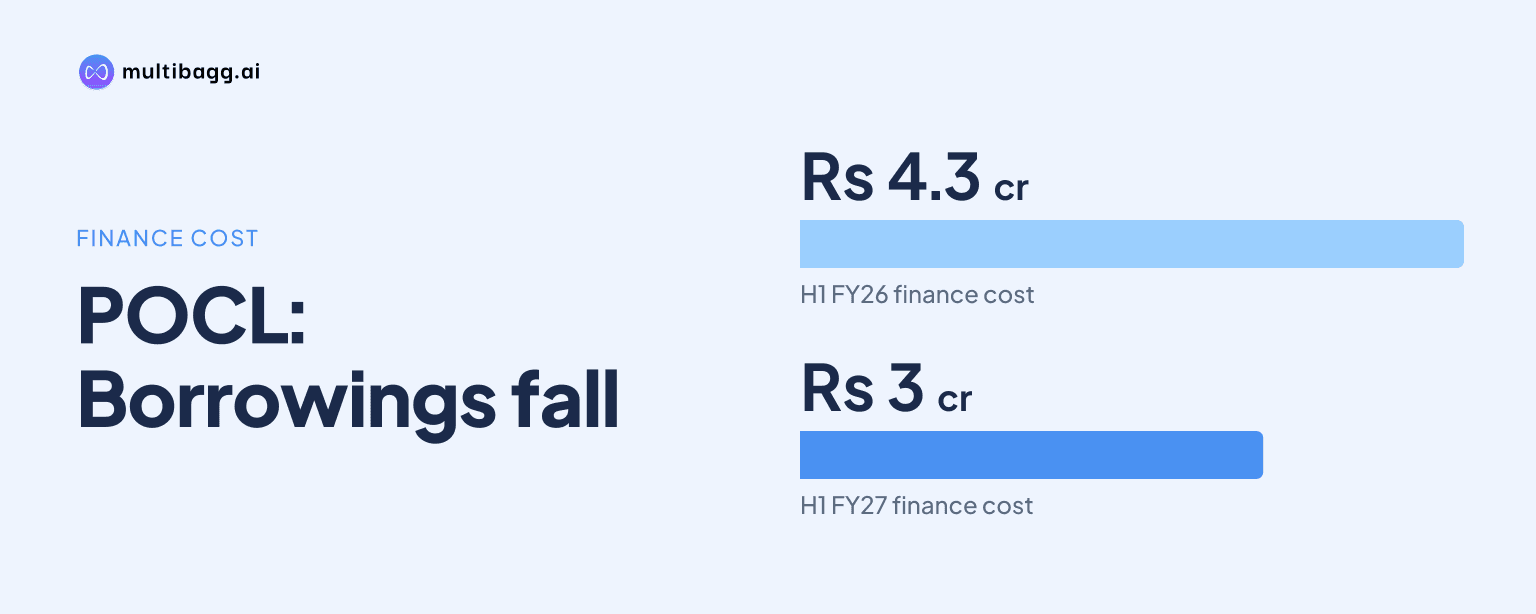
- POCL’s H1FY27 finance cost declined to Rs 3 crore from Rs 4.3 crore in H1FY26.
powered by IRIS
POCL became net cash-positive on a cash-less-short-term-borrowings basis at 30 September 2026, reporting Rs 128 crore of cash and bank balances against Rs 2.4 crore of short-term borrowings. The Rs 125.6 crore surplus followed a Rs 149.7 crore reduction in short-term borrowings from 31 March 2026.
Know Pondy Oxides & Chemicals inside out
Results, valuation, peers and who's buying, in one view.
How did POCL become net cash-positive by September 2026?
POCL’s cash and bank balances exceeded its reported short-term borrowings by Rs 125.6 crore at 30 September 2026. Cash and bank balances increased from Rs 12.3 crore at 31 March 2026 to Rs 128 crore, while short-term borrowings fell from Rs 152.1 crore to Rs 2.4 crore. The balance sheet does not report an amount for long-term borrowings at either date, although total non-current liabilities were Rs 2.7 crore at September.
The movement marks a Rs 265.4 crore swing in cash less short-term borrowings. At 31 March 2026, short-term borrowings exceeded cash by Rs 139.8 crore, matching the FY26 net debt reported in POCL’s financial highlights. By 30 September, the position had reversed to a cash surplus of Rs 125.6 crore. The presentation does not provide a separately calculated September net-debt figure.
What balance-sheet movements accompanied POCL’s borrowing reduction?
POCL’s current assets declined by Rs 145 crore between 31 March and 30 September 2026, with trade receivables, inventories and other current assets all lower. Trade receivables fell by Rs 121.2 crore to Rs 141.8 crore, inventories declined by Rs 57.5 crore to Rs 211.3 crore, and other current assets fell by Rs 70 crore to Rs 51.1 crore. Cash and bank balances were the major current-asset line that increased.
Other financial assets partly offset the decline in operating asset balances, rising by Rs 11.4 crore to Rs 23.3 crore. Total current assets consequently stood at Rs 555.4 crore at September, compared with Rs 700.4 crore in March. POCL reported FY26 net working-capital days of 53, compared with 50 days in FY25 and 55 days in FY24, but it did not disclose a comparable half-year days measure for September 2026.
Which liabilities changed alongside POCL’s cash increase?
POCL’s total current liabilities fell by Rs 151.7 crore to Rs 40.1 crore by 30 September 2026. The Rs 149.7 crore reduction in short-term borrowings accounted for nearly all of that change. Trade payables increased by Rs 3 crore to Rs 18 crore, and short-term provisions rose by Rs 3.1 crore to Rs 15.8 crore, while other current and financial liabilities declined by Rs 8 crore to Rs 3.9 crore.
Current assets exceeded current liabilities by Rs 515.3 crore at September, compared with Rs 508.6 crore at March. This Rs 6.7 crore increase occurred even as current assets declined, because the reduction in current liabilities was larger. Outside current assets, property, plant and equipment fell by Rs 6.5 crore to Rs 193.8 crore, while capital work-in-progress increased by Rs 6.1 crore to Rs 8.7 crore.
Got a follow-up? Ask IRIS
Did lower borrowings coincide with lower finance costs?
POCL’s reported finance cost declined during H1FY27, alongside the lower short-term borrowing balance at September. Standalone finance cost was Rs 3 crore in H1FY27, down from Rs 4.3 crore in H1FY26. In Q2FY27, finance cost was Rs 60 lakh, compared with Rs 2.5 crore in Q1FY27 and Rs 1.3 crore in Q2FY26. The presentation does not attribute the finance-cost change to a specific balance-sheet action.
The funding improvement did not coincide with higher operating profit in the half year. Net revenue increased 33% year on year to Rs 1,638.7 crore in H1FY27, while earnings before interest, tax, depreciation and amortisation, or EBITDA, declined 10% to Rs 88.7 crore. EBITDA margin declined to 5.4% from 8.0%, and profit after tax fell 11% to Rs 56.4 crore from Rs 63.1 crore.
How did POCL’s operations perform during the September half year?
POCL’s lead volumes declined in H1FY27 while copper volumes increased. Lead production was 31,083 metric tonnes, down from 50,475 metric tonnes in H1FY26, and lead sales fell to 31,679 metric tonnes from 47,408 metric tonnes. Lead EBITDA per tonne was broadly unchanged at Rs 18,617, compared with Rs 18,510 a year earlier.
Copper production rose to 5,649 metric tonnes in H1FY27 from 2,040 metric tonnes in H1FY26, while sales increased to 6,040 metric tonnes from 2,074 metric tonnes. Copper EBITDA per tonne rose to Rs 44,536 from Rs 34,171. In Q2FY27, however, lead EBITDA per tonne was Rs 15,811 and copper EBITDA per tonne was Rs 36,979, below Q1FY27 levels of Rs 21,595 and Rs 48,488 respectively.
How does POCL’s September position compare with FY26?
POCL’s September cash surplus contrasts with the Rs 139.8 crore net debt reported for FY26. That FY26 balance was higher than net debt of Rs 63.4 crore in FY25 and Rs 64.6 crore in FY24. POCL also reported FY26 net debt to equity of 0.17 times, compared with 0.11 times in FY25, and an interest coverage ratio of 19.99 times, compared with 8.28 times in FY25.
FY26 revenue from operations was Rs 2,938.7 crore, EBITDA was Rs 218.1 crore and profit after tax was Rs 138.7 crore. POCL’s installed annual capacities include 204 thousand tonnes for lead, 12 thousand tonnes each for copper and aluminium, and 9 thousand tonnes for plastics. Management also identifies a target of more than 60% share of value-added products.
Conclusion
POCL’s September 2026 standalone balance sheet shows a substantial shift in short-term funding: cash increased by Rs 115.7 crore and short-term borrowings fell by Rs 149.7 crore. Lower receivables, inventories and other current assets accompanied the change, while current liabilities declined by Rs 151.7 crore. The balance-sheet improvement occurred despite H1FY27 EBITDA declining 10% as revenue rose 33%.
The next issue to watch is whether POCL retains cash above short-term borrowings while its operating margins and volumes develop. Management’s disclosed plan includes targeting more than 60% value-added products and operating across lead, copper, aluminium and plastics capacities. Future balance sheets and quarterly EBITDA per tonne disclosures will indicate how those plans affect funding needs and earnings conversion.