










POCL's 84% lead and 99% copper imports shape supply risk
Key highlights
- POCL imports 84% of lead procurement for its 2,04,000-MTPA lead vertical.
- POCL imports 99% of copper procurement, while copper production and sales grew nearly threefold year on year in H1FY27.
- POCL's plastics vertical sources 92% of procurement domestically, compared with 16% for lead and 1% for copper.
- POCL plans Rs 200 crore for a 36,000-MTPA copper cathode facility, with an 18,000-MTPA first phase expected by December 2026.
powered by IRIS
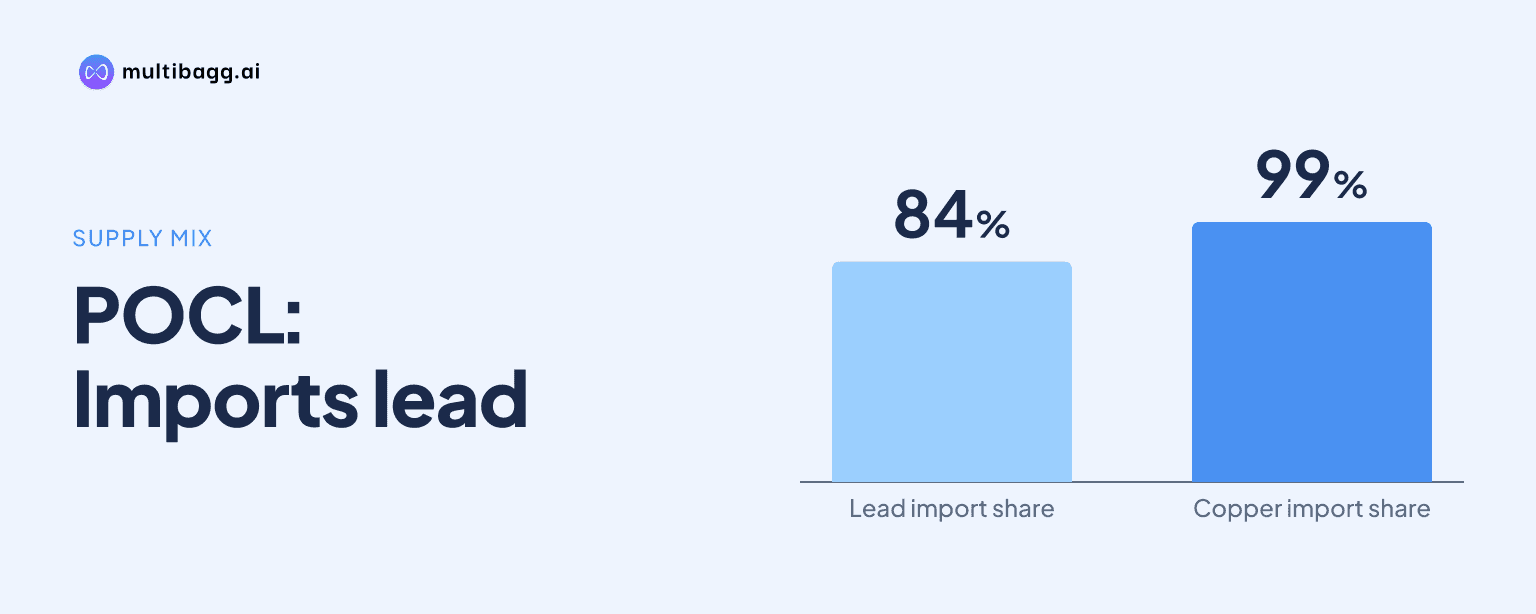
POCL relies on imports for 84% of lead scrap procurement and 99% of copper scrap procurement, making overseas supply central to its metals-recycling operations. The exposure is most material in lead, POCL's largest vertical at 2,04,000 metric tonnes per annum (MTPA), where the company reported supply-chain disruptions in H1FY27.
Know Pondy Oxides & Chemicals inside out
Results, valuation, peers and who's buying, in one view.
What share of POCL's scrap procurement is imported?
POCL imports 84% of lead procurement, 99% of copper procurement and 100% of aluminium procurement. Plastics is the exception among its four recycling verticals: 8% of plastics procurement is imported, while 92% is sourced domestically.
Lead has a 16% domestic procurement share, compared with 1% for copper. The presentation does not disclose procurement volumes by material, supplier concentration, country-level sourcing, or any split between different grades of imported scrap. It does state that lead, plastics, copper and aluminium scrap are sourced through a diversified domestic and global procurement network.
POCL describes itself as operating four recycling verticals and recycling more than 1,40,000 metric tonnes of scrap annually. Its lead business is substantially larger in stated finished-goods capacity than copper and aluminium, each at 12,000 MTPA, and plastics at 9,000 MTPA. That capacity gap makes the lead procurement mix particularly significant within the disclosed operating structure.
How does POCL's import exposure differ by recycling segment?
POCL's procurement profile differs sharply between its metals businesses and plastics. Copper has the highest stated import dependence excluding aluminium, at 99%, while plastics has the lowest, at 8%, creating a 91-percentage-point difference in imported procurement shares.
Lead combines an 84% import share with 2,04,000 MTPA of finished-goods capacity. Copper's capacity is 12,000 MTPA, or 1,92,000 MTPA below lead, but its domestic procurement share is only 1%. Aluminium also has 12,000 MTPA of capacity and is shown as fully import supplied, although the presentation does not list a domestic procurement percentage separately.
The company disclosed different sales patterns alongside those sourcing mixes. Lead sales are 56% export and 44% domestic, whereas copper sales are 39% export and 61% domestic. Aluminium is sourced entirely through imports and sold entirely in India, while plastics combines 92% domestic procurement with 100% domestic sales.
These segment data show that imported scrap does not correspond to one common end-market pattern. Lead uses predominantly imported procurement and has a majority export sales split, but copper uses almost entirely imported procurement while selling a 61% majority domestically. Aluminium is another contrast, with 100% imported procurement and 100% domestic sales.
How does POCL turn scrap into finished products?
POCL segregates and classifies scrap against predefined quality parameters before processing it. For lead, copper and aluminium, the processing route is smelting and refining into high-purity metals; for plastics, it is grinding, washing and extrusion into recycled plastic granules.
The resulting product portfolio includes lead alloys, tin alloys, copper and aluminium alloys, and plastics granules. POCL identifies lead-acid battery and other battery original equipment manufacturers, or OEMs, as lead target industries. Copper is aimed at copper wire and other copper applications, while aluminium targets the automobile industry.
Plastics has the broadest disclosed list of end-use sectors: automobile, appliances, furniture, paints, battery OEMs and electronics. Its 9,000-MTPA finished-goods capacity is lower than the 12,000 MTPA disclosed for each of copper and aluminium, but it has the highest domestic procurement share at 92% and a fully domestic sales split.
POCL also says its process includes quality assurance and delivery after refining or granule production. The presentation says products undergo quality checks before delivery to OEMs, but it does not provide rejection rates, recovery yields, inventory days, freight costs or a measured effect of the quality process on margins.
Got a follow-up? Ask IRIS
Did supply-chain disruption affect POCL's H1FY27 performance?
POCL said supply-chain disruptions moderated lead volumes in H1FY27, while copper production and sales grew nearly three times year on year because of improved capacity utilisation. It also said lower lead production and sales volumes, together with elevated operating costs, moderated standalone earnings in Q2FY27 and H1FY27.
Standalone revenue increased 33% to Rs 1,638.7 crore in H1FY27 from Rs 1,230.7 crore in H1FY26. However, earnings before interest, tax, depreciation and amortisation, or EBITDA, declined to Rs 88.7 crore from Rs 98.1 crore, while profit after tax, or PAT, fell to Rs 56.4 crore from Rs 63.1 crore.
POCL reported H1FY27 EBITDA per tonne of Rs 18,617 for lead and Rs 44,536 for copper. That difference occurred in a period when lead volumes were affected by the disclosed supply-chain disruption and copper production and sales increased nearly threefold. The company also reported positive cash flow from operations of Rs 297.2 crore and said its balance sheet remained net cash positive in H1FY27.
What is POCL planning in copper and capacity expansion?
POCL is investing Rs 200 crore to establish a 36,000-MTPA London Metal Exchange Grade A copper cathode facility. Phase I, with 18,000 MTPA of capacity, is expected to be commissioned by December 2026, according to management's presentation.
The presentation's milestone timeline says copper finished-goods capacity increased to 12,000 MTPA in 2025. It also lists a Mundra expansion and commencement of copper cathode production as expected developments in 2026 and 2027, alongside exploration of new recycling verticals. These entries are plans or expectations rather than completed operating capacity.
POCL incurred Rs 16 crore of capital expenditure in H1FY27 and planned another Rs 164 crore for the remainder of FY27. The disclosed capital programme comes after the company raised Rs 307.5 crore through preferential issuance and a qualified institutional placement in 2024, although the presentation does not allocate that fund raise across individual projects.
Conclusion
POCL's disclosed sourcing data places import dependence at the centre of its metals-recycling model: 84% for lead, 99% for copper and 100% for aluminium. Plastics provides the contrasting model, with 92% domestic procurement and 100% domestic sales. The H1FY27 lead-volume disruption connects this procurement exposure to an operating outcome, even as copper production and sales grew nearly threefold year on year.
The next items to watch are POCL's planned Rs 164 crore of remaining FY27 capital expenditure and the expected December 2026 commissioning of the 18,000-MTPA first phase of its copper cathode project. The presentation also identifies the Mundra expansion, copper cathode commencement and exploration of new recycling verticals as expected developments during 2026 and 2027, without specifying changes to lead or copper import shares.