










POCL targets 36,000 MTPA copper cathode capacity by 2030
Key highlights
- POCL plans 36,000 MTPA of copper-cathode capacity in two phases.
- POCL targets value-added products above 60% of its portfolio by 2030.
- FY26 revenue from operations rose to Rs 2,938.7 crore from Rs 2,028.3 crore in FY25.
- FY26 EBITDA margin increased to 7.4% from 5.3% in FY25.
powered by IRIS
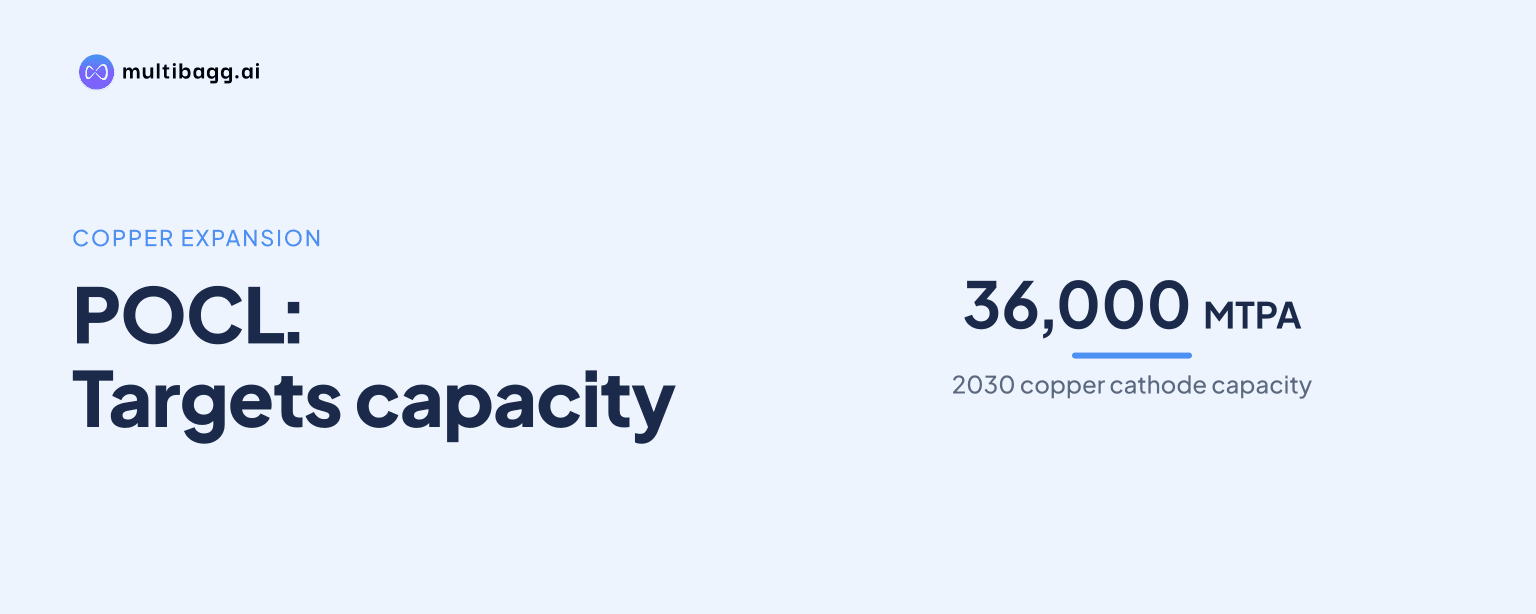
POCL targets 36,000 metric tonnes per annum (MTPA) of copper-cathode capacity in two phases by 2030, alongside a goal for value-added products to exceed 60% of its portfolio. Management also lists targets of more than 20% revenue compound annual growth rate (CAGR), more than 15% volume growth and EBITDA margin above 8%.
Know Pondy Oxides & Chemicals inside out
Results, valuation, peers and who's buying, in one view.
What is POCL’s 2030 growth strategy?
POCL’s 2030 strategy is to expand lead and copper capacity, pursue forward integration and develop a more diversified portfolio of value-added products. Its current portfolio comprises lead, copper, plastics and aluminium, while lithium-ion recycling is listed under feasibility and rubber and e-waste are listed under pre-feasibility.
Management’s disclosed 2030 objectives include revenue CAGR above 20%, profitability growth above 20%, volume growth above 15%, return on capital employed (ROCE) above 20%, earnings before interest, tax, depreciation and amortisation (EBITDA) margin above 8%, and value-added products above 60%. The presentation does not state the current value-added-product share, so the size of the targeted portfolio shift cannot be calculated from the disclosure.
POCL also links the roadmap to operating-resource targets. Management aims for renewable power usage above 50% and energy-consumption reduction above 20% to reduce the carbon footprint. These are stated targets rather than reported results for a particular financial year.
How much copper-cathode capacity does POCL plan?
POCL plans 36,000 MTPA of copper-cathode capacity in two phases. The project is listed in the execution stage of the portfolio and futuristic roadmap, while the company separately reports that copper capacity reached 12,000 MTPA after expansion.
The planned cathode capacity is three times the disclosed post-expansion copper capacity of 12,000 MTPA. POCL also reports post-expansion lead capacity of 204,000 MTPA, making lead its larger disclosed recycling capacity base.
POCL does not disclose a commissioning schedule, capital expenditure, location, phase-wise capacity split or feedstock requirement for the copper-cathode plan. Its current copper portfolio lists Clove, Cobra, Mill Berry, Grease Mill Berry and Tin Mill Berry, but the presentation does not specify cathode grades, expected sales markets or output volumes.
How will POCL increase its value-added product share?
POCL plans to lift value-added products above 60% by building on specialised alloys, engineering plastic granules and tailor-made aluminium products. The company lists pure lead, lead-calcium alloys, lead-tin alloys, lead-antimony alloys, lead master alloys and specialty alloys in its lead offering.
The presentation states that POCL manufactures more than 100 lead alloys and more than 100 other specialised alloys. This product range provides the disclosed basis for the value-added-product target, although POCL does not give revenue, volume or margin contributions for individual alloy categories.
POCL’s plastics portfolio includes industrial and engineering granules such as PPCP, acrylonitrile butadiene styrene, high-density polyethylene, low-density polyethylene, polycarbonate, PPHP, and Nylon 6 and Nylon 66. Its aluminium range includes ADC-series alloys under Japanese Industrial Standards, LM-series alloys under British Standards, and tailor-made alloys for customer requirements.
The portfolio therefore spans recycled metals, customised alloys and plastic granules rather than a single material stream. However, the presentation does not disclose the current split between commodity and value-added products, or identify the product segments expected to supply most of the increase toward the 60% target.
Got a follow-up? Ask IRIS
What FY26 performance supports POCL’s expansion plans?
POCL reported FY26 lead production of 104,481 metric tonnes (MT), compared with 94,115 MT in FY25. Lead sales increased to 100,727 MT from 90,565 MT, while production was also above the 72,531 MT reported in FY24.
Revenue from operations rose to Rs 2,938.7 crore in FY26 from Rs 2,028.3 crore in FY25. EBITDA increased to Rs 218.1 crore from Rs 107.6 crore, and the EBITDA margin rose by 2.1 percentage points to 7.4% from 5.3%.
Profit after tax increased to Rs 138.7 crore in FY26 from Rs 65.1 crore in FY25, and net profit margin rose to 4.7% from 3.2%. The FY26 EBITDA margin of 7.4% was 0.6 percentage points below management’s stated 2030 target of above 8%.
Exports represented 66% in both FY25 and FY26. Return on equity increased to 17% in FY26 from 11% in FY25, while net debt increased to Rs 139.8 crore from Rs 63.4 crore over the same period, according to the financial highlights.
What factors could shape POCL’s roadmap execution?
POCL identifies capacity expansion, new verticals, technology, automation and funding through debt, equity and internal accruals as execution levers. Management also says POCL is open to mergers and acquisitions, joint ventures and collaborations, while research and development centres and strategic joint ventures are identified as exploration activities.
Lithium-ion recycling is at the feasibility stage, whereas rubber and e-waste are at the pre-feasibility stage. These descriptions place those areas earlier in development than the stated copper-cathode execution plan, and POCL provides no capacity, capital-cost or launch-date disclosure for the three streams.
POCL also points to regulation as a factor supporting domestic scrap availability. It cites Battery Waste Management Rules and Extended Producer Responsibility, or EPR, under which manufacturers take responsibility for end-of-life product disposal through approved recyclers and EPR credits.
For 2026-27, the presentation lists compliance targets of 90% for portable and electric-vehicle batteries, and 60% for automotive and industrial batteries. POCL also cites the goods and services tax reverse-charge mechanism for metal-scrap transactions and a recommended 2% tax deducted at source in business-to-business metal-scrap supplies.
Conclusion
POCL’s roadmap combines a 36,000-MTPA copper-cathode plan with a target for value-added products to exceed 60% by 2030. Its FY26 results show higher revenue, EBITDA, lead production and lead sales than FY25, while the portfolio already includes specialised lead alloys, engineering plastics and aluminium alloys.
The next disclosed items to watch are execution of the two copper-cathode phases and progress toward management’s targets for EBITDA margin above 8%, ROCE above 20%, renewable power usage above 50% and energy-consumption reduction above 20%. Further disclosure on funding, project timing and the feasibility of lithium-ion, rubber and e-waste recycling would clarify the roadmap’s sequence.