










Powerica’s Rs 1,950 crore genset backlog is data-centre led
Key highlights
- Powerica reported a Rs 1,950 crore Cummins-powered DG set order book as of October 2026.
- Data-centre orders accounted for approximately Rs 1,200 crore of Powerica's Cummins DG set backlog.
- Powerica expects the backlog to be executed over 12 to 18 months, subject to engine availability and customer-site readiness.
- Powerica's Cummins-powered genset business grew 14% year on year in Q2 FY27.
powered by IRIS
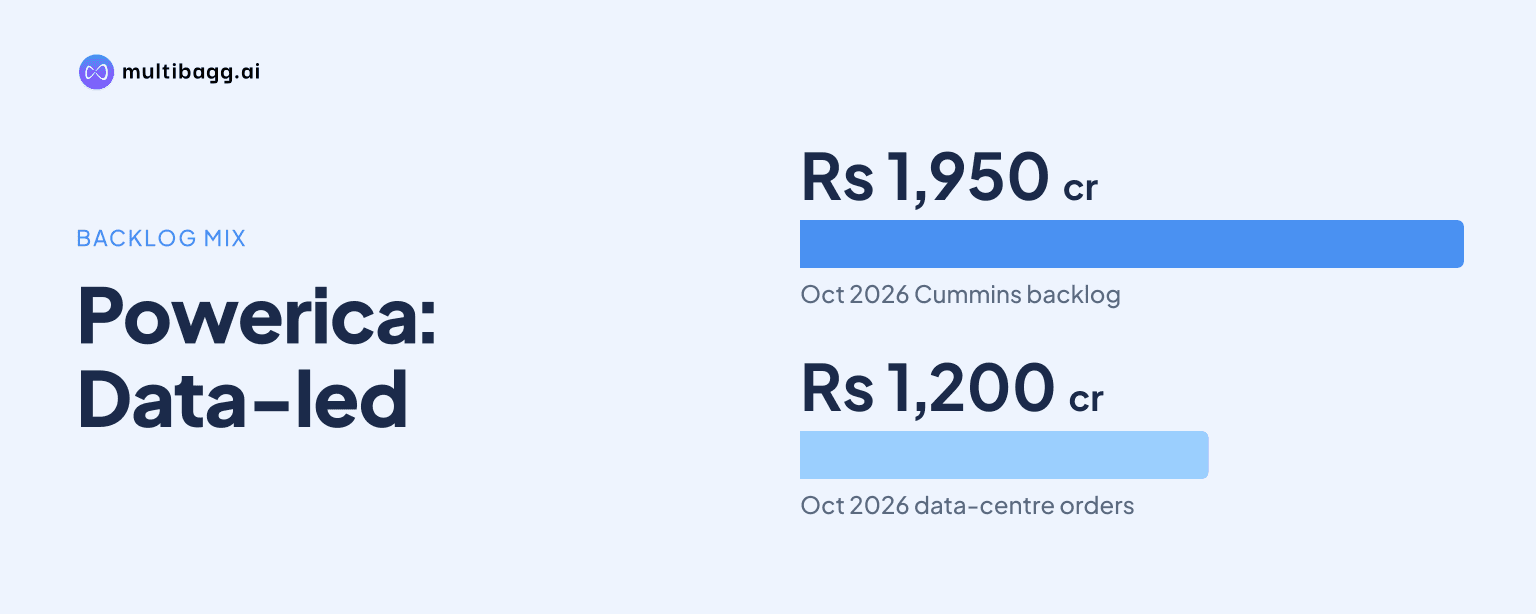
Powerica Limited had a Rs 1,950 crore Cummins-powered diesel generator set order book in October 2026, including about Rs 1,200 crore for data centres, and management expects execution in 12 to 18 months. Powerica said engine availability and customer-site readiness, rather than demand, will determine the pace at which the backlog converts.
Know Powerica inside out
Results, valuation, peers and who's buying, in one view.
What is Powerica's Cummins genset order book?
Powerica's Cummins-powered diesel generator, or DG, set order book was Rs 1,950 crore as of October 2026, with approximately Rs 1,200 crore linked to data-centre projects. Management said the remaining opportunity base includes manufacturing, real estate, rental and infrastructure applications, while the disclosed orders are expected to be executed over 12 to 18 months.
The Rs 1,200 crore data-centre component equals about 62% of the Rs 1,950 crore Cummins DG set backlog, based on management's disclosed figures. That makes data centres the largest identified end-market in the order book, although Powerica also reported demand across medium- and high-horsepower DG sets for manufacturing, real estate and rental customers.
Management said the backlog provides visibility for coming quarters, but it did not provide a quarter-by-quarter execution schedule for the Rs 1,950 crore book. The company said operators are sharing requirements and order pipelines earlier, while taking a more realistic view of project execution timelines.
How dependent is Powerica on data-centre demand?
Powerica said data centres contributed approximately 20% of revenue in H1 FY27, compared with about Rs 1,200 crore of its Rs 1,950 crore October 2026 Cummins DG set backlog. The disclosed mix therefore places a greater emphasis on data-centre projects in pending orders than in first-half revenue.
Management attributed current data-centre demand to operators expanding capacity to meet growing requirements. However, the company said it could not quantify the contribution from data centres to H2 FY27 revenue because the timing depends on acceptance of equipment at each customer project site.
Outside data centres, Powerica said renewable energy and rental demand had picked up, while commercial and residential real estate continued to grow. It reported some moderation in infrastructure and described low-horsepower DG set demand as steady but price-sensitive, compared with strong traction for medium- and high-horsepower products.
What will determine Powerica's backlog execution pace?
Powerica said engine availability was the main factor influencing DG set execution as of the November 16, 2026 earnings call, rather than a lack of demand. Management said it did not foresee an H2 FY27 impact from availability and retained its expectation of double-digit revenue growth for FY27.
Customer-site readiness is a separate timing factor for the Rs 1,200 crore data-centre order component. Management said it may be able to execute orders, but revenue recognition depends on readiness and acceptance at the respective project site, preventing it from assigning a specific H2 FY27 data-centre revenue share.
Product mix may also affect delivery timing. Management said high-horsepower DG sets, where it described competition as relatively limited, form the core of the order book, while the low-horsepower category is more competitive. Powerica did not disclose a numerical split of the Rs 1,950 crore backlog by horsepower range.
Got a follow-up? Ask IRIS
How did Powerica's genset business perform in H1 FY27?
Powerica said its Cummins-powered genset business grew 14% year on year in Q2 FY27, supporting consolidated revenue of approximately Rs 848 crore in the quarter. In H1 FY27, consolidated revenue was Rs 1,628 crore, up 12.5% year on year, with the DG set segment contributing 80.6% of revenue.
The first-half revenue mix contrasted with the wind power segment, which contributed 19.4% of consolidated revenue in H1 FY27. Management said revenue from its MSLG business was Rs 16 crore in H1 FY27, down from Rs 74 crore a year earlier, because project execution in the Middle East was delayed amid the war crisis cited by the company.
Reported segment profitability also differed between the two businesses in H1 FY27. Powerica reported an earnings before interest, tax, depreciation and amortisation, or EBITDA, margin of 6.5% for DG sets, while the wind power segment reported a 47.4% EBITDA margin; management described both wind activities as project-driven.
How are input costs and pricing affecting Powerica?
Powerica reported a consolidated EBITDA margin of 15.2% in Q2 FY27, against 14.4% for H1 FY27, and management said profitability improved sequentially as earlier price revisions flowed through. Consolidated profit after tax was approximately Rs 71 crore in Q2 FY27 and Rs 135 crore for H1 FY27.
Management said a fresh round of commodity inflation had emerged from the beginning of Q3 FY27, led by steel, followed by copper and aluminium. Steel is Powerica's largest raw-material input, while alternators used in DG sets rely heavily on copper for internal electrical components; domestic steel producers announced further increases through October.
Powerica said its earlier price increases had not fully offset the latest rise in input costs and that it planned further calibrated price hikes during the current quarter. Management did not quantify the proposed increases or their margin effect, but said it expects raw-material costs to moderate if geopolitical conditions improve.
Conclusion
Powerica's Rs 1,950 crore Cummins-powered DG set order book places data centres at the centre of its near-term demand profile, with approximately Rs 1,200 crore of disclosed orders from that end-market. The 14% year-on-year growth in Cummins gensets in Q2 FY27 and the DG set segment's 80.6% revenue contribution in H1 FY27 link the backlog directly to the company's principal operating business.
The next measure to watch is execution during the stated 12-to-18-month period, particularly engine availability and customer-site acceptance for data-centre projects. Management's planned Q3 FY27 price increases and its expectation that raw-material costs could moderate if geopolitical conditions improve will also shape whether pricing catches up with higher steel, copper and aluminium costs.