










Powerica says fresh input inflation erodes earlier price gains
Key highlights
- Powerica reported a Rs 1,950 crore Cummins-powered genset order book as of October 2026.
- Data-centre orders accounted for about Rs 1,200 crore of Powerica’s genset order book.
- Powerica reported Q2 FY27 EBITDA margin of 15.2%, versus 14.4% for H1 FY27.
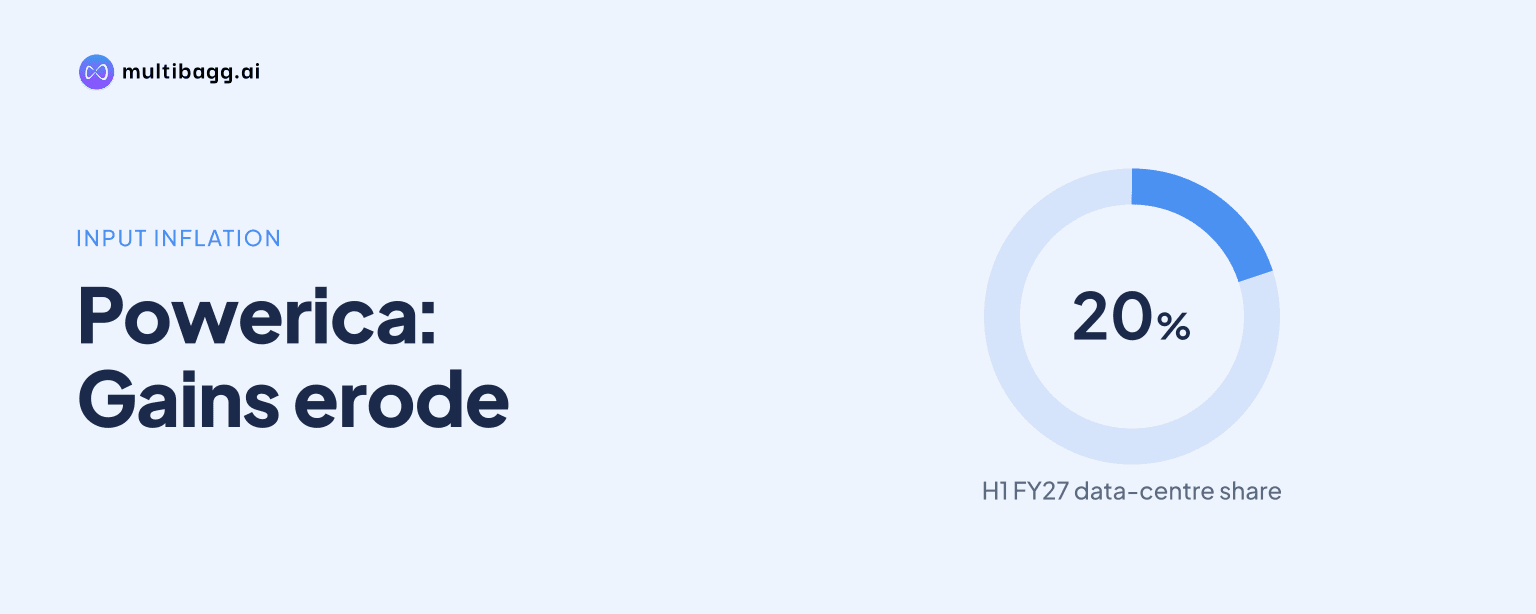
- Powerica said data centres contributed approximately 20% of H1 FY27 revenue.
powered by IRIS
Powerica Limited said on November 16, 2026, that fresh steel, copper and aluminium inflation had eroded prior genset price protection, requiring calibrated further increases even as current pricing covered costs; it held a Rs 1,950 crore Cummins-powered genset order book in October 2026.
Know Powerica inside out
Results, valuation, peers and who's buying, in one view.
Why have earlier Powerica price increases lost protection?
Powerica said its earlier price revisions have not fully offset a new increase in input costs that began at the start of Q3 FY27. Steel is its largest raw-material input, while copper and aluminium are also important, including because alternators use copper extensively in their electrical components. Domestic steel producers announced further increases through October, management said.
The company had taken regular price revisions during the preceding six months, with management saying it had made more changes than in the prior three to four years because of commodity volatility. Those revisions began improving profitability sequentially in Q2 FY27, but the effect is diluted when new raw-material costs rise after prices for existing orders have already been set. Management therefore described the need for additional increases as calibrated rather than as a single uniform hike.
The Q2 margin improvement versus Q1 was attributed principally to price revisions flowing through, rather than to a fall in commodity costs. Management said profitability nevertheless remained affected by elevated commodity prices and the time lag between higher procurement costs and customer pass-through. It did not quantify either the contribution from price revisions in Q2 or the size of any proposed Q3 increase.
Does Powerica’s current pricing cover raw-material inflation?
Powerica said current pricing covered raw-material inflation as it stood on the November 16 call, but this conclusion depends on prices not rising further. Management said it monitors commodity movements nearly day by day and would revise selling prices if there were further sudden increases. It also said pricing decisions are based on the costs at which it procures materials.
That spot-price coverage does not mean all secured orders reflect the latest costs. The Rs 1,950 crore order book is a mix of orders placed at older and newer prices, and management said the timing of margin recovery depends on execution. About Rs 1,200 crore of the October order book was related to data centres, where site readiness and customer acceptance determine delivery timing.
The remaining roughly Rs 750 crore of the Cummins-powered genset book is more cyclical, according to management, and may move from booking to delivery in periods ranging from two days to six months. This shorter-cycle business can incorporate revised prices faster than longer-duration projects. Management added that if commodity prices stabilise from current levels, it would not need further revisions, although the legacy order mix will take time to fully roll over.
Got a follow-up? Ask IRIS
How is Powerica managing cost and pass-through delays?
Powerica said it uses demand planning, vendor price negotiations, industry intelligence, purchase timing and bulk buying where possible to manage raw-material inflation. Management said it books supplies when it expects cost escalation, which had helped prevent margins from deteriorating to the same extent as input inflation during the earlier period of increases.
The company distinguished these procurement actions from pricing decisions. New orders are being calibrated for current commodity costs, while existing contracts may have a lag before their economics reflect revised procurement prices. This explains why management would not split the Q2 FY27 benefit between new and existing orders or provide a quantified H2 FY27 pricing contribution.
For context, management said the FY26 normal-scenario margins it had previously disclosed were about 9% for the genset business on a consolidated basis, about 62% on a blended basis for wind independent power producer assets, and about 10% for wind engineering, procurement and construction, or EPC, work. These were management’s reference points, not FY27 margin guidance. In H1 FY27, the DG set segment represented 80.6% of revenue and had a 6.5% EBITDA margin, while wind represented 19.4% and had a 47.4% margin.
Which genset markets can support Powerica price actions?
Powerica said demand across its genset business remained healthy, with medium- and high-horsepower products showing strong traction from data centres, manufacturing, real estate and rental customers. Manufacturing remained the largest contributor even excluding data centres, management said. It expects double-digit revenue growth through FY27, supported by the order pipeline and demand rather than by an announced volume target.
Pricing conditions vary by product category. The low-horsepower segment has more suppliers and is more price-sensitive, while management said competition is relatively limited in high horsepower, particularly for QSK products. It reported no material new competitive threat in high horsepower. Infrastructure demand was described as moderate, whereas renewable energy, rental, commercial and residential real estate were said to be growing.
Data centres contributed approximately 20% of H1 FY27 revenue, but management declined to forecast their H2 contribution because project-site readiness governs acceptance and dispatches. Engine availability, rather than demand, remains the key influence on execution, according to the company. That operational constraint matters because a price increase can protect an order’s economics only when the equipment can be procured and delivered under the revised terms.
Conclusion
Powerica’s Q2 FY27 sequential margin improvement shows that earlier price revisions were beginning to pass through, but fresh steel, copper and aluminium inflation has reduced that protection. Current selling prices cover prevailing costs, management said, while the mix of legacy and newer orders means the pace of recovery will differ between long-cycle data-centre work and shorter-cycle non-data-centre sales.
The next issue to watch is whether commodity prices stabilise and allow the newest price revisions to flow across the order book. Management continues to target double-digit FY27 revenue growth and has Rs 1,200 crore of data-centre orders within the Rs 1,950 crore Cummins-powered genset book, with the order book expected to be executed over 12 to 18 months.