








Prabha Energy Limited (PEL) has 47 Jharia wells left for Q4 FY27
MAX Plan at ₹4,999/yr

Find your next multibaggerBe a Pro Investor
Research stocks and track your picks on the go. Download the app.
Key highlights
- PEL targets Q4 FY27 commercial production from its Jharia CBM block.
- Jharia has 8 drilled wells out of a 55-well phased plan, leaving 47 wells remaining.
- PEL holds a 90% participating interest in Jharia, while Bharat Coking Coal Ltd holds 10%.
- Jharia has an approximately 8 km pipeline link to the Urja Ganga or National Gas Grid.
powered by IRIS
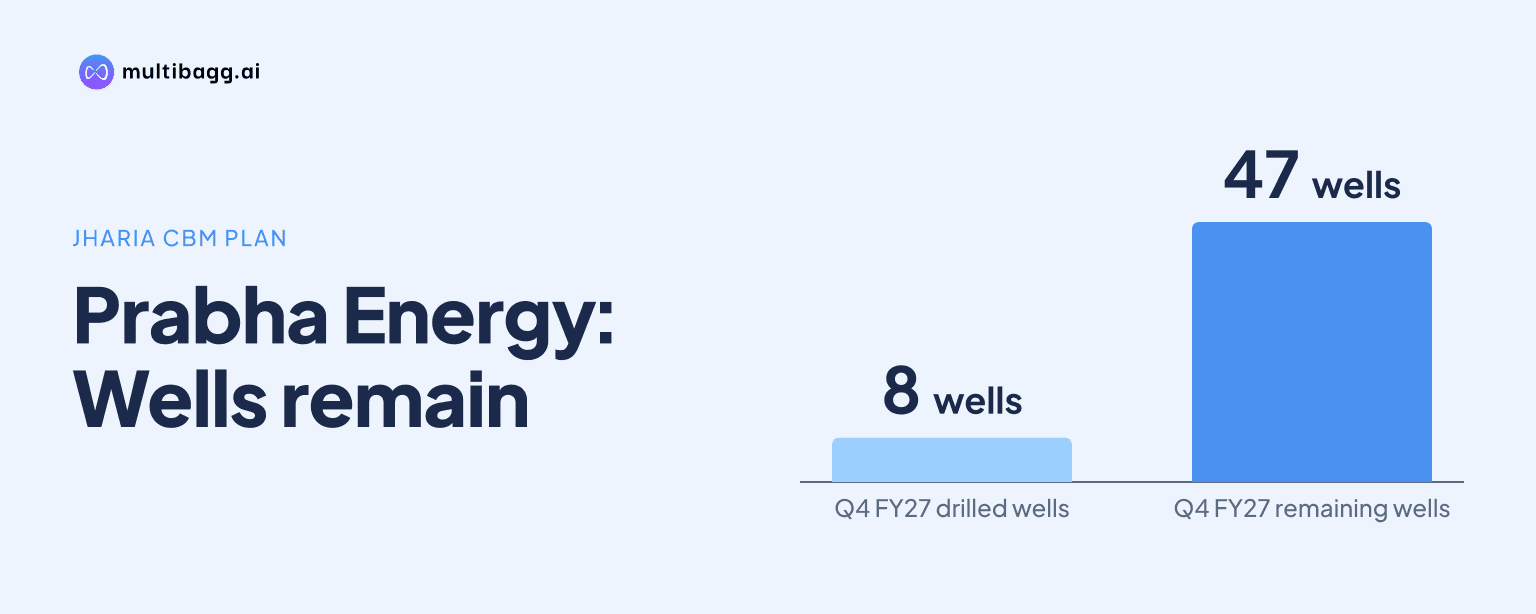
Prabha Energy Limited (PEL) targets commercial production from its Jharia coal-bed methane (CBM) block in Q4 FY27, but 47 of the 55 planned wells remain to be funded and drilled. The target therefore depends on phased execution, funding through internal cash flows and debt, and completion of the block’s route to the National Gas Grid.
Know Prabha Energy inside out
Results, valuation, peers and who's buying, in one view.
What must PEL complete before Jharia starts production?
PEL must fund and drill the remaining 47 wells in its 55-well phased Jharia programme before its stated Q4 FY27 commercial-production target can be reached. The presentation records eight wells drilled at Jharia, leaving most of the programme outstanding. PEL holds a 90% participating interest in the block, while Bharat Coking Coal Ltd, a Coal India subsidiary, holds the remaining 10%.
The schedule places continued phased drilling in 2026 and the commercial-production target in Q4 FY27. PEL describes the remaining Jharia capital expenditure as requiring funding, with a staggered capital-expenditure strategy intended to use internal cash flows and debt. The presentation does not disclose a capital-expenditure amount, drilling timetable by well, production-volume forecast, or a specific financing facility for the 47 remaining wells.
The well count shows a material difference in project maturity. North Karanpura has drilled 68 of 74 wells, or all but six, whereas Jharia has drilled eight of 55, or all but 47. PEL calls the Jharia drilling programme phased, so the Q4 FY27 timing is a management target rather than a record of production already achieved.
How does Jharia compare with North Karanpura?
Jharia is earlier in development than North Karanpura, while PEL’s economic interest is larger at Jharia. PEL has a 90% participating interest in Jharia compared with 25% in North Karanpura (NK), where Oil and Natural Gas Corporation holds 55% and Indian Oil Corporation holds 20%. NK began commercial production in May 2025 after 68 wells had been drilled.
This means PEL can draw on operating experience from a producing CBM asset as it develops Jharia, but the two blocks have different execution profiles. The presentation says NK is progressing within budgeted capital expenditure and has an option for 50 additional Phase-II wells at lower incremental capital expenditure. It does not state that this Phase-II option is approved, financed, or applicable to Jharia’s 55-well plan.
The portfolio contains two CBM blocks in Jharkhand and three marginal gas fields in Rajasthan, with 31 billion cubic metres of gas initially in place cited for the CBM blocks. That portfolio figure is not a Jharia reserve estimate or a forecast of saleable Jharia output. Likewise, the presentation gives no daily production forecast for either Jharia or NK, limiting a direct comparison of expected volumes.
Got a follow-up? Ask IRIS
How does PEL plan to fund and sell Jharia gas?
PEL says its staggered capital-expenditure strategy will fund further Jharia development through internal cash flows and debt, while an approximately 8 km PEL pipeline connects Jharia to the Urja Ganga or National Gas Grid. The funding approach is presented as a mitigant to capital risk, not as confirmation that all drilling funds have already been secured.
The pipeline link is central to PEL’s response to market and offtake risk because it is intended to provide access to gas consumers beyond the block. NK has an approximately 68 km Indian Oil Corporation pipeline connection, compared with the approximately 8 km PEL pipeline at Jharia. PEL says both CBM blocks have free, market-driven gas pricing, though the presentation does not provide realised gas prices, customer contracts, or contracted sales volumes.
The national gas-grid backdrop forms part of PEL’s roadmap rather than a company delivery milestone. Its presentation says the network crosses 25,000 km in 2026 and is expected to connect almost every state by the end of FY27. These network statements do not remove the need for PEL to commission Jharia wells, move gas through its own approximately 8 km pipeline, and arrange the practical terms of gas sales.
What risks could change PEL's Q4 FY27 target?
PEL identifies execution and ramp-up risk from phased well drilling across NK and Jharia as a factor that could change the Q4 FY27 target. Its stated mitigants are that NK is already in commercial production and that partners include Oil and Natural Gas Corporation, Indian Oil Corporation and Bharat Coking Coal Ltd. At Jharia, however, the relevant operational fact remains that eight of 55 planned wells have been drilled.
Capital and funding risk is specifically tied to the remaining 47 Jharia wells. PEL’s proposed mitigant is a combination of staggered expenditure, internal cash flows and debt, but the presentation does not set out debt terms, expected internal cash generation, funding conditions, or the total amount needed. The target therefore remains exposed to whether those mechanisms are available on the timetable required for Q4 FY27.
PEL also identifies regulatory, pricing, market and offtake risks over an asset life. Free market-driven pricing applies to both blocks according to the presentation, but policy and gas pricing can change. The company cites the direct Jharia pipeline link as its answer to market access, while its disclaimer states that forward-looking statements can differ materially because of factors including cost overruns, government actions and fiscal costs.
Conclusion
PEL’s stated Q4 FY27 production target for Jharia rests on a clearly defined but substantial development task: drilling and financing 47 remaining wells out of a 55-well plan. Jharia offers PEL a 90% participating interest and an approximately 8 km link to the Urja Ganga or National Gas Grid, while NK provides a May 2025 production reference point after 68 of 74 wells were drilled.
The next disclosed milestones are continued phased Jharia drilling in 2026 and the Q4 FY27 commercial-production target. Investors will need to watch whether PEL identifies funding for the remaining capital expenditure, reports further well completions, and provides production or sales details. Beyond that period, the presentation cites a Central Government target of 5.0 million metric standard cubic metres per day of CBM production in 2028.

