










Prabha Energy targets 16 lakh cubic metres daily by FY29
Key highlights
- Prabha Energy targets combined CBM peak output of about 16 lakh cubic metres a day by FY29.
- Current cascade gas sales are about 20,000 cubic metres a day before gas-grid connectivity.
- Jharia’s approximately 8-kilometre pipeline is targeted for January 2027, while North Karanpura’s 68-kilometre pipeline is expected by March 2027.
- Prabha Energy plans capital expenditure above Rs 500 crore for 47 additional Jharia wells.
powered by IRIS
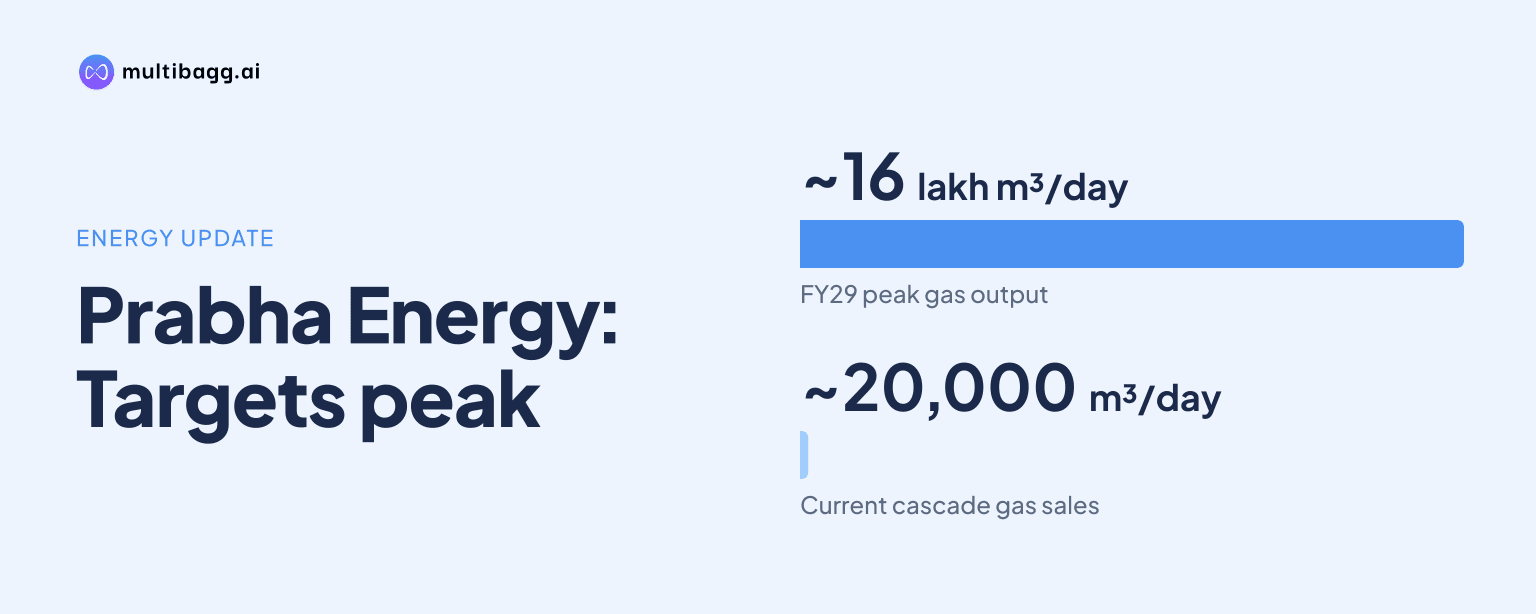
Prabha Energy Limited expects its North Karanpura and Jharia coal bed methane blocks to reach combined peak output of about 16 lakh cubic metres a day by FY29, compared with current cascade sales of about 20,000 cubic metres a day. The ramp depends on Jharia and North Karanpura pipeline links to the Urja Ganga gas grid and 47 additional wells at Jharia.
Know Prabha Energy inside out
Results, valuation, peers and who's buying, in one view.
How much CBM output is Prabha Energy targeting by FY29?
Prabha Energy is targeting about 16 lakh cubic metres a day of combined peak coal bed methane, or CBM, output by FY29, based on management’s estimates of about 9 lakh cubic metres a day from North Karanpura and about 7 lakh cubic metres a day from Jharia. This compares with present cascade sales of around 20,000 cubic metres a day while the blocks lack gas-grid connectivity.
Management said North Karanpura could begin grid-linked sales at a few lakh cubic metres a day after its pipeline is commissioned, before progressing towards peak output. Jharia’s first eight wells are expected to produce 20,000 to 40,000 cubic metres a day initially. North Karanpura has 68 drilled wells, while Jharia requires 47 further wells beyond its eight first-phase wells to reach the stated 55-well total.
When will Prabha Energy connect its CBM blocks to the gas grid?
Prabha Energy expects Jharia’s approximately 8-kilometre pipeline connection to the Urja Ganga pipeline to be completed by January 2027, with initial production planned from Q4 FY27. Management said the Petroleum and Natural Gas Regulatory Board authorised the connection, while GAIL had approved connectivity and the required formalities were complete.
North Karanpura’s 68-kilometre evacuation pipeline, being developed by Indian Oil Corporation Limited, was more than 60% complete at the time of the call and is expected to be commissioned by March 2027. North Karanpura began gas sales in April 2025, but management said volumes remain limited because cascades, rather than a pipeline, currently move the gas to customers.
Management identified pipeline connectivity as the main bottleneck to commercial scale-up. It said cascade sales total about 20,000 cubic metres a day, whereas grid connection can support much larger volumes. Once connected to Urja Ganga, management said the blocks could sell under an open-price mechanism to buyers across India, including through the Indian Gas Exchange.
What is the economic difference between North Karanpura and Jharia?
Prabha Energy holds a 25% participating interest in North Karanpura, sharing revenue and expenses with Oil and Natural Gas Corporation Limited and Indian Oil Corporation Limited. At Jharia, Prabha Energy holds a 90% revenue-sharing interest under its contract with Bharat Coking Coal Limited. Management therefore said Jharia’s output would have a higher monetary contribution to Prabha Energy despite broadly similar block-level output potential.
North Karanpura covers about 271 square kilometres, compared with about 26 square kilometres for Jharia. Development drilling at North Karanpura began in 2018 and has produced 68 completed wells. Management said reservoir evaluation identified coal seams of about 65 metres, compared with about 35 metres in the earlier field development plan, and cited high to very high gas potential in tests from the block’s southern area.
Jharia has completed drilling and testing on eight wells, where management said gas breakthrough had occurred during dewatering. The next phase calls for 47 additional wells. Management said the smaller 26-square-kilometre footprint may offer operational ease relative to developing North Karanpura’s 271-square-kilometre area, but it did not quantify a cost or margin advantage from that difference.
Got a follow-up? Ask IRIS
What spending and funding does Prabha Energy need for Jharia?
Prabha Energy said the planned 47 additional Jharia wells require capital expenditure above Rs 500 crore, with spending expected to start in the next financial year. Management said most capital expenditure at North Karanpura had already been completed. It expects North Karanpura to become fully operational after its March 2027 connection, although peak production may take a further one to two years.
Management said it may fund Jharia’s capital expenditure with roughly 50% equity and 50% debt or internal accruals. This is a stated funding target, not a completed financing plan: the call did not give a timetable for an equity issue, name lenders, or specify how much of the non-equity portion would come from borrowings rather than internal cash generation.
Prabha Energy also said North Karanpura expenditure is currently capitalised because output remains in the test-production stage. Management expects capitalisation to stop when production and sales rise after grid connection. It estimated operating costs of around 20% and earnings before interest, tax, depreciation and amortisation margins of 70% to 75% at optimum production, subject to the planned increase in volumes.
How long does Prabha Energy expect CBM production to last?
Prabha Energy said its CBM projects have award periods of 25 to 30 years, and management expects well production to continue for at least 25 years. It expects initial peak output within two to three years, followed by a production plateau for several years. Management said operators can drill further wells to maintain a plateau, although it disclosed no such plan beyond Jharia’s identified 47 wells.
The portfolio also includes three marginal gas fields in Jaisalmer, Rajasthan, spanning about 100 square kilometres and carrying estimated gas reserves of around 1.4 billion cubic metres. Those fields have about 15 kilometres of pipeline connecting producing wells to the Bankia gathering station, which has separation, purification and dehydration facilities. Management’s focus there is operational optimisation and gas marketing, rather than the FY29 CBM target.
Conclusion
Prabha Energy’s stated FY29 objective represents a move from 20,000 cubic metres a day of cascade sales to about 16 lakh cubic metres a day of grid-linked CBM production. North Karanpura is expected to provide about 9 lakh cubic metres a day at peak, while Jharia is expected to contribute about 7 lakh cubic metres a day and has a 90% revenue-sharing interest for Prabha Energy, compared with a 25% participating interest at North Karanpura.
The next milestones are Jharia’s targeted January 2027 pipeline completion and initial production from Q4 FY27, followed by North Karanpura’s expected March 2027 pipeline commissioning. Management must also execute Jharia’s 47-well drilling programme and arrange funding for capital expenditure above Rs 500 crore, with its current plan calling for roughly equal equity and debt or internal-accrual funding.