










Pakka Delays FlexC Coating Until PM4 Base Paper Stabilises
Key highlights
- Pakka will wait for PM4 to stabilise after its planned January start before advancing FlexC coating commercially.
- Management’s ultimate aim is to route all PM4 output into coated FlexC structures.
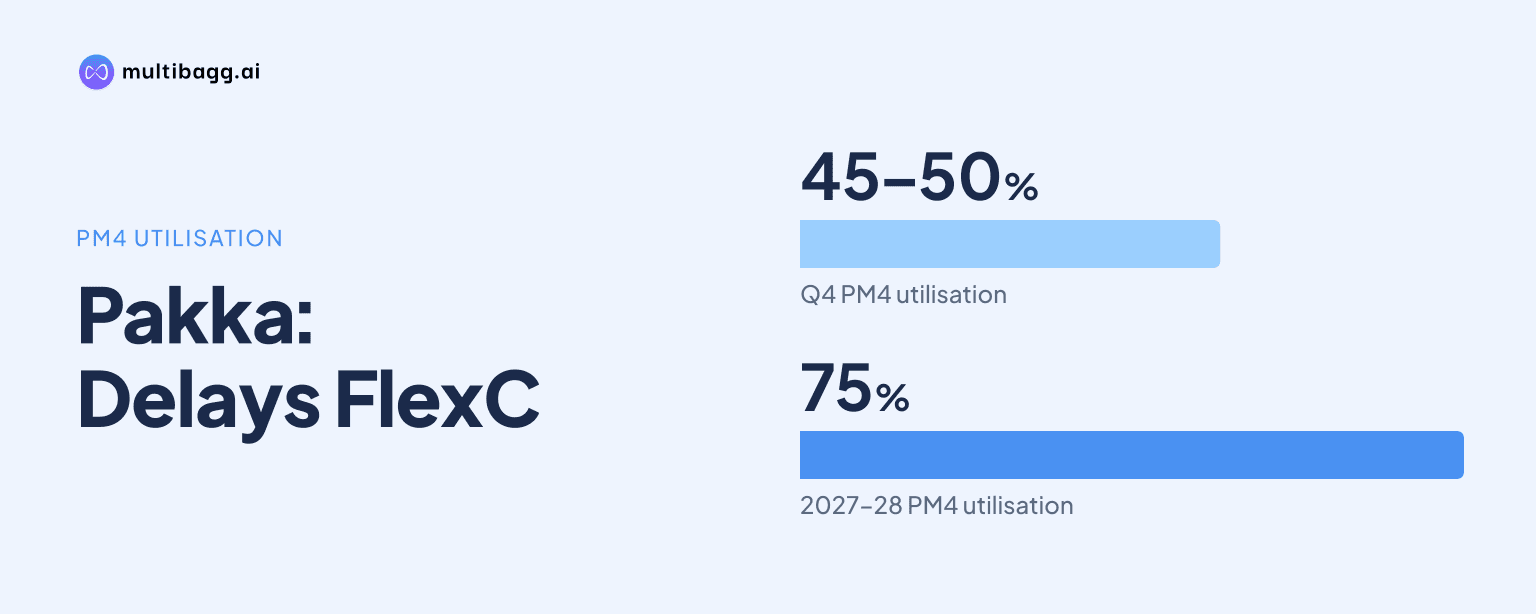
- PM4 is targeted to average 45% to 50% utilisation in Q4 and around 75% in 2027-28.
- Pakka plans to start FlexC Base at about Rs 110 per kg before pursuing Rs 140 to Rs 150 per kg.
powered by IRIS
Pakka will defer the FlexC coating launch until PM4 has started and stabilised after January, while management’s eventual target is to direct all PM4 output into coated structures. The immediate priority is to produce Pakka’s own FlexC Base paper, after which it plans to validate coating chemistry and finalise customer-facing FlexC formats.
Know Pakka inside out
Results, valuation, peers and who's buying, in one view.
Why has Pakka delayed the FlexC coating launch?
Pakka has delayed FlexC because it does not want to introduce a coated structure before establishing its own FlexC Base paper from PM4. Management said coating had been placed “slightly on the back burner” while it develops the base paper, a project it said has been in the making for more than three to four years. Its concern is that replacing the paper after launch could alter the product’s look, feel and performance for customers.
Pakka distinguishes FlexC Base from FlexC. FlexC Base is the coating substrate, while FlexC is the intended final coated flexible-packaging structure. Pakka is currently selling about 500 tonnes of an outsourced grease-resistant FlexC Base grade, but FlexC remains in development. Management said the real development and launch process for FlexC would begin after January, once PM4 starts producing and is stabilised.
The sequence means a commercial coating launch is not tied only to completing a formulation. Pakka is continuing to evolve its coating chemistry and engage with customers, but management said it does not want to finalise a new structure before its own base paper is available. This makes PM4’s product consistency, rather than demand alone, the principal near-term dependency for FlexC.
What must PM4 prove before Pakka advances FlexC?
PM4 must reliably produce Pakka’s coating-ready FlexC Base before FlexC advances beyond pilot-stage work. Management described the intended paper as non-porous and translucent in look and feel, with properties designed to affect the final structure of a coated package. The base paper is being developed specifically for coating, rather than as only an uncoated paper sold into the market.
Pakka’s development work included a pilot programme with a research institute in Slovenia that lasted a little over one month. Management said the product structure, ratios and chemistry were finalised during that work, and that indicative results were extremely positive. It also planned another pilot before the PM4 start to produce the final structure and achieve the required look and feel.
Management said the live PM4 machine should produce FlexC Base of better quality than the pilot machine because it is more sophisticated. The initial operating plan nevertheless allows for a ramp-up: Pakka is targeting average PM4 utilisation of about 45% to 50% in Q4 after the January start, followed by a gradual increase to around 75% in 2027-28. The difference between those periods indicates that output and quality qualification are expected to progress in stages.
How will Pakka make FlexC without an in-house coater?
Pakka will initially use external facilities for coated structures because it has not ordered its own coater. Management said it conducts coating trials on small continuous laboratory machines in England and then moves promising formulations to pilot machines, usually in Europe. It intends to consider ordering its own coater only after the chemistry has been proven on a pilot machine.
In the meantime, Pakka expects to use outsourced domestic facilities, including existing tie-ups, as it does for metallised structures. This lets it test coating chemistries while PM4 establishes the base paper. Management said that once it has its own paper, it can assess how the substrate influences the final FlexC product’s properties before agreeing a final structure with customers.
The approach separates coating development from capital commitment. Pakka first needs to stabilise the chemistry, validate it on a pilot machine and establish FlexC Base on PM4; only then would an order for an in-house coating line be considered. As a result, the timing of a full FlexC launch remains unresolved even though outsourced coating capacity is available.
Got a follow-up? Ask IRIS
What price does Pakka expect for FlexC Base?
Pakka plans to begin PM4 sales at about Rs 110 per kg, a rate management described as discounted, before seeking higher realisations as the paper is developed. Management said this is the base price supported by a product already being delivered to the market. It expects PM4’s greater sophistication to enable a higher-quality FlexC Base than the outsourced grade currently sold.
Management said high-end uncoated papers can sell at Rs 170, Rs 180 and Rs 200 per kg, and described Rs 140 to Rs 150 per kg as within the possible range for the new base paper. It did not present Rs 140 to Rs 150 per kg as achieved pricing. Instead, it said price acceptance depends on demonstrated quality and customer confidence after the actual product reaches the market.
Pakka said the market-establishment process could take three, four or six months once the production-grade paper is available. Management attributed its confidence to bagasse pulp, which it said has high transparency and the porosity characteristics needed for this kind of paper. However, management also said the price still needs to be established, leaving realised pricing and customer qualification as open factors.
What is Pakka’s ultimate plan for PM4 output?
Pakka’s ultimate aim is for all PM4 output to go into coating and become the final FlexC structure. Management said its effort over the next few months would be directed toward getting the entire output coated, rather than treating coated material as a limited share of the new machine’s volumes. This is distinct from the initial plan to sell FlexC Base at about Rs 110 per kg during the PM4 ramp-up.
The company’s stated target depends on several steps that have not yet been completed: PM4 must first stabilise after January, its base paper must meet the intended non-porous and translucent specifications, and the coating formulation must be validated on production-relevant material. Pakka has not ordered a coater, so outsourced facilities would remain part of the process until a future capital decision.
Pakka is also retaining and expanding its Bengaluru innovation operation, including a larger laboratory expected within two to three months. Management said it had decided to separate innovation from product development and would continue recruiting talent, including for barrier coating. That organisation supports FlexC’s chemistry work, although commercial progress remains linked to the PM4 base-paper sequence.
Conclusion
Pakka’s FlexC plan is a staged product-development programme centred on PM4: establish its own FlexC Base, validate the coating chemistry and customer-facing structure, then work toward coated use for all output. The contrast between the 45% to 50% Q4 utilisation target and the 75% target for 2027-28 indicates that management expects manufacturing ramp-up and market qualification to take time.
The next disclosed milestones are PM4’s January start, the quality of FlexC Base from the live machine and the market’s response to the initial Rs 110 per kg price. Management also indicated that price development toward Rs 140 to Rs 150 per kg could take three to six months after product launch, while a decision to order an in-house coater awaits pilot validation of the chemistry.