










Pakka puts Project Jagriti depreciation at Rs 30-32 crore
Key highlights
- Pakka expects Project Jagriti to add Rs 30-32 crore of annual depreciation in the next financial year.
- Management indicated approximately Rs 3 crore of monthly depreciation after capitalisation, with a lower January-to-March charge.
- Project Jagriti costs about Rs 750 crore and includes a 22% subsidy on eligible plant and machinery.
- Pakka targets PM4 utilisation of around 45-50% in Q4 and around 75% in 2027-28.
powered by IRIS
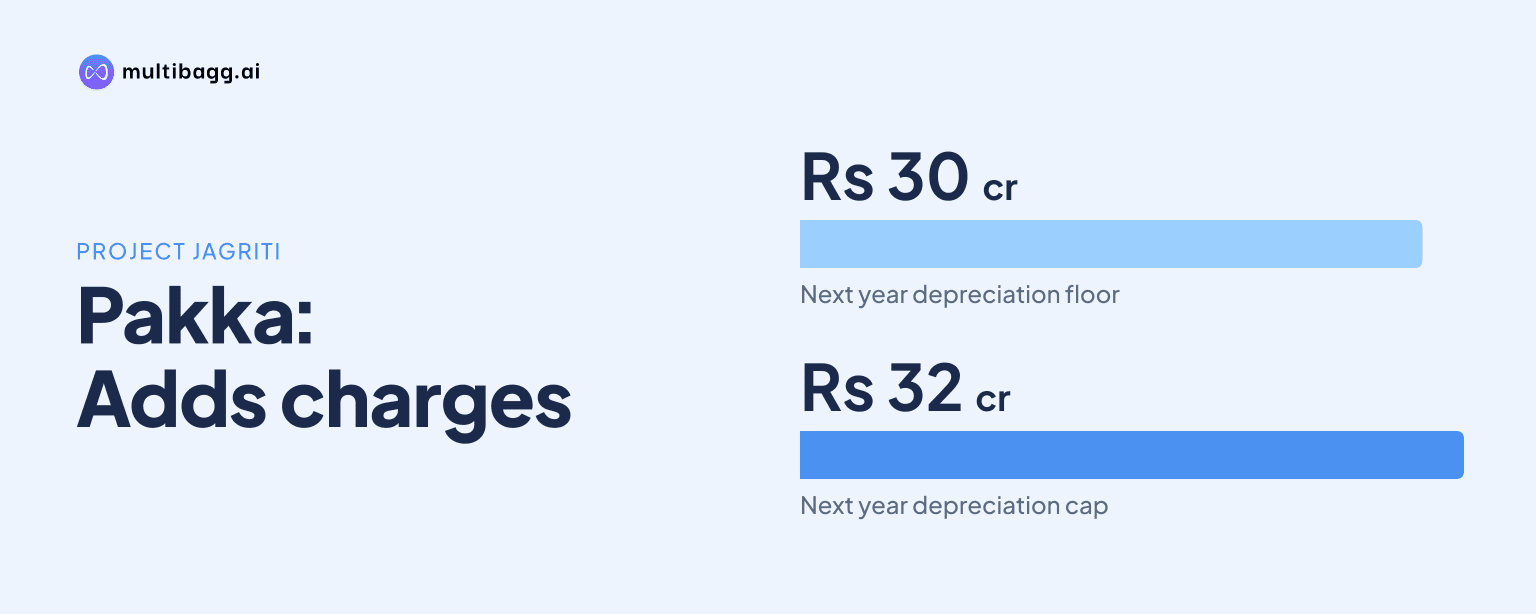
Pakka expects Project Jagriti to add Rs 30-32 crore of depreciation in the next financial year, after a lower charge from January to March, management said. The estimate reflects an approximately Rs 750 crore project cost, a 22% Uttar Pradesh subsidy on eligible plant and machinery, and a 15-year depreciation period.
Know Pakka inside out
Results, valuation, peers and who's buying, in one view.
How much depreciation will Project Jagriti add?
Pakka expects Project Jagriti to add approximately Rs 30-32 crore of depreciation in the next financial year. Management also indicated a rough charge of around Rs 3 crore a month after capitalisation, although it said the January-to-March expense would be lower than a full-period monthly run rate.
The disclosed charge is an accounting expense that follows capitalisation of the project assets, rather than an operating-cost target. It is separate from earnings before interest, tax, depreciation and amortisation, or EBITDA, for which management discussed a Rs 130-150 crore annual run rate as suitable for refinancing discussions.
The Rs 30-32 crore range is not a forecast of net profit because Pakka did not disclose the associated tax impact, interest expense, revenue contribution or a complete depreciation schedule. Management did, however, distinguish the lower January-to-March charge from the larger full-year charge expected in the following financial year.
When will Pakka start recording the depreciation charge?
Pakka will begin recording depreciation when Project Jagriti is capitalised under Indian Accounting Standards, or Ind AS, rather than automatically when the plant is commissioned. Management said capitalisation depends on the machinery being capable of operating in the manner intended by management.
The timing is linked to PM4, which Pakka expects to start in January. Management targets average PM4 utilisation of around 45-50% in Q4 after startup, followed by a gradual increase to around 75% in 2027-28, giving context for the lower depreciation expense expected from January to March.
Pakka did not specify the date in January on which PM4 would satisfy the Ind AS operating-readiness condition. That date matters because it determines how much of the three-month January-to-March period will carry depreciation, while the Rs 30-32 crore estimate applies to the next full financial year.
Management's accounting explanation also means that commissioning and capitalisation may not occur on the same date. The transcript supports a January PM4 startup target and a lower January-to-March depreciation charge, but does not provide a day-by-day capitalisation or depreciation timetable.
What will happen to Pakka's Rs 734 crore CWIP balance?
Pakka said most of the approximately Rs 734 crore capital work-in-progress, or CWIP, cited from its September balance sheet should be capitalised, subject to the Ind AS readiness test. Management said the CWIP balance includes both the main Project Jagriti investment and a smaller product-development component.
About Rs 10-15 crore of CWIP relates to delivery containers and flexible-packaging research and development, according to management. Pakka did not provide the exact residual portion of CWIP that would be assigned to Project Jagriti or state whether every asset category would have the same 15-year depreciation period.
This distinction limits the extent to which the Rs 734 crore balance can be used to independently calculate depreciation. Management said the Project Jagriti estimate is based on a net amount after subsidy, while the transcript does not disclose the eligible machinery value, the final subsidy received, residual values or asset-level useful lives.
Pakka separately plans approximately Rs 1 crore of delivery-container capital expenditure for one coating-machine and gluing-machine set. Management said that set would enable production of 10-12 tonnes per month, with further spending dependent on successful commissioning, making it distinct from the approximately Rs 750 crore Project Jagriti project.
Got a follow-up? Ask IRIS
How do the subsidy and asset life shape the estimate?
Pakka said its depreciation estimate incorporates a 22% Uttar Pradesh government capital subsidy on eligible plant and machinery and depreciation over 15 years. The wording is important because management did not say that the 22% subsidy applies to the full approximately Rs 750 crore Project Jagriti cost.
The subsidy reduces the depreciable base for the eligible assets, which is why the annual charge cannot be derived simply by dividing Rs 750 crore by 15 years. Pakka gave the resulting guidance of around Rs 3 crore a month and Rs 30-32 crore in the next financial year, but did not disclose the detailed calculation behind those figures.
The new accounting expense will be considered alongside financing obligations. Management said debt on the books should be about Rs 500 crore and illustrated that 10% interest on that amount would be around Rs 50 crore annually, declining as instalments are repaid.
Management also said total principal and interest outflow would not exceed about Rs 110 crore at any point under its refinancing arithmetic. It described Rs 130-150 crore of EBITDA as a suitable range for refinancing and said it could begin pursuing refinancing at quarterly EBITDA of Rs 30 crore, while Rs 35 crore per quarter would make banks comfortable.
What other spending and operating assumptions has Pakka disclosed?
Pakka expects maintenance capital expenditure for Project Jagriti to settle at around 2% of the asset block after the first year. Management said the first year should need little replacement spending because the machinery is new, apart from commissioning spares normally consumed during startup.
Pakka did not translate the 2% maintenance benchmark into a rupee forecast. Applying it directly to the approximately Rs 750 crore project cost would be unsupported because the final capitalised asset block and eligible subsidy amount have not been disclosed.
PM4's operating ramp is central to the project plan: utilisation is targeted at 45-50% in Q4 after the January start and around 75% in 2027-28. Management also said the real development and launch of FlexC would start after January once the machine is stabilised, while FlexC Base is being sold through a 500-tonne market run for an outsourced grease-resistant grade.
The wider business has other expansion plans, but they do not change the Project Jagriti depreciation guidance. Pakka said Chuk is building capacity to 550 tonnes per month by the end of the calendar year, with a planned 30:70 in-house-to-outsourced production mix and an approximately 25% product-level gross margin on an arm's-length basis.
Conclusion
Pakka has quantified the accounting cost expected from Project Jagriti at Rs 30-32 crore of additional annual depreciation in the next financial year, following a lower charge in January to March. The estimate incorporates a 15-year asset life and a 22% subsidy on eligible machinery, but the final depreciable base and capitalisation date remain undisclosed.
The next items to watch are PM4's January startup, the point at which it meets the Ind AS readiness test, and progress toward 45-50% Q4 utilisation. Pakka's plan to reach around 75% utilisation in 2027-28 will provide the operating setting for a full-year depreciation charge and management's stated Rs 130-150 crore EBITDA refinancing range.