










Pakka Food Services turns EBITDA-positive as revenue rises 38%
Key highlights
- Pakka Food Services became EBITDA-positive for the first time in the half year ended 30 September 2026.
- Pakka Food Services revenue increased 38% in the half year and 19% quarter on quarter in the September 2026 quarter.
- Pakka is adding 350 tonnes of monthly Food Services capacity through outsourced, capex-free partners.
- Pakka said August 2026 was Food Services’ highest-ever monthly sales period.
powered by IRIS
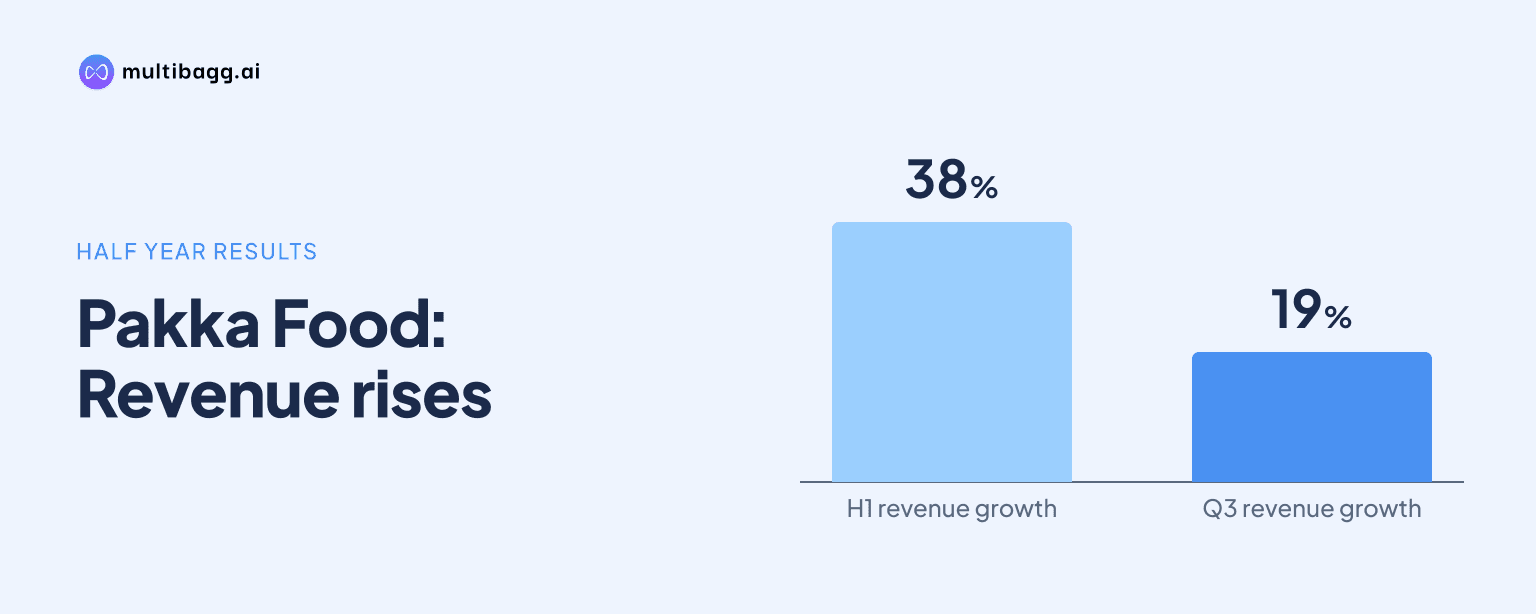
Pakka Limited said its Food Services business became EBITDA-positive for the first time in the half year ended 30 September 2026, as revenue increased 38% and the unit added or began adding 350 tonnes of monthly outsourced capacity. Management also reported its highest-ever monthly Food Services sales in August across business-to-business, consumer and export channels.
Know Pakka inside out
Results, valuation, peers and who's buying, in one view.
Has Pakka Food Services become EBITDA-positive?
Yes. Pakka said Food Services became EBITDA-positive for the first time in the half year ended 30 September 2026, after a period in which the business had reported losses. Shubham Tibrewal, Food Services business head, said revenue rose 38% in the half year and that like-for-like losses had more than halved.
The reported profit before tax, or PBT, comparison was less clear. Management said Food Services PBT dipped slightly from the previous year, but exceptional items affected both the earlier period and the current quarter. Pakka did not disclose the segment’s absolute EBITDA, PBT or normalised PBT, so the call establishes the EBITDA-positive milestone but not its monetary scale.
Food Services also recorded 19% quarter-on-quarter revenue growth in the quarter ended 30 September 2026. Management described August as the business’s highest-ever monthly sales period and said all three channels, business-to-business, business-to-consumer and exports, exceeded their previous records during the half year.
What drove Pakka Food Services sales growth?
Pakka attributed the 38% half-year revenue increase to wider distribution, additional key accounts, marketing investment and 10 new products. The company said the new portfolio was intended to help Food Services serve customers as a one-stop supplier, while sales records were exceeded in B2B, B2C and export channels.
The distribution plan includes expansion into ecommerce and big-box retail. Management also said it had added a significant number of accounts, including new customers and win-backs such as TFS and LBF. The transcript does not disclose sales from those customers, but Pakka presented the account additions as a contributor to B2B channel growth.
For B2C, Pakka said continued marketing spending had built the brand and supported channel performance. It did not provide marketing expenditure, product-wise revenue or channel-level revenue for the 38% growth period. That leaves the relative contribution of ecommerce, retail, key accounts and the 10 product launches undisclosed.
The company had previously cited Chuk revenue of Rs 63.23 crore and volumes above 3,100 tonnes for financial year 2025-26. In the current call, management discussed Food Services without separately reporting Chuk figures for the half year ended 30 September 2026. As a result, the current segment update cannot be directly compared with that earlier full-year Chuk revenue figure.
Got a follow-up? Ask IRIS
How is Pakka adding Food Services capacity without capex?
Pakka said it had added, and was in the process of adding, 350 tonnes of Food Services capacity per month through outsourcing partners. Management described the arrangement as completely asset-light and capex-free, meaning the division can seek to meet higher demand without announcing a corresponding manufacturing investment.
The call does not state that 70% of Food Services capacity is outsourced. It also does not disclose total capacity before or after the 350-tonne monthly addition, the share already operational, or outsourced-partner utilisation. The source therefore supports an outsourced expansion strategy, but not a percentage split between captive and third-party capacity.
This model differs from Pakka’s wider Project Jagriti manufacturing programme. That project includes Paper Machine 4, a recovery boiler, a 15-megawatt power plant and a pulp-mill upgrade; management said the pulp-mill upgrade was complete and the boiler and turbine had started and were under stabilisation as of the 3 November 2026 call.
Pakka is also selling more than 500 tonnes of FlexC Base paper made through outsourcing before Paper Machine 4 starts regular production. Management said that volume represented roughly one-sixth of the paper expected from Paper Machine 4. FlexC Base belongs to the group’s paper operations rather than Food Services, but it shows the company using outsourced production in another product line during a capacity ramp-up.
What does Pakka say about Food Services profitability next?
Pakka’s management said Food Services would grow both its top line and bottom line after reaching EBITDA positivity in the half year ended 30 September 2026. Ved Krishna listed Food Services profitability and growth among the company’s next commitments, indicating management’s focus is on maintaining the initial improvement rather than treating one reporting period as the final outcome.
EBITDA and PBT measure different stages of profitability. EBITDA excludes interest, tax, depreciation and amortisation, while PBT includes expenses and other items before tax. Since Pakka said exceptional items affected PBT in both comparison periods but gave no adjusted PBT figure, a conclusion that Food Services is net profitable would not be supported by the call.
The group reported consolidated revenue of Rs 241 crore and an EBITDA margin of 13.7% for the half year ended 30 September 2026. Those are consolidated figures, not Food Services targets or margins. By comparison, the established Wrap & Carry business reported volume of 10,700 tonnes, up from 7,600 tonnes in the comparable previous-year period, showing the difference in disclosed scale between the two divisions.
Future disclosures will need to show whether Food Services sustains EBITDA positivity as the 350 tonnes of monthly outsourced capacity is brought on stream. Relevant operating measures would include segment revenue, EBITDA, PBT, capacity utilisation and the sales contribution from its 10 added products, none of which were quantified in the 3 November call.
Conclusion
The half-year result suggests that Food Services’ operating model is changing through broader sales routes, account additions, 10 product launches and third-party capacity rather than a disclosed manufacturing build-out. The available evidence supports an EBITDA turnaround, while the absence of segment-level EBITDA and adjusted PBT amounts limits the precision with which its profitability can be assessed.
The next disclosed milestone is the planned expansion of Food Services revenue and profitability while the 350 tonnes of monthly outsourced capacity is added. Elsewhere, management is targeting commercial production from Paper Machine 4 from January 2027 and a larger FlexC Base launch in January, following more than 500 tonnes of market sales before the machine’s start-up.