










Pakka's Reliance order starts at 200 tonnes, potential 800
Key highlights
- Pakka received a roughly 200-tonne Reliance interleaving-paper order worth about Rs 1.6 crore.
- Management said the Reliance opportunity could potentially rise from 200 tonnes to 500 or 800 tonnes.
- Pakka said interleaving-paper users may pay Rs 5 to Rs 10 more per kg than for domestic alternatives.
- Pakka reported overall volumes of 10,700 tonnes versus 7,600 tonnes in the same period last year.
powered by IRIS
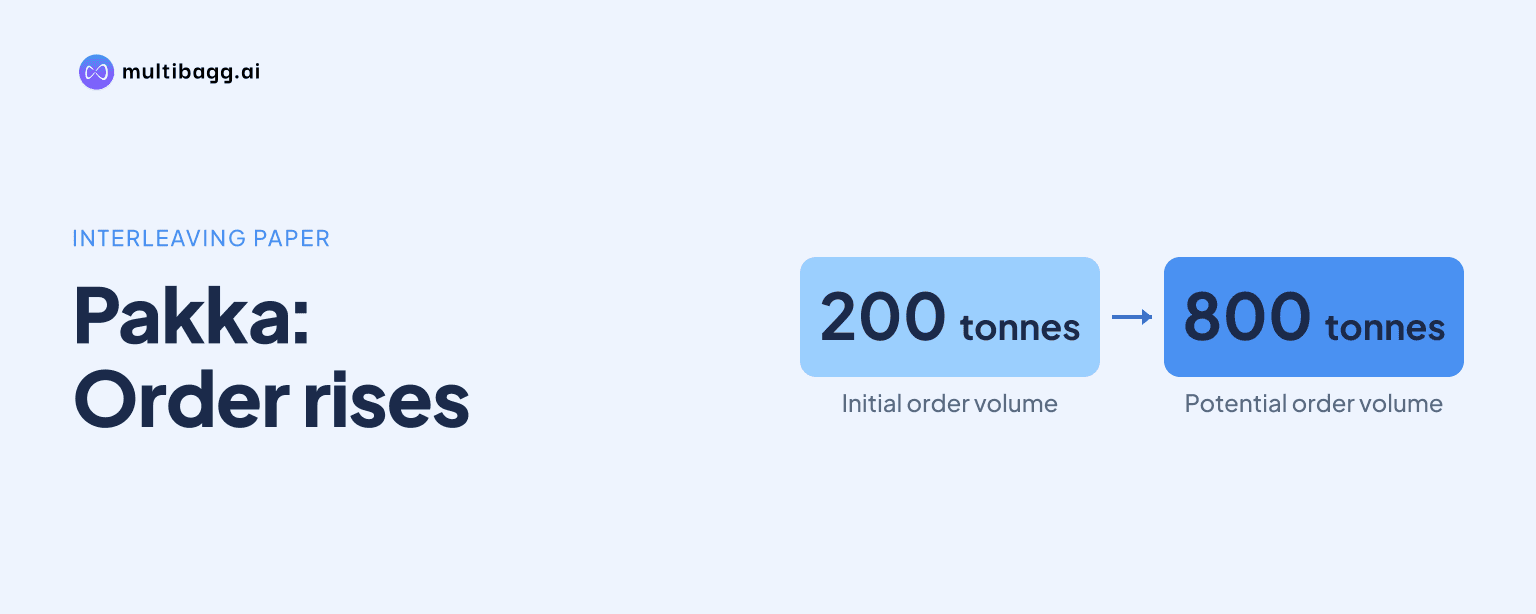
Pakka received a roughly 200-tonne solar-glass interleaving-paper order from Reliance worth about Rs 1.6 crore, and management said the requirement could ultimately reach 500 to 800 tonnes as Reliance builds a large facility. The customer win gives Pakka an identified volume opportunity in a segment where it says buyers accept a Rs 5 to Rs 10-per-kg premium over domestic alternatives.
Know Pakka inside out
Results, valuation, peers and who's buying, in one view.
How large is Pakka's Reliance solar-glass paper order?
Pakka's disclosed Reliance order is around 200 tonnes, with management estimating revenue of about Rs 1.6 crore at a realisation of roughly Rs 80 per kg. Mayank Jindal said the opportunity could increase to 500 tonnes or even 800 tonnes because Reliance is building what management described as a very large solar-glass facility. The 800-tonne figure is a potential future requirement, not a committed order disclosed on the call.
Pakka did not disclose the duration of the 200-tonne order, its delivery schedule, or whether all supply had begun at the time of the call. An analyst specifically asked whether supplies had started or remained at trial stage, but management's response described the order size, expected expansion and pricing rather than confirming that operational detail. That leaves execution and repeat ordering as the next measurable milestones.
What price premium can Pakka charge for interleaving paper?
Pakka said interleaving-paper users were willing to pay Rs 5 to Rs 10 more per kg for its product than for paper from other domestic manufacturers. Management attributed that willingness to product quality, saying it had met interleaving users who were confident about Pakka's paper. The company also said imported products and domestic competitors operate in the segment, so the stated premium is relative to Indian domestic alternatives rather than a claim of exclusive supply.
The Rs 80-per-kg level quoted for the Reliance order implies the 200-tonne contract is worth about Rs 1.6 crore, according to management. Mayank Jindal called this realisation attractive compared with the other products made on the relevant machine, but Pakka did not provide realised prices for those other grades. The transcript therefore supports the stated order value and premium range, but not a quantified margin comparison across products.
How established is Pakka's interleaving-paper business?
Pakka said its glass interleaving products hold almost 50% market share, presenting Reliance as an addition to an already active business rather than an entry based only on trials. Management described interleaving as a new segment that is growing quickly and said Pakka was supplying good volumes to Reliance. It did not disclose the total size of India's glass-interleaving market or Pakka's total tonnes sold in this category.
Pakka reported overall volumes of 10,700 tonnes against 7,600 tonnes in the same period a year earlier, an increase of 3,100 tonnes. That company-wide volume comparison cannot be treated as interleaving-paper growth because Pakka did not split the 10,700 tonnes by product. Still, the disclosed 200-tonne Reliance order equals about 1.9% of the reported 10,700-tonne total, while a potential 800 tonnes would be about 7.5%, using those figures as a simple scale reference.
Got a follow-up? Ask IRIS
What does the Reliance order mean for Pakka's expansion plans?
The Reliance order adds a customer-led demand opportunity while Pakka prepares Project Jagriti, whose main elements include Paper Machine 4, a recovery boiler, a 15 megawatt power plant and a pulp-mill upgrade. Management said the pulp-mill upgrade was complete, the recovery boiler and turbine had started and were under stabilisation, and Paper Machine 4 was ready for trials. It expected the machine to start in December and aimed for commercial production from January.
Pakka separately said it was already selling more than 500 tonnes of FlexC Base in the market before Paper Machine 4 starts. That product is distinct from the disclosed Reliance interleaving order, and the call did not say that the Reliance tonnes would be made on Paper Machine 4. Management said FlexC Base's larger launch would occur in January, while the interleaving order offers a different application in glass handling.
What could determine whether the Reliance opportunity reaches 800 tonnes?
The key determinant is Reliance's facility build-out, since management linked the possible rise from 200 tonnes to 500 or 800 tonnes to the customer's construction of a large solar-glass facility. Pakka's management said its product had an edge over imported and domestic alternatives, but it did not disclose a supply agreement giving it exclusive status. Other suppliers remain relevant because management referred to multiple players and varying quality requirements in interleaving paper.
Pakka's ability to fulfil additional demand will also depend on production and customer acceptance, neither of which was quantified for the possible 500-to-800-tonne requirement. Management's stated market share of almost 50% in glass interleaving indicates existing participation, but it does not establish future share at Reliance. The disclosed revenue of Rs 1.6 crore applies only to the roughly 200 tonnes at around Rs 80 per kg and should not be automatically extended to larger volumes without a disclosed price and product mix.
Conclusion
Pakka's Reliance order is a concrete 200-tonne customer win valued at about Rs 1.6 crore, with management identifying a path to 500 to 800 tonnes as the customer's solar-glass capacity develops. The opportunity stands out because Pakka says its interleaving paper commands a Rs 5 to Rs 10-per-kg premium over domestic manufacturers and already accounts for almost 50% of the glass-interleaving market.
The next points to watch are whether Pakka reports repeat or expanded Reliance orders, confirms delivery progress and maintains the roughly Rs 80-per-kg realisation cited for the initial order. Management is also targeting commercial production from Paper Machine 4 in January and a larger FlexC Base launch that month, making execution of Project Jagriti a separately disclosed near-term event.