










Pakka retains Bengaluru innovation hub after scientist losses
Key highlights
- Pakka will retain its innovation centre in Bengaluru after losing a couple of scientists during the Ayodhya move.
- Pakka plans to move its Bengaluru laboratory to a larger facility on the same campus within two to three months.
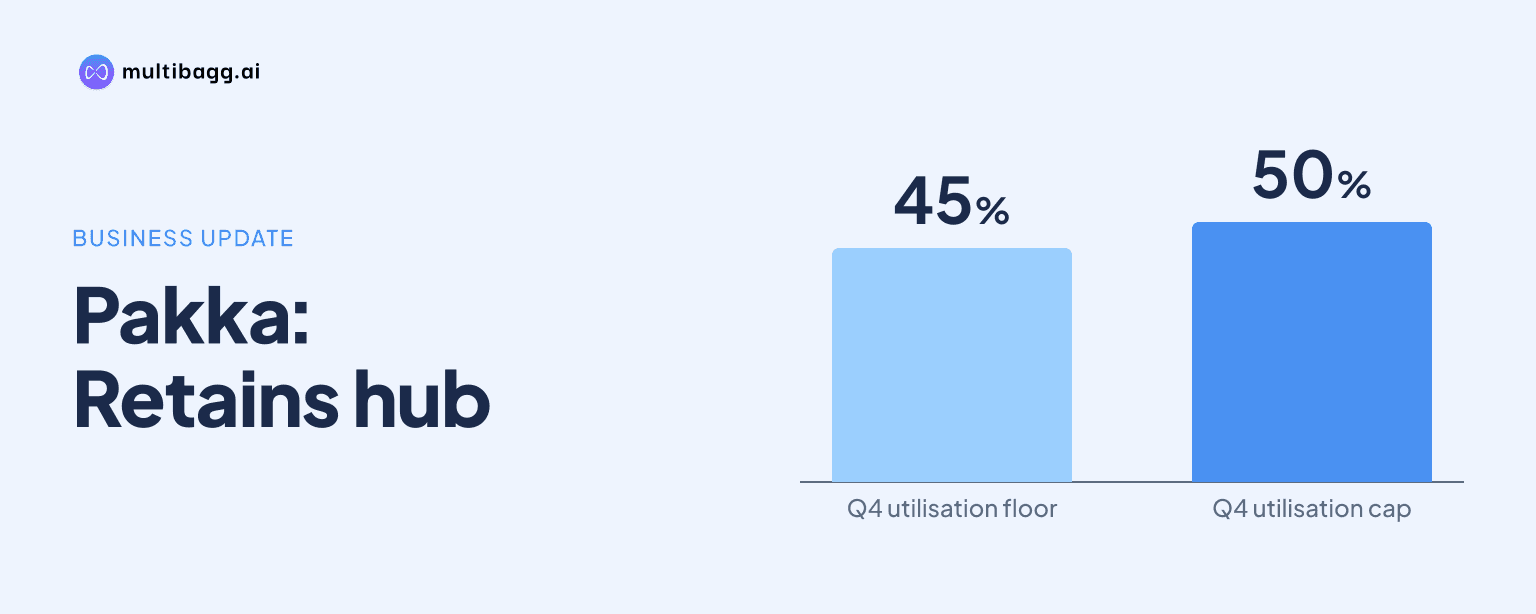
- PM4 is planned to start in January, with average Q4 utilisation targeted at 45% to 50%.
- One delivery-container machinery set is expected to cost about Rs 1 crore and provide capacity of 10 to 12 tonnes a month.
powered by IRIS
Pakka will retain its innovation centre in Bengaluru rather than complete the intended shift to Ayodhya after losing a couple of scientists during the move, and plans to relocate its laboratory to a larger facility on the same campus within two to three months. Management said the decision is intended to support specialist talent for breakthrough work.
Know Pakka inside out
Results, valuation, peers and who's buying, in one view.
Why is Pakka retaining innovation in Bengaluru?
Pakka is retaining innovation in Bengaluru because management concluded that specialist talent is central to breakthrough development. Ved Krishna said the company had gone back and forth on the location decision, but reconsidered it after a couple of scientists left while the team was starting to move to Ayodhya. Pakka then discussed the issue with its team and decided that Bengaluru was the better base for innovation.
The decision reverses Pakka's earlier intention to move out of Bengaluru to Ayodhya altogether. The company had continued advertising Bengaluru positions, including lead scientists and an innovation head for barrier coating, prompting an investor question about its research and development direction. Management confirmed that those posts reflect continued team building in Bengaluru, rather than a remaining operation being wound down.
Pakka also said placing innovation close to production could make its work too focused on cellulose. Ayodhya remains central to production-linked activity, including the planned January start of PM4, the new paper machine. Bengaluru, in contrast, is intended to provide a broader remit beyond paper and bagasse-based product work.
How will Pakka separate innovation from product development?
Pakka will separate breakthrough innovation from product development, which management said had previously been combined in the organisation. Product businesses will take greater ownership of development work, while the Bengaluru team will focus on breakthroughs. Management cited delivery containers as an example of a product that has moved from research towards production preparation.
Pakka has started supplying very small quantities of its delivery-container product to certain customers and expects scale in the next two to three months once machinery is installed. Management said it has finalised the product structure, while technology and commercial terms with suppliers are still being finalised. The work involves two technologies, including coating and gluing equipment intended to make the containers leak-proof.
The split changes the route from research to commercialisation. Pakka said the delivery-container product is ready, but efficient manufacturing requires further work with vendors. One initial machinery set is expected to cost about Rs 1 crore and provide capacity of 10 to 12 tonnes a month, with expansion planned only after the first set is commissioned and works successfully.
What will Pakka's larger Bengaluru laboratory do?
Pakka will move its Bengaluru laboratory to a larger space on the same campus within two to three months. Management said the new facility will support existing innovation work as well as biology and fermentation. Pakka also plans to collaborate with startups it has already been working with, seed further collaborations and incubate some ventures.
Barrier coating is one immediate recruitment area, as indicated by the open innovation-head position. The work is relevant to FlexC, Pakka's flexible-packaging structure, where management said chemistry is still being refined. FlexC's commercial development is being kept at the pilot stage until Pakka has its own FlexC Base paper from PM4, because the paper affects the final structure's properties.
The Bengaluru programme therefore extends beyond Pakka's current paper grades. PM4's initial base-paper product is expected to sell at about Rs 110 per kg, while management said high-end uncoated papers can sell at Rs 170, Rs 180 and Rs 200 per kg, depending on quality and customer confidence. The laboratory is intended to develop coatings, structures and other technology for final applications rather than only optimise the initial base grade.
Got a follow-up? Ask IRIS
How does Bengaluru support Pakka's flexible-packaging plans?
Pakka's Bengaluru innovation work will support its longer-term plan to convert PM4 output into coated FlexC structures. Management said the ultimate intention is for all of PM4's output to go into coating, but it first wants to establish FlexC Base production. PM4 is scheduled to start in January, with management targeting average utilisation of about 45% to 50% in Q4 and around 75% in 2027-28.
Pakka is delaying a commercial FlexC coating launch until its own paper is stable. The company has not ordered an in-house coater and currently uses small continuous laboratory machines, testing in England and pilot machinery usually located in Europe. It will continue using outsourced facilities, including domestic tie-ups for metallised structures, until chemistry is proven at pilot scale.
FlexC Base and FlexC have different roles in Pakka's plan. FlexC Base is the paper substrate currently focused on a grease-resistant grade, with about 500 tonnes being outsourced, while FlexC is the final coated flexible-packaging structure under development. Management said PM4's paper is designed to be non-porous and translucent, and that the structure has been in development for more than three to four years.
What does the Bengaluru decision mean for Pakka's operations?
Pakka is assigning Bengaluru to talent-led innovation while linking Ayodhya more closely to production stabilisation and product development. The split coincides with PM4's January start, delivery-container scale-up over the next two to three months and continued FlexC coating work. Management presented the Bengaluru decision as a response to actual talent losses during the proposed move, rather than as a change in the underlying product strategy.
The production side still has substantial execution requirements. Management said the PM4 project cost is about Rs 750 crore and estimated additional depreciation of about Rs 30 crore to Rs 32 crore in the next financial year after capitalisation, net of a 22% Uttar Pradesh government capital subsidy on eligible plant and machinery. Under Indian Accounting Standards, or Ind AS, capitalisation depends on an asset being capable of operating in the manner management intends.
Pakka's approach also leaves product businesses responsible for commercial delivery. Chuk, its food-services business, is building capacity to 550 tonnes a month by the end of the calendar year, with a planned 30:70 split between in-house production and outsourcing. That structure is intended to leave the Bengaluru team focused on barrier coatings, biology and fermentation collaborations instead of routine capacity expansion.
Conclusion
Pakka's decision keeps a dedicated innovation base in Bengaluru after the Ayodhya move led to the loss of a couple of scientists. The company is separating breakthrough work from product development: the expanded Bengaluru laboratory will recruit scientific talent and pursue barrier coatings, biology and fermentation, while delivery containers and PM4-linked base paper move towards commercial production.
The next points to watch are the laboratory relocation within two to three months and PM4's planned January start. Management is targeting 45% to 50% PM4 utilisation in Q4 and intends to advance broader FlexC development only after its own FlexC Base paper is stable, leaving the timing of coating commercialisation unresolved.