










Pakka plans Rs 1 crore bagasse-container capex for up to 12 tonnes
Key highlights
- Pakka plans approximately Rs 1 crore of initial capex for one bagasse delivery-container equipment set.
- The first coating-and-gluing machine set is designed to produce 10 to 12 tonnes of containers per month.
- Pakka expects delivery-container scale in the next two to three months once machinery is installed.
- Chuk is building capacity to 550 tonnes per month by the end of the calendar year.
powered by IRIS
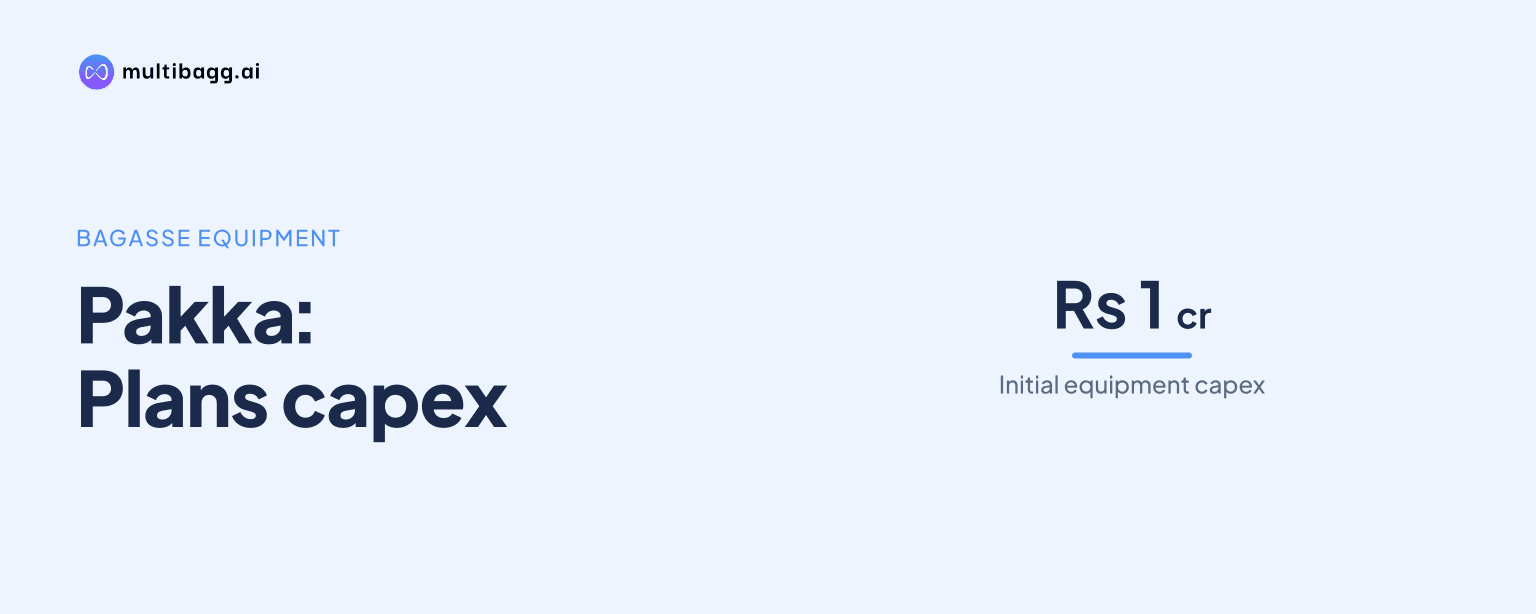
Pakka plans about Rs 1 crore of initial capital expenditure for a bagasse delivery-container machine set capable of producing 10 to 12 tonnes a month. Management said the product has moved from research and development into production preparation after pilot testing, small customer supplies and what it described as a strong market response.
Know Pakka inside out
Results, valuation, peers and who's buying, in one view.
How is Pakka moving bagasse delivery containers into production?
Pakka has completed pilot testing, finalised the bagasse delivery-container product and begun supplying very small quantities to selected customers. Management said the container structure had been established and the company was finalising a plant for commercial production, with larger-scale supplies expected in the next two to three months once machinery is installed.
The project is not yet a broad commercial rollout. Shubham Tibrewal said Pakka had seeded the product in the market and received what management characterised as a strong response, but the immediate work is to establish efficient production. That involves selecting production technology, negotiating commercial terms with suppliers and commissioning the equipment rather than changing the basic container product.
Pakka described delivery solutions as an application gap for compostable products and said it was developing its offering from bagasse. The product development is complete, according to management, while the innovation lies in the commercial manufacturing process. The company said it was exploring two technologies, making the production method rather than container design the remaining execution issue.
What will Pakka's first container equipment set produce?
Pakka is considering approximately Rs 1 crore of capital expenditure for one initial equipment set comprising a coating machine and a gluing machine. Management said the two steps are needed to produce the leak-proof part of the container, and that one set can make 10 to 12 tonnes per month after commissioning.
The 10-to-12-tonne capacity is an initial validation step rather than a disclosed long-term capacity target. Pakka said it would begin with one set because the technologies are novel, then add capacity only after the first commercial-scale machines are commissioned and shown to be successful. This makes operating performance on the first line the condition for further orders.
The proposed equipment has two distinct functions: coating and gluing. Pakka said both are required for leak resistance in delivery containers, but it had not disclosed a final supplier, commissioning date or equipment utilisation target. The Rs 1 crore estimate therefore covers an initial production set whose vendor terms were still being negotiated during the call.
How does the container pilot fit into Pakka's Chuk business?
Pakka is placing delivery containers within Chuk's food-service assortment, which management said is designed by starting with a customer application and identifying a gap. Management said Chuk had sold more than it made for the better part of the year, reversing a position of significant inventory that existed about 12 months earlier.
Chuk is building total capacity to 550 tonnes per month by the end of the calendar year, but Pakka did not specify how much of that figure will be delivery containers. The new line's 10-to-12-tonne monthly capacity is therefore a specialised addition to a wider food-service production plan, not evidence that containers will initially represent a large portion of Chuk output.
Pakka expects Chuk's manufacturing mix to reach 30% in-house and 70% outsourced by the end of the year. Management said outsourcing partners are required to buy pulp from Pakka, after which Chuk buys back the finished products. It cited an approximately 25% gross margin at the product level on an arm's-length, like-for-like basis, while saying pulp sales to outsourcing partners create a separate benefit for the company.
Got a follow-up? Ask IRIS
What must Pakka prove before adding more delivery-container capacity?
Pakka must prove that the first commercial-scale equipment set can produce leak-proof containers efficiently before it expands capacity. Management said pilot testing was complete and the product was final, but it was still negotiating with suppliers over two production technologies and their commercial terms. The unresolved matter is therefore manufacturing execution rather than the feasibility of a pilot container.
Management expects delivery-container scale to emerge in the next two to three months once machinery is in place. However, it also said the next lot of machines would be ordered only after the first set had been run. Pakka disclosed no sales target, selling price, customer order volume, utilisation assumption or profitability forecast for the delivery-container line.
The planned Rs 1 crore investment is small relative to Pakka's wider project spending. Management said capital work-in-progress, or CWIP, included approximately Rs 10 crore to Rs 15 crore for product development, including delivery containers and flexible-packaging research and development. It separately put the total cost of its main project at about Rs 750 crore, placing the container equipment within a broader investment programme.
What does the delivery-container launch mean for Pakka's product strategy?
Pakka's delivery-container initiative adds a bagasse-based offering to Chuk's food-service range while management continues to build capacity through both internal production and outsourcing. The company said the product was created by addressing an application requirement, and the first 10-to-12-tonne machine set is intended to establish the manufacturing route before larger volumes are committed.
The project is separate from Pakka's flexible-packaging development, where management said it was holding commercial rollout of coated FlexC products until its own base paper production stabilises. Delivery containers, by contrast, have already reached market seeding and small supplies. That difference shows that the container product has progressed to commercial production preparation, while FlexC chemistry remains at a pilot stage.
Conclusion
Pakka has advanced its bagasse delivery-container project beyond research and development through pilot testing, small customer supplies and a proposed Rs 1 crore first equipment set. The 10-to-12-tonne monthly line is a controlled production launch, while Chuk's planned 550-tonne monthly capacity and intended 30:70 in-house-to-outsourced mix provide the wider food-service operating context.
The next development to watch is the completion of supplier negotiations and commissioning of the coating and gluing machines. Management expects scale in the next two to three months after machinery is installed, but has made further capacity orders conditional on the first set demonstrating successful commercial production.