










Pritika Auto Industries needs 28,000 tonnes capacity by 2028
Key highlights
- Pritika Auto targets 100,000 tonnes of installed machined-casting capacity by 2028.
- Pritika Auto added 22,000 tonnes of annual capacity during 2024-26, reaching 72,000 tonnes.
- Pritika Auto produced 52,620 tonnes in FY26 against 72,000 tonnes of installed annual capacity.
- Pritika Auto received an order worth Rs 51.5 crore per year from a leading OEM tractor manufacturer during 2024-26.
powered by IRIS
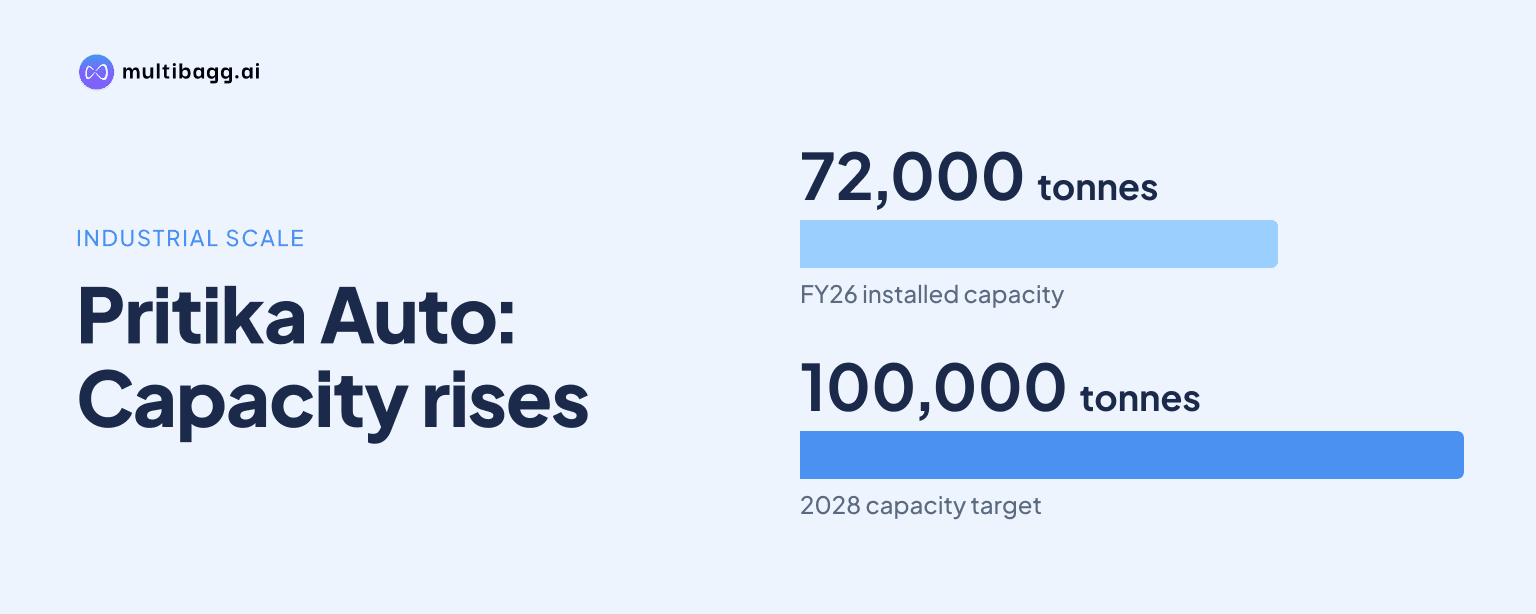
Pritika Auto Industries targets 100,000 tonnes of installed machined-casting capacity by 2028, requiring a further 28,000 tonnes above its 72,000-tonne annual capacity reported for FY26. The current base followed a 22,000-tonne annual expansion during 2024-26, when Pritika Auto also bought land at Village Simbli, Punjab.
Know Pritika Auto Industries inside out
Results, valuation, peers and who's buying, in one view.
What capacity is Pritika Auto targeting by 2028?
Pritika Auto is targeting installed capacity of 100,000 tonnes of machined castings by 2028. Its stated mission specifies that capacity objective, while its vision is to become the first choice among original equipment manufacturers (OEMs) for machined castings and one of India’s largest producers in the category.
The 2028 target is 28,000 tonnes higher than the 72,000 tonnes of installed annual capacity disclosed for FY26. That is an increase of about 38.9% from the FY26 base, calculated from the two capacity figures stated in the presentation.
The presentation does not disclose the capital expenditure, commissioning schedule, funding structure, plant allocation or customer orders specifically attached to the remaining 28,000 tonnes. Pritika Auto does disclose the purchase of land at Village Simbli, Punjab, during 2024-26, but does not say whether the planned addition will be located there.
Where is Pritika Auto’s current capacity located?
Pritika Auto reports five manufacturing facilities in Punjab and Himachal Pradesh with combined installed capacity of 72,000 tonnes per annum. The company describes the footprint as an integrated platform spanning casting, forging and machining, with facilities strategically located in North India.
The capacity split disclosed in the presentation assigns 42,000 tonnes per annum to PAIL, 18,000 tonnes per annum to PECL and 12,000 tonnes per annum to Meeta Casting. The three disclosed unit capacities add to the reported 72,000-tonne total.
Pritika Auto’s product range includes axle housings, wheel housings, hydraulic-lift housings, end covers, plate differential carriers, cylinder blocks and crank cases. The presentation says the company manufactures and sells tractor and other automotive parts, components and engineering goods, rather than identifying a single product line for the planned 2028 capacity.
How does Pritika Auto’s latest expansion compare with earlier additions?
Pritika Auto added 22,000 tonnes per annum during 2024-26, taking installed capacity to 72,000 tonnes per annum. This disclosed addition exceeds the 4,800-tonne increments recorded in 2010, 2012, 2015, 2017 and 2019, as well as the 3,200-tonne expansion recorded in 2018.
The company’s capacity history began with a 3,000-tonne-per-annum foundry at Derabassi, Punjab, in 1997. A 2,400-tonne expansion in 1999 took capacity to 5,400 tonnes, another 2,400 tonnes in 2003 lifted it to 7,800 tonnes, and the first integrated foundry and machine shop at Village Bathri, Himachal Pradesh, took total capacity to 15,600 tonnes in 2007.
By 2010, a 4,800-tonne expansion had taken capacity to 24,000 tonnes, which the company said was fully booked by leading OEMs. The presentation reports 25,200 tonnes in 2012, 30,000 tonnes in 2015 and 34,800 tonnes in 2017; it also says 2017 capacity was 100% booked by leading OEMs.
In 2018, Pritika Auto added 3,200 tonnes and acquired 12,000 tonnes of foundry capacity from Amrit Duraparts. The timeline also records a 4,800-tonne expansion in 2019 but lists total installed capacity for that year as 34,800 tonnes, so the presentation does not provide a fully reconciled annual bridge from 2017 to the 72,000-tonne FY26 level.
Got a follow-up? Ask IRIS
What do FY26 output and recent financial results show?
Pritika Auto produced 52,620 tonnes in FY26 against installed annual capacity of 72,000 tonnes. On those reported figures, FY26 production equalled about 73.1% of nameplate capacity, leaving a numerical difference of 19,380 tonnes between production volume and installed capacity.
That difference does not establish unused sellable capacity because the presentation does not disclose plant-level utilisation, maintenance downtime, product mix or order coverage. It does show that production would need to increase by 47,380 tonnes from the FY26 level to equal the proposed 100,000-tonne installed-capacity target.
FY26 revenue from operations was Rs 482.95 crore and earnings before interest, tax, depreciation and amortisation (EBITDA) were Rs 71.03 crore, up 24.30% year on year. Pritika Auto reported return on capital employed of 11.4% and return on equity of 6.22% in FY26, but does not state expected returns from the future 28,000-tonne addition.
In the first half (H1) of FY27, consolidated net revenue rose 29.04% year on year to Rs 298.16 crore from Rs 231.06 crore in H1 FY26. EBITDA increased 12.93% to Rs 40.72 crore, while the EBITDA margin declined by 194 basis points to 13.66% from 15.60%.
Which customer disclosures relate to Pritika Auto’s expansion path?
Pritika Auto identifies customers including M&M, Swaraj, TAFE, Escorts, SML Isuzu, TMTL, Ashok Leyland, New Holland Tractors India Ltd and Brakes India Ltd. It reports relationships of more than 50 years with Escorts, 27 years with TAFE and 19 years with M&M, while not disclosing customer-level revenue concentration or capacity allocation.
During 2024-26, Pritika Auto received an order worth Rs 51.5 crore per year from a leading OEM tractor manufacturer. The presentation does not identify the customer, product, contract term or the amount of capacity expected to serve that order.
The company’s timeline also records a repeat axle-housing order worth Rs 10 crore per year in 2020. Pritika Auto says it won its first export order in 2020 and subsequently received a repeat export order, but it does not disclose an export target or export-linked capacity plan for 2028.
Conclusion
Pritika Auto’s stated 2028 objective would lift installed machined-casting capacity from 72,000 tonnes in FY26 to 100,000 tonnes, following a 22,000-tonne addition during 2024-26. FY26 production of 52,620 tonnes, a five-facility footprint and a Rs 51.5 crore-per-year OEM order provide context for the expansion path, while H1 FY27 revenue increased 29.04% from a year earlier.
The next disclosures to watch are the location, cost, funding and commissioning timing of the remaining 28,000 tonnes. Pritika Auto has set the 2028 capacity target and disclosed land acquisition at Village Simbli, Punjab, but has not stated interim capacity milestones or confirmed whether that site will host the planned expansion.