










Pritika Auto Q2 margin fell to 13.85% despite 32% sales rise
Key highlights
- Pritika Auto’s Q2 FY27 revenue rose 31.55% to Rs 153.19 crore.
- Pritika Auto’s Q2 FY27 EBITDA margin fell to 13.85% from 15.99% a year earlier.
- Pritika Auto’s Q2 FY27 production increased about 22% to 15,665 metric tons.
- Pritika Auto said raw-material price changes are normally passed through on a quarter-on-quarter basis.
powered by IRIS
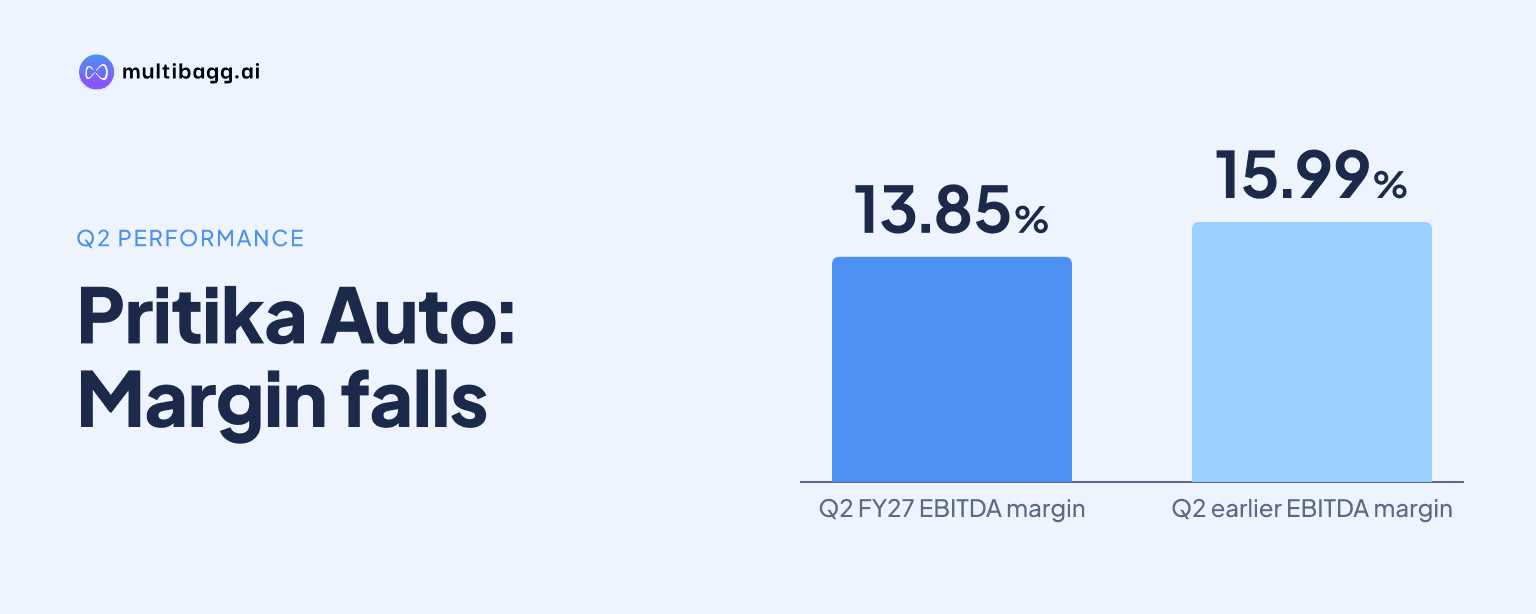
Pritika Auto Industries Limited reported Q2 FY27 revenue growth of 31.55% to Rs 153.19 crore, but its EBITDA margin fell to 13.85% from 15.99% a year earlier because scrap and pig-iron costs increased before the company’s quarterly customer pricing pass-through could take effect. EBITDA rose 13.97% to Rs 21.21 crore.
Know Pritika Auto Industries inside out
Results, valuation, peers and who's buying, in one view.
Why did Pritika Auto’s EBITDA margin decline in Q2 FY27?
Pritika Auto’s Q2 FY27 margin declined chiefly because raw-material costs rose sharply during the quarter, according to management. Scrap and pig iron are its major raw materials, and management said price volatility in these inputs reduced the pace of earnings before interest, tax, depreciation and amortisation, or EBITDA, growth relative to revenue growth. Revenue increased by Rs 36.74 crore year on year, while EBITDA increased by Rs 2.60 crore.
The effect was a 214-basis-point year-on-year decline in EBITDA margin, where 100 basis points equal one percentage point. Margin was 13.85% in Q2 FY27 versus 15.99% in Q2 FY26, even as production rose 22% to 15,665 metric tons from 12,881 metric tons. Management also cited an evolving product mix when discussing the quarter’s profitability.
Pritika Auto’s profit after tax still rose 12.41% to Rs 7.43 crore in Q2 FY27 from Rs 6.61 crore a year earlier, while profit before tax rose to Rs 9.55 crore from Rs 8.62 crore. Basic earnings per share were Rs 0.39. The comparison shows that sales and production expansion supported absolute profit growth, but did not prevent a lower margin rate as raw-material costs moved faster than selling-price recovery.
How quickly can Pritika Auto recover higher material costs?
Pritika Auto said its raw-material price pass-through operates on a quarter-on-quarter basis, meaning a cost increase in one quarter is normally passed to customers in the next quarter. Management therefore told an analyst that it expected a better EBITDA margin in the following quarter, subject to the stated mechanism taking effect. This is management’s expectation, not a formal numerical margin forecast.
The sequential trend already showed a modest recovery: EBITDA margin improved by 40 basis points to 13.85% in Q2 FY27 from 13.45% in Q1 FY27. That improvement did not offset the year-on-year fall from 15.99%, but it indicates that the Q2 margin was higher than the first quarter of the financial year despite continuing input-cost pressure.
Management did not provide a Q3 FY27 revenue or EBITDA guidance figure. It said Q3 is usually lower than Q2 for the tractor industry because planned maintenance occurs in December and production falls after Diwali across tractors, commercial vehicles, passenger vehicles and two-wheelers. Management added that October retail sales appeared to be as good as October of the prior year, while saying the market outcome remained to be seen.
Got a follow-up? Ask IRIS
What does Pritika Auto’s first-half performance show?
Pritika Auto’s H1 FY27 results show the same pattern as Q2: revenue grew faster than EBITDA and margins were lower than a year earlier. Consolidated revenue from operations rose 29.04% to Rs 298.16 crore from Rs 231.06 crore, while EBITDA rose 12.93% to Rs 40.72 crore from Rs 36.05 crore. The resulting H1 EBITDA margin was 13.66%, compared with 15.60% in H1 FY26.
Production volume increased 19% to 30,000 metric tons in H1 FY27 from 25,267 metric tons in H1 FY26. Management attributed volume growth to demand from existing original equipment manufacturer, or OEM, customers, execution of ongoing programmes and ramp-up of manufacturing operations. Its customers include Mahindra & Mahindra, Mahindra Swaraj, TAFE, Escorts Kubota and CNH Industrial.
H1 profit after tax rose 14.52% to Rs 14.55 crore from Rs 12.70 crore, while profit before tax increased to Rs 17.80 crore from Rs 16.46 crore. Basic earnings per share for the half year were Rs 0.77. Thus, profitability in rupee terms increased in the six months ended September 30, 2026, but the 194-basis-point EBITDA-margin decline showed the material-cost and mix impact persisted across both quarters.
What is Pritika Auto doing to support margins and growth?
Pritika Auto is pursuing automation, capacity addition and a higher share of larger or critical castings to support manufacturing efficiency and product value addition. Management said it is procuring machines for fettling automation, a foundry bottleneck, and plans robotics and gantry systems in high-volume machining applications to reduce manpower costs. These measures are initiatives underway, rather than quantified savings commitments.
The company said its green-sand facilities were operating at about 90% utilisation, while Lost Foam Casting, or LFC, was at about 50%. Management stated that LFC can make critical and large castings at lower cost than comparable green-sand production with lower capital expenditure. It targets an EBITDA margin of roughly 14% to 15%; management added that margin should increase slightly if LFC is streamlined and utilisation rises above 50% to 60%.
Capacity expansion is also planned alongside these efficiency projects. Pritika Auto said an immediate addition of 7,800 metric tons would lift installed capacity to 80,000 metric tons by the end of the month, followed by a planned further 24,000 metric tons by March 2028. The company’s stated target is 1 lakh metric tons of installed capacity by the end of 2028, with the later expansion intended as a greenfield plant at a new location.
Conclusion
Pritika Auto delivered materially higher Q2 FY27 revenue and production, but its 13.85% EBITDA margin confirmed that scrap and pig-iron inflation temporarily outweighed the operating benefit of 22% volume growth. The quarterly pass-through structure is central to interpreting the result: management said costs are normally recovered in the following quarter, while the sequential margin increase from 13.45% provides some evidence of recovery already beginning.
The next items to watch are whether the quarterly material-cost pass-through improves Q3 margin, and whether seasonal tractor demand affects Q3 sales after Diwali. Management’s disclosed plans also put focus on the 7,800-metric-ton capacity addition, LFC utilisation above 50% to 60%, and its longer-term target of 1 lakh metric tons of capacity by the end of 2028.