










Inflame targets May 2027 BLDC output to cut delays
Key highlights
- Inflame targets BLDC motor production from May 2027 and PCB lines from October-December 2027.
- Imported parts represent approximately 38%-39% of Inflame's BLDC material, according to management.
- Inflame reported three container delays of 10 to 15 days in the three to four months before November 17, 2026.
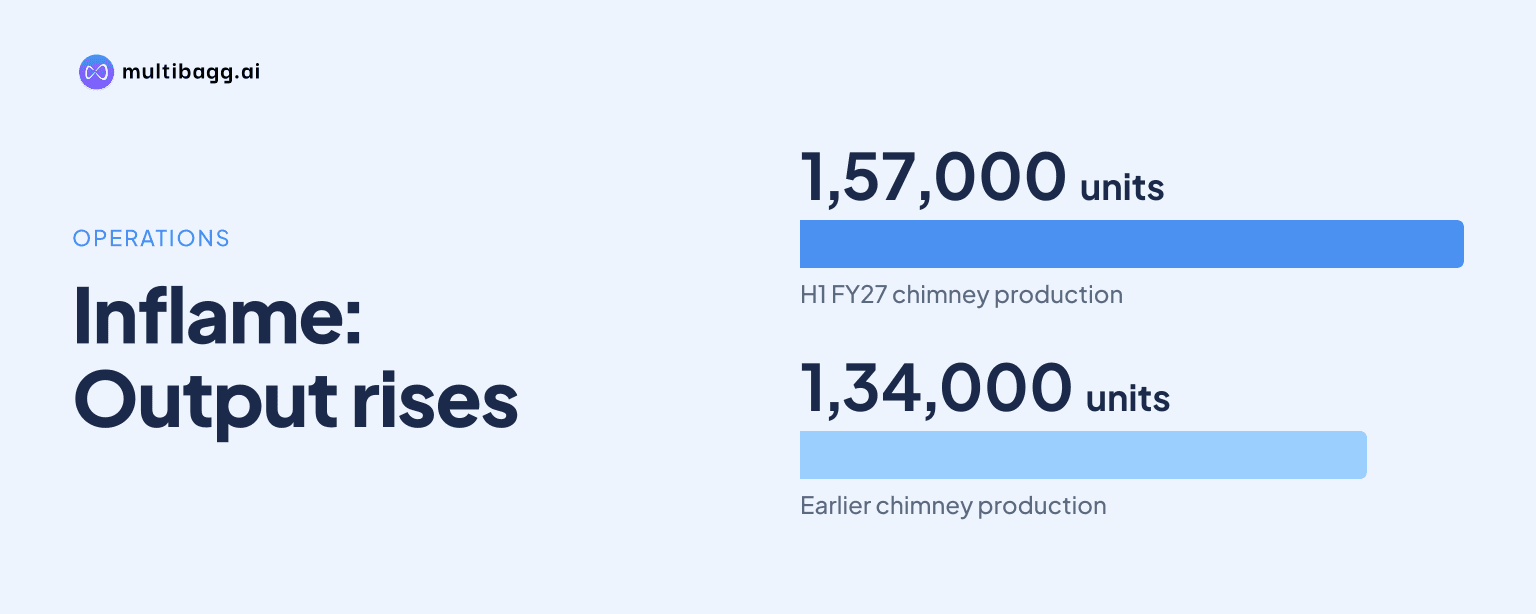
- H1 FY27 chimney production rose to 1,57,000 units from about 1,34,000 units a year earlier.
powered by IRIS
Inflame Appliances Limited plans to start brushless direct current, or BLDC, motor production in May 2027 after imported parts representing roughly 38%-39% of BLDC material faced three shipment delays of 10 to 15 days in the preceding three to four months. The company is also targeting printed circuit board, or PCB, lines in October-December 2027.
Know Inflame Appliances inside out
Results, valuation, peers and who's buying, in one view.
Why is Inflame making BLDC motors and PCBs in India?
Inflame is localising critical chimney components to reduce dependence on imports and prevent production interruptions caused by delayed containers. Management said on November 17, 2026 that China-related supply constraints had forced the company to hold substantial stocks of motors, switches and other parts across several chimney configurations, including 100-watt and 130-watt BLDC motor variants.
The operational problem was visible in the three to four months before the H1 FY27 call. Management said containers were delayed three times by 10 to 15 days, disrupting output of particular models when a required component was unavailable. The company must then alter production schedules rather than make the model ordered, a constraint it expects local supply to reduce after the planned May 2027 motor launch.
Management attributed part of the pressure on Chinese supply chains to manufacturing capacity being used for artificial-intelligence development. That was management's explanation for its decision, taken about a year earlier, to establish domestic production of critical electronics rather than a separately verified industry-wide conclusion. The stated objective is supply continuity, product development and lower inventory exposure, not a disclosed target for component cost savings.
Inflame is pursuing the project through a joint venture with two other individuals for BLDC motors, PCBs and other electronic components. Management described Inflame as a major partner and said the structure is intended to give it control over quality and pricing. It also said the venture partners must earn their own returns, which is why management did not present localisation as a simple, immediate margin expansion.
When will Inflame's motor, PCB and glass facilities start?
Inflame targets BLDC motor production in May 2027, PCB-line output in October-December 2027 and production from a new glass plant in April-May 2028. These dates are management targets rather than completed commissioning events. The proposed factory is around 25 kilometres from the parent factory in Panchkula, linking the component site to the existing chimney manufacturing base.
The company said machines had already been identified, while orders for motor-assembly equipment were expected to be concluded by the end of November 2026. Management did not disclose the planned annual output of the motor or PCB lines, nor did it provide a separate capital-expenditure amount for the joint venture. It previously cited about Rs 10 crore of capital expenditure for broader capacity enhancement when discussing increased borrowings.
The glass expansion is planned at the same site as the motor and PCB facilities, on about 40,000 square feet. Management described the project as an automated dark-factory concept, with automated testing online. Its timetable is later than the electronics lines, meaning local motor supply is expected to arrive roughly a year before the new glass facility is targeted to begin production.
Got a follow-up? Ask IRIS
How much inventory exposure could local supply remove?
Inflame said imported content accounts for approximately 38%-39% of material used in BLDC products, making shipping delays a working-capital and production issue. Management said this inventory is separate from materials shown in stock because goods in transit must also be considered. The company did not give a target for inventory days or state how much of its total inventory would fall after local production begins.
Each imported container has a dollar value of about Rs 1.70 crore to Rs 2.20 crore before duties, according to management. Duties add another 35%-40% to that value, and the company said two containers are generally at sea at a time. These figures explain why management identified just-in-time supply as the main benefit of domestic motors and PCBs rather than specifying a direct purchasing-cost reduction.
Localisation will not remove every inventory requirement. Inflame said it must also hold steel because it uses GPSP 120 GSM, a particular steel grade purchased directly from JSW. If that material is not rolled or delivered, management said the factory cannot stop operating. The project therefore addresses imported electronic-component exposure, while steel procurement remains a separate supply requirement.
Management expects faster local availability to support development and reduce shortages across product variants. In September 2026, Inflame produced 40,000 chimneys from its two plants, above its earlier record of 32,000 units. It said order visibility for December 2026 through March 2027 appeared similar to September and October, but did not quantify orders or link those near-term volumes to components that will only begin production from May 2027.
What could the plan mean for output and margins?
Inflame expects the project to support steadier production and only a slight direct improvement in margins, according to management. For H1 FY27, total income rose about 21% year on year to Rs 92.30 crore, while earnings before interest, tax, depreciation and amortisation, or EBITDA, margin increased to 12.3% from 11.8% in H1 FY26. Management said depreciation, maintenance and the joint venture's economics must be considered alongside any manufacturing benefit.
The company linked component availability more directly to output than to a numerical profitability target. H1 FY27 chimney production reached 1,57,000 units, compared with about 1,34,000 units a year earlier. Chimney revenue accounted for about 89%-90% of sales, down from about 94% in H1 FY26, indicating that other categories had begun contributing a larger share before the motor and PCB plans are due to start.
Glass processing remains another production variable. Existing bent-glass capacity increased from about 800-900 pieces a day to 1,700-1,800 pieces a day. Management said range-hood glass can face rejection rates of 30%-35% because scratches and other visible defects cannot be used, but new facilities installed in recent months could lift production by 5%-7% from the same glass capacity.
Inflame said it is targeting chimney output of 45,000 to 50,000 units by the end of FY27, following the shift to new premises. Management said 40,000 units had already been achieved once and could become a regular production level across both plants after relocation. That FY27 target precedes the May 2027 motor deadline, while the April-May 2028 glass plant is intended to support a further increase in chimney production.
Conclusion
Inflame's backward-integration plan is primarily a response to supply disruption and inventory tied to imported BLDC inputs, which management puts at roughly 38%-39% of BLDC material. The programme combines a joint venture for motors and PCBs with a later automated glass facility, while H1 FY27 showed chimney output rising to 1,57,000 units and EBITDA margin increasing by 0.5 percentage points to 12.3%.
The next disclosed milestones are the expected conclusion of motor-assembly machine orders by the end of November 2026, the May 2027 BLDC production target and the October-December 2027 PCB-line target. Management's separate near-term test is whether it can make 45,000 to 50,000 chimneys by the end of FY27, before the planned April-May 2028 start of the 40,000-square-foot glass plant.