










Accord plans Rs 35-40 crore 220 kV plant with 15,000 MVA
Key highlights
- Accord plans Rs 35 crore to Rs 40 crore of capital expenditure for its Bhiwadi Tijara EHV plant.
- The proposed facility will have 15,000 MVA of annual transformer manufacturing capacity up to 220 kV.
- Accord reported an order book of about Rs 173 crore as of September 30, 2026.
- Management expects total plant commissioning to take about six months.
powered by IRIS
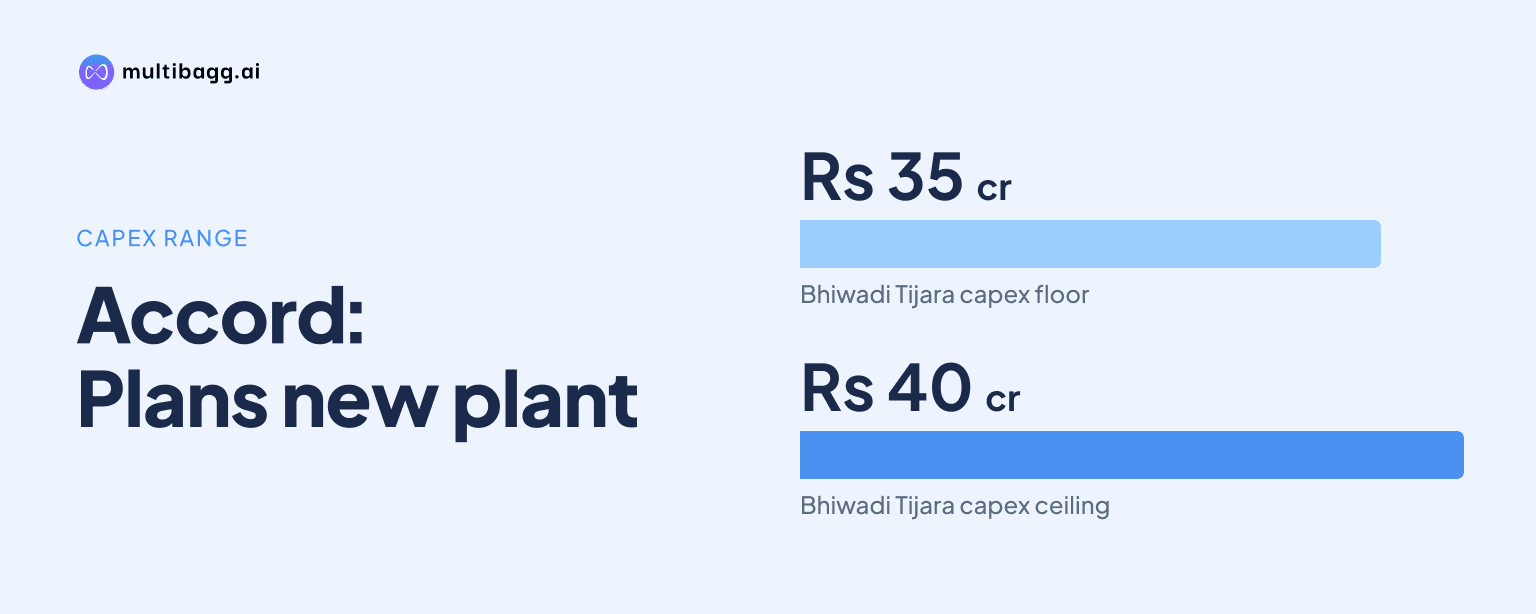
Accord Transformer & Switchgear Limited plans to spend Rs 35 crore to Rs 40 crore on an extra-high-voltage, or EHV, transformer plant at Bhiwadi Tijara with 15,000 megavolt-amperes, or MVA, of annual capacity and capability up to 220 kilovolts, or kV. Accord said on November 19, 2026 that construction had started and commissioning should take about six months.
Know Accord Transformer & Switchgear inside out
Results, valuation, peers and who's buying, in one view.
What will Accord’s EHV plant manufacture?
Accord’s proposed EHV plant will manufacture transformers up to the 220 kV class, compared with its current participation in receiving-station applications of up to about 20 megawatts. Management said this capability would enable Accord to serve power-generation, receiving-substation and distribution stages of the electricity network rather than only selected parts of it.
Accord acquired 20,300 square metres, equivalent to 2.25 lakh square feet, at Bhiwadi Tijara, Rajasthan for manufacturing, warehousing and testing. The company held a Bhoomi Pujan for the facility on the Delhi-Alwar Highway on October 30, 2026, and said the proposed plant would have annual transformer manufacturing capacity of 15,000 MVA.
How will Accord fund the Rs 35-40 crore plant?
Accord expects the EHV plant’s construction and machinery to cost Rs 35 crore to Rs 40 crore. Management said about Rs 20 crore would come from internal accruals and initial public offering proceeds, while the balance would be funded through debt.
The company had reserved Rs 13 crore of its March initial public offering proceeds for plant and machinery and Rs 7 crore for construction, according to management. Management also said interest and depreciation could initially affect profitability, although it expects the higher-capacity transformer mix to lift earnings before interest, tax, depreciation and amortisation, or EBITDA, after production starts; it did not disclose a revenue, utilisation or margin target for the plant.
Why is the 220 kV segment important to Accord?
The 220 kV segment is important because management said customers that already buy lower-rating transformers from Accord want supply continuity for 220 kV equipment as well. Management named JSW, Birla Group, ReNew Power, Inox Wind, Torrent Power and Adani Group as users of 220 kV and 400 kV transformers, while noting that Accord does not currently manufacture or hold approvals for the 220 kV class.
Management said a single 220 kV transformer can be valued from Rs 6 crore or Rs 7 crore to Rs 70 crore, making the potential unit value higher than the company’s existing range. It also said competition in the segment is limited to relatively few manufacturers and that EHV revenue could exceed current transformer revenue in capacity and value terms, but it did not quantify that prospective contribution.
Accord said the facility could also let it participate in government tenders requiring the relevant manufacturing infrastructure and approvals. Management said Accord is already approved by Power Grid up to 33 kV and described a facility visit and an approval process of about 30 days for an upgrade, though no 220 kV approval has yet been granted.
Got a follow-up? Ask IRIS
What order pipeline and product progress support the expansion?
Accord reported an order book of about Rs 173 crore as of September 30, 2026, after receiving about Rs 77 crore of orders in H1 FY27 across solar, wind and other transformer segments. Management also cited about Rs 200 crore of orders under discussion that it aims to close during FY27, but those discussions are not confirmed orders.
The company’s H1 FY27 revenue from operations rose 90.90% year on year to Rs 52.68 crore, while EBITDA increased 170% to Rs 6.21 crore from Rs 2.31 crore in H1 FY26. EBITDA margin increased by 345 basis points to 11.72%, which management attributed to largely fixed operating costs being absorbed across higher revenue rather than to a change in plant capacity.
A 17.6 MVA type test completed at the Central Power Research Institute, or CPRI, is another route to larger renewable-energy applications. Management said it submitted the report to Adani for review and expects it to support entry into solar projects, where it said transformers rated 10 MVA to 20 MVA are commonly used; Accord currently supplies Adani’s wind segment.
When could Accord start EHV production?
Accord has not disclosed a fixed commercial-production date, but management said total commissioning should take about six months from the start of construction. The pre-engineered building order had been placed about one month before the November 19 call, and the supplier was expected to begin site deliveries in December.
Management said existing customers had been told that Accord intends to enter the 220 kV class in the next financial year and had given a positive response. It expects customers to place initial trial orders after the plant is ready, followed by bulk orders after successful installation, but disclosed neither trial-order quantities nor binding EHV commitments.
Accord said transformer delivery after an order normally takes six to eight weeks, depending on quantity, and it expects the current booked transformers to be delivered by the end of March. Its near-term operational plan includes adding an operational head or chief executive officer in the month following the call to oversee two existing factories and the planned larger facility.
Conclusion
Accord’s proposed Rs 35 crore to Rs 40 crore EHV plant would add planned annual capacity of 15,000 MVA and extend its transformer range to 220 kV. The project is intended to give Accord access to higher-value transformer requirements, while its disclosed funding structure combines about Rs 20 crore of internal accruals and initial public offering proceeds with debt for the remaining cost.
The next disclosed markers are building deliveries from December, the roughly six-month commissioning process and progress toward 220 kV customer qualification and approvals. Investors can also track execution of the Rs 173 crore order book reported on September 30, 2026 and whether management’s Rs 200 crore of discussed orders convert into confirmed business.