










Inflame targets 20-25% non-chimney sales next financial year
Key highlights
- Inflame targets 20-25% of sales from non-chimney appliances next financial year, versus about 10% currently.
- Inflame dispatched its first full container of 600 hobs about 15 days before the call.
- Inflame has developed five or six wine-chiller models ranging from 60 litres to 415 litres.
- Inflame targets 45,000 to 50,000 chimney units a month by the end of the current financial year after producing 40,000 in September.
powered by IRIS
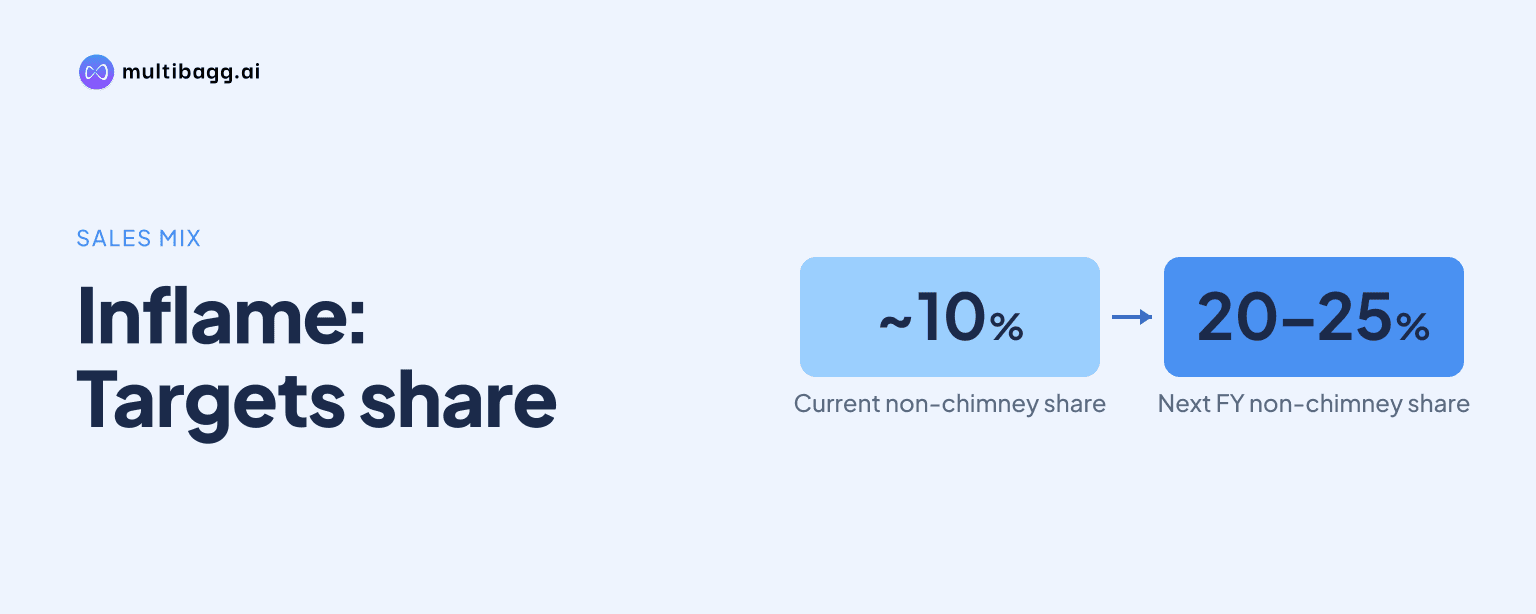
Inflame Appliances Limited expects non-chimney appliances to contribute 20-25% of sales in the next financial year, compared with about 10% currently, as hob shipments, cooling products and built-in appliances expand. Management said its first full container of 600 hobs had been dispatched and new products sell to buyers at Rs 15,000 to Rs 45,000.
Know Inflame Appliances inside out
Results, valuation, peers and who's buying, in one view.
How will Inflame reduce its reliance on chimney sales?
Inflame plans to reduce chimneys’ share of sales to 75-80% next financial year from roughly 90% currently, with other categories rising to 20-25%. Management identified hobs, built-in refrigerators, wine chillers, ovens, dishwashers and built-in microwaves as the products intended to change the mix.
Management subsequently targets chimneys at 60-65% of sales and other categories at 30-35%. The diversification plan does not replace chimney expansion: Inflame produced 40,000 chimneys from its two plants in September, above its previous 32,000-unit record, and is targeting 45,000 to 50,000 monthly units by the end of the current financial year.
Inflame’s mix target is based partly on the higher value of the added categories, for which management cited buyer prices of Rs 15,000 to Rs 45,000. By comparison, management placed the average selling price of a hob to manufacturers at Rs 7,000 to Rs 8,000, depending on the model.
Which new product lines are scaling at Inflame?
Hobs are the earliest new category to show shipments, with Inflame dispatching its first full container of 600 units about 15 days before the call. Management said the shipment went to a customer in Cochin after hobs came under the Bureau of Indian Standards, or BIS, framework a few months earlier and customer inventories began to run down.
Inflame said KAFF was already buying hobs and IFB had also started buying, while a customer in Goa had begun purchases. Management expects all product lines to be ready by the end of the current financial year, but declined to disclose separate hob capacity or utilisation at its Panchkula and Hyderabad plants.
Cooling appliances are another part of the plan. Inflame has developed five or six wine-chiller models ranging from 60 litres to 415 litres, has begun supplying built-in ovens, and holds an exclusivity arrangement with KAFF for built-in refrigerators and wine chillers until September-October next year.
Dishwashers and microwaves remain at earlier stages. Management said the first dishwasher consignment was in transit, while built-in microwave samples had been submitted to BIS and approval was expected in about one month at the time of the call; it said imports could not reach port without that certification.
Why will Inflame continue sourcing new appliances from China?
Inflame expects to source and assemble much of its non-chimney portfolio because important hob components, including valves and burners, are made in China rather than India. Management said the company can make hob glass and bodies locally, but remaining components must be imported.
Management estimated India’s hob market at 500,000 to 600,000 units annually, against a chimney market of about 2.5 million units. It said a 15,000-unit monthly hob volume at an average selling price of Rs 7,500 would equate to about Rs 100 crore of annual business, but that the current market is insufficient for large domestic component investments.
The investment risk arises from the number and changing design of burners. Management said manufacturers may need 10 to 12 design sets, with tooling for individual burner sets costing Rs 50 lakh to Rs 80 lakh, while wider domestic burner manufacturing could require Rs 8 crore to Rs 10 crore.
Inflame will use a specification-led model for dishwashers and microwaves rather than design them internally. Management said buyers specify required functions and accessories, after which Inflame works with Chinese supply partners; it has selected 18 to 20 products across models that customers have accepted.
Got a follow-up? Ask IRIS
What do sourcing and capacity plans mean for execution?
Inflame said assembly-led products have a different economics from its chimney operations, which include sheet-metal work, powder coating and glass processing. Management estimated that assembly can earn a 3-4% margin, while its chimney model also includes design and component value but carries machinery, maintenance, power and space costs.
The company is localising selected chimney inputs through ventures involving motors and printed circuit boards, or PCBs. Management said the objective is quality and pricing control, faster development and lower inventory risk, rather than a specified immediate margin increase; 38-39% of material in brushless direct-current, or BLDC, products is currently imported.
Import dependence has affected both inventory and production. Management said each container holds goods worth about Rs 1.70 crore to Rs 2.20 crore before duty, with duty adding 35-40%, and reported three container delays of 10 to 15 days during the preceding three to four months.
Management estimated that these delays prevented production of at least 10,000 chimneys over the prior three to four months. It also said it has about Rs 10 crore of capacity expenditure planned, funded with bank term loans, and is targeting 30-35% growth in the current financial year.
What milestones will determine Inflame’s new sales mix?
Inflame’s ability to meet the 20-25% mix target depends on certification, first deliveries and customer approvals. The expected BIS certification for built-in microwaves, the dishwasher consignment in transit and recurring hob orders will determine how quickly the categories move beyond samples and initial shipments.
The end of KAFF exclusivity is a separate timing point for cooling products. Management said it would start sampling built-in refrigerators and wine chillers with other prospective buyers in January, as endurance tests, laboratory tests, specification changes and resampling typically take five to six months.
That timetable is intended to support delivery in September-October, when management expects the KAFF exclusivity period to end. Inflame said it already has demand from other buyers, but disclosed neither prospective order volumes nor revenue expected from the two cooling categories.
Chimney production remains material to the transition because the company plans to make 40,000 units regularly after shifting to its new premises. Management said order bookings for December through March appeared comparable with September and October, although it did not provide revenue guidance by appliance category.
Conclusion
Inflame is pursuing diversification while retaining chimneys as its main business. Management’s plan is to move non-chimney products from about 10% of sales to 20-25% next financial year through hobs, cooling appliances and built-in kitchen products, while raising chimney production from the September record of 40,000 units toward 45,000 to 50,000 monthly units.
The next items to watch are the expected BIS decision for built-in microwaves, delivery of the dishwasher consignment, hob order conversion and January sampling of cooling products for additional buyers. Management also expects the KAFF exclusivity for built-in refrigerators and wine chillers to end in September-October next year, which would allow wider customer supply if approvals are completed.