










Pritika Auto develops 530-kg casting once sourced from China
Key highlights
- Pritika Auto said it developed a 530-kg SG iron casting in FY27 that had previously been imported only from China.
- Pritika Auto said Lost Foam Casting was operating at about 50% utilisation, versus about 90% for green-sand capacity.
- Q2 FY27 production volume increased 22% to 15,665 metric tons from 12,881 metric tons a year earlier.
- Pritika Auto targets 100,000 metric tons of installed capacity by the end of calendar 2028.
powered by IRIS
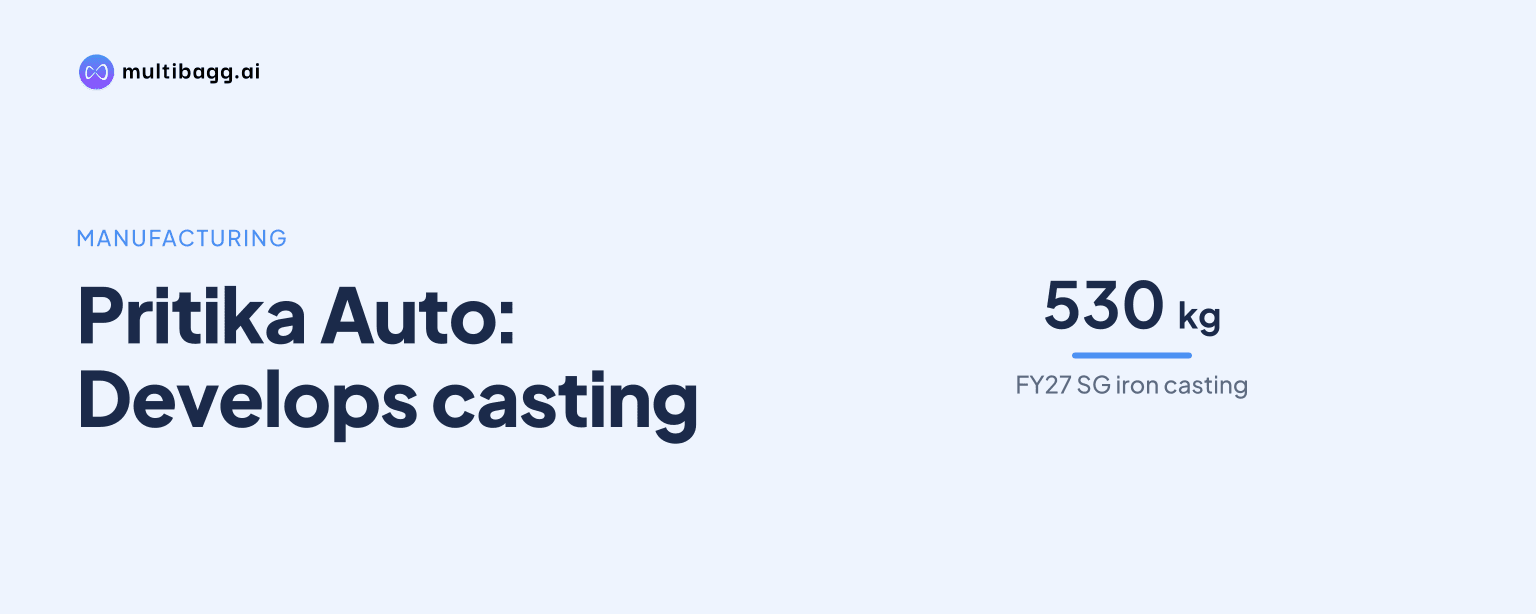
In financial year 2027 (FY27), Pritika Auto Industries Limited said it developed a 530-kilogram spheroidal graphite (SG) iron casting previously sourced only from China. Management said Lost Foam Casting (LFC), introduced about three years earlier, enabled the large critical component and has generated inquiries for similar products.
Know Pritika Auto Industries inside out
Results, valuation, peers and who's buying, in one view.
How did Pritika Auto develop the 530-kg casting?
Pritika Auto said it developed the 530-kg SG iron casting during FY27 after adding LFC about three years ago. Management told investors that China had been the sole manufacturer of this particular component before its development, and described Pritika Auto as the first company in India to develop the casting.
The company did not disclose the customer, annual volume, selling price, order value or commercial-production schedule for the 530-kg component. The transcript therefore establishes a product-development milestone and subsequent customer inquiries, but does not establish revenue, a supply contract or market share from this casting as of the quarter ended September 30, 2026.
Management linked the development to a change in Pritika Auto’s product range. Pritika Auto had historically focused on small and medium tractor castings, but said it is diversifying into large castings as well as construction and material-handling equipment. It already supplies ACE and recently added KION India, while discussing additional customers for those applications.
What advantage does Lost Foam Casting give Pritika Auto?
Pritika Auto said LFC can produce large and critical castings at lower capital expenditure than conventional green-sand moulding, while delivering the same quality at a lower cost. Management said the technology is suitable for large, critical parts rather than normal or low-value products, limiting its use to a narrower part of the overall casting portfolio.
Management contrasted LFC with green-sand moulding, which it said is the prevalent Indian process for large castings. It said the technology was developed in Europe in the late 1970s for critical castings, was further developed during the 1980s and 1990s, and was subsequently adopted by China. Pritika Auto described its foundry as India’s second using the technology and said few Indian foundries operate it at its scale.
The utilisation split identifies available LFC capacity for additional programmes. Management said green-sand operations were running at about 90% capacity utilisation, whereas LFC was at about 50%. It did not disclose LFC tonnage capacity or specify what portion of the planned 7,800-ton expansion related to LFC, so the potential output increase cannot be calculated from the call.
Can Pritika Auto convert LFC into new business?
Pritika Auto said it has received very good inquiries from potential customers for products similar to the 530-kg China-sourced casting, but disclosed no conversion timetable or value. The mechanism management identified is import substitution, with LFC potentially allowing domestic production of large, critical castings that management said are still imported from China.
The company’s integrated casting-and-machining model is another part of its customer proposition. Management said its facilities combine foundry operations with machining, allowing it to act as a single source for both processes. It also cited a mix of Indian and Japanese machines, advanced machining and three-dimensional precision scanning in describing its capability for domestic and international customers.
Pritika Auto’s Italian export order provides a separate disclosed route for heavy castings, although management did not link it to the 530-kg component. Subsidiary Pritika Engineering Components Limited secured an order worth about Rs 12 crore a year for a heavy casting used in tractors in Italy. Management said the inquiry could grow to Rs 40 crore to Rs 50 crore within three years, which is an expectation rather than a contracted value.
Got a follow-up? Ask IRIS
How does the casting opportunity fit Pritika Auto’s expansion plan?
Pritika Auto’s LFC opportunity sits alongside management’s plan to reach 100,000 metric tons of installed capacity by the end of calendar 2028. Management said an immediate addition of 7,800 tons would be ready by the end of the month discussed on the call, taking total capacity to 80,000 tons, followed by a planned 24,000-ton addition by March 2028.
The first 7,800-ton project was described as an expansion at Pritika Engineering, while the subsequent project is expected to be a greenfield plant at a new location. Management said it was acquiring land for that project and expected the following year to be the construction period. The larger capacity plan therefore remains subject to land acquisition, construction and execution milestones.
Pritika Auto reported production volume of 15,665 metric tons in the second quarter of FY27 (Q2 FY27), up 22% from 12,881 metric tons in Q2 FY26. First-half production was 30,000 metric tons, compared with 25,267 metric tons a year earlier, an increase of about 19%. Management attributed those gains to demand from existing customers, execution of ongoing programmes and manufacturing ramp-up, rather than specifically to LFC.
What financial and execution issues should readers watch?
Pritika Auto’s Q2 FY27 revenue rose 31.55% year on year to Rs 153.19 crore, faster than the 22% increase in production volume. EBITDA increased 13.97% to Rs 21.21 crore, while EBITDA margin declined to 13.85% from 15.99%. Management attributed the margin movement mainly to higher scrap and pig-iron prices and said customer pass-through generally operates quarter to quarter.
Management said it expects margins to improve after the raw-material pass-through, but also said the third quarter is normally lower in sales than the second quarter because of planned maintenance and post-Diwali production declines. The timing of any margin recovery therefore depends on cost recovery and seasonal demand, neither of which was quantified as guidance.
Funding is another disclosed execution consideration. Management said future expansion would most probably use mainly debt with some equity, and confirmed that net debt-to-equity would rise from 0.67 in FY26. It described the debt position as comfortable, but did not provide a projected leverage ratio, capital-expenditure amount or funding timeline for the 24,000-ton greenfield project.
Conclusion
Pritika Auto’s 530-kg SG iron casting is a specific example of management using LFC to address a product category it says had previously been supplied only from China. Its significance is the move toward large, critical castings and the customer inquiries that followed, while the commercial outcome remains unquantified because no order value, volumes or start date for this component were disclosed.
The next checkpoints are completion of the 7,800-ton expansion targeted for month-end, progress on land and construction for the planned 24,000-ton greenfield addition, and whether LFC utilisation rises from about 50%. Readers can also watch for disclosed orders from similar-casting inquiries and progress toward management’s 100,000-metric-ton installed-capacity target by the end of calendar 2028.