










Privi targets 20% growth as Q4 capacity use ramps to 90%
Key highlights
- Privi completed its 6,000-metric-tonne annual Phase 1 capacity addition by 30 September 2026.
- Management expects almost 85%-90% utilisation of the added capacity in Q4 FY27.
- Privi maintained its 20% annual growth target after reporting about 15% growth in H1 FY27.
- Q2 FY27 total income was Rs 773.16 crore and EBITDA was Rs 212.49 crore.
powered by IRIS
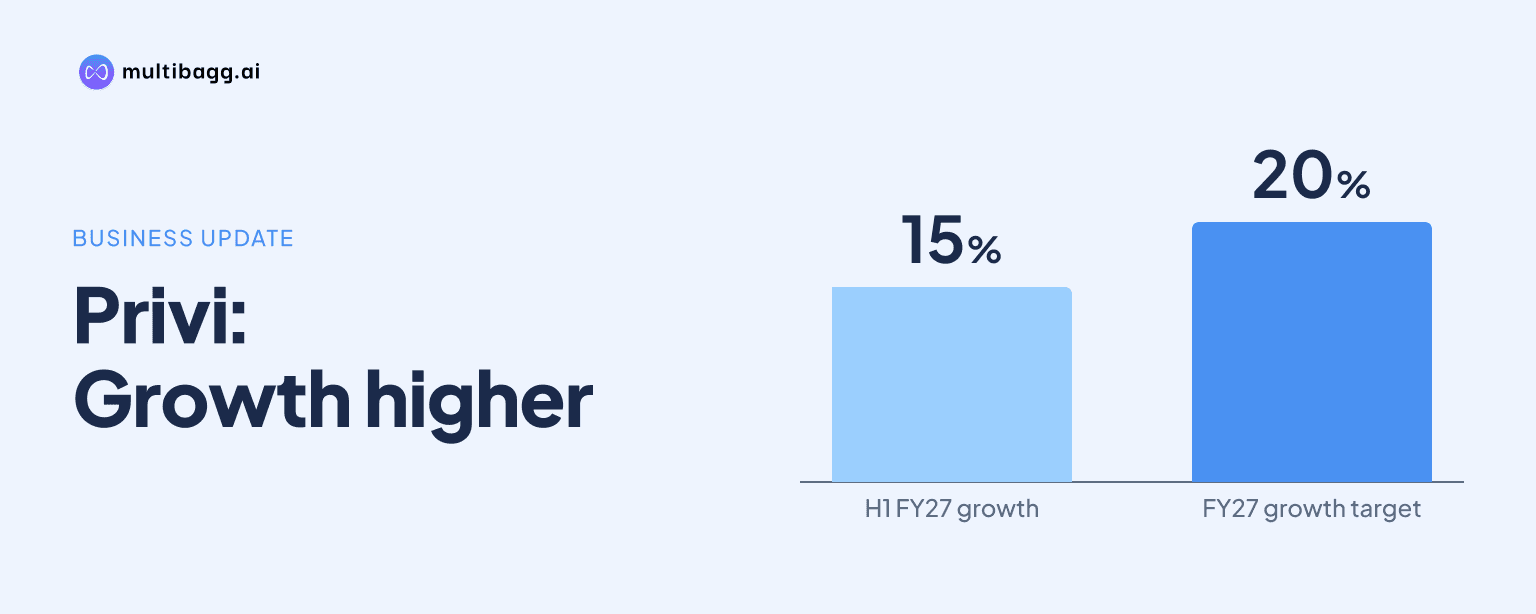
Privi Speciality Chemicals Limited expects its completed 6,000-metric-tonne capacity addition to reach almost 85%-90% utilisation in the fourth quarter (Q4) of financial year 2026-27 (FY27), supporting management’s maintained 20% annual growth target after first-half growth of about 15%.
Know Privi Speciality Chemicals inside out
Results, valuation, peers and who's buying, in one view.
What is Privi’s Q4 capacity ramp plan?
Privi expects the added capacity to make its largest contribution in Q4 FY27, when new annual customer contracts begin and utilisation of the expanded capacity is expected to reach almost 85%-90%. Management said the debottlenecking expansion itself had already been completed, meaning the expected Q4 increase is a volume ramp rather than a further capacity addition.
Phase 1 increased installed capacity to 54,000 metric tonnes per annum from 48,000 metric tonnes per annum, adding 6,000 metric tonnes per annum. Privi said the project was completed by 30 September 2026, with part of the contribution expected in Q3 FY27 and a significant part expected in Q4 FY27.
The company tied the timing to customer contracting rather than plant commissioning alone. Privi said products move through development, sampling, customer qualification and commercialisation before volumes can build, and management specifically linked the larger Q4 contribution to annual contracts starting in that quarter.
How does the ramp support Privi’s 20% growth target?
Privi maintained its expectation of 20% annual growth, citing its usually stronger second half and the Q4 contract-led ramp-up at the completed Phase 1 expansion. An analyst noted that first-half, or H1, FY27 growth was about 15%, requiring a faster pace in the remaining six months to reach the full-year target.
Chief Financial Officer Narayan S. Iyer said the first half is normally lower than the second half for Privi and asked investors to assess performance on yearly numbers rather than only quarter-on-quarter results. Management did not provide product or segment-specific growth guidance, but said overall utilisation across plants had been around 85%-90%.
Management cited rising usage of aroma chemicals, including pinene, and demand from customers serving African markets as factors behind its outlook. However, Privi did not disclose sales, volume or revenue targets by product, customer or geography for the additional 6,000 metric tonnes of annual capacity.
What financial results preceded Privi’s capacity ramp?
Privi reported Q2 FY27 total income of Rs 773.16 crore, up 13.9% year on year, earnings before interest, tax, depreciation and amortisation (EBITDA) of Rs 212.49 crore, up 16.66%, and profit after tax of Rs 117.03 crore, up 24.61%. These results were recorded before the expected full Q4 contribution from the expanded capacity.
The Q2 FY27 EBITDA margin was 27.48%, while raw-material consumption was about 52% of sales, compared with 54% in Q1 FY27 and 51% in September 2025. Other expenses were 9.72% of sales, which management attributed to expense monitoring and the spreading of fixed costs over a larger sales base.
Cash generated from operations was Rs 445 crore in H1 FY27, and the working-capital cycle fell to below 100 days from 124 days in the comparable prior-year period. As of 30 September 2026, net debt was Rs 814.51 crore, while net debt to EBITDA stood at 1.07 times and net debt to equity was 0.51 times.
Return on capital employed was 24.30% on 30 September 2026, up 216 basis points year on year, while return on equity was 26.34%, up 134 basis points. Management also reported fixed-asset turnover of 1.7 times, but Privi did not quantify the specific revenue, profit or cash-flow contribution expected from the 6,000-metric-tonne Phase 1 addition.
Got a follow-up? Ask IRIS
Which later projects could add to Privi’s growth?
Privi expects Phase 2 to be available for commercial sales in the second half of the next financial year, after completion planned by June and subsequent trial production. Management said additional revenue and margins from that expansion are expected from September onwards, subject to the stated execution schedule.
The Phase 2 programme includes furfural-based derivatives, maltol, ethyl maltol, cyclopentanone and a couple of specialty molecules. Earlier in the call, Privi also identified ethyl vanillate, referred to as Musty, among molecules planned in its broader expansion programme.
Management expects margins from the new products to remain in the current range, but did not give a numerical margin target by molecule. It also said commercialisation depends on development, sampling and customer qualification, leaving customer acceptance and project execution as variables in the Phase 2 revenue timetable.
Privi’s PRIGIV joint venture with Jeevadan made a profit in Q2 FY27 after its first profitable quarter in Q4 FY26. The company said it is focused on scaling the existing PRIGIV business, improving consistency and developing higher-value products, without disclosing the venture’s revenue or profit figure.
How are raw materials and freight affecting Privi?
Privi said it was not seeing procurement challenges for raw materials despite shipping-route disruption concerns. Management said almost 70% of revenue comes from products based on non-petroleum raw materials, which it said limits the direct impact of West Asia-related disruption.
The company uses a quarterly freight-pricing mechanism in customer contracts, according to the chief financial officer. Management said this allows Privi to seek changes in customer pricing if freight costs rise or fall materially, although it did not quantify freight expense or the extent of any price pass-through in Q2 FY27.
Management also said foreign-exchange gains formed a major part of other income because exports were high and the US dollar had been favourable. In H1 FY27, Privi received Rs 1.62 crore of state incentives, compared with Rs 9 crore in the prior-year period, and management expected further incentive receipts during the next six months.
Conclusion
Privi’s FY27 growth target depends on converting completed Phase 1 capacity into contracted volumes in Q4. The company entered that ramp with Q2 total income of Rs 773.16 crore, 13.9% year-on-year revenue growth and an additional 6,000 metric tonnes of annual capacity completed by 30 September 2026.
The next result to watch is whether Q4 FY27 utilisation of the new capacity approaches management’s 85%-90% expectation as annual contracts begin. Beyond FY27, management plans to complete Phase 2 by June, conduct trial production and seek commercial sales from the second half of the next financial year.