










Privi reports record Q2 revenue, profit and first dividend
Key highlights
- Privi reported record Q2 FY27 total income of Rs 773.16 crore, up 13.9% year on year.
- Q2 FY27 PAT was Rs 117.03 crore, up 24.61% year on year.
- Privi declared its first interim dividend of 5 rupees per share for FY27.
- Phase 1 raised installed capacity to 54,000 metric tonnes per annum from 48,000 metric tonnes per annum.
powered by IRIS
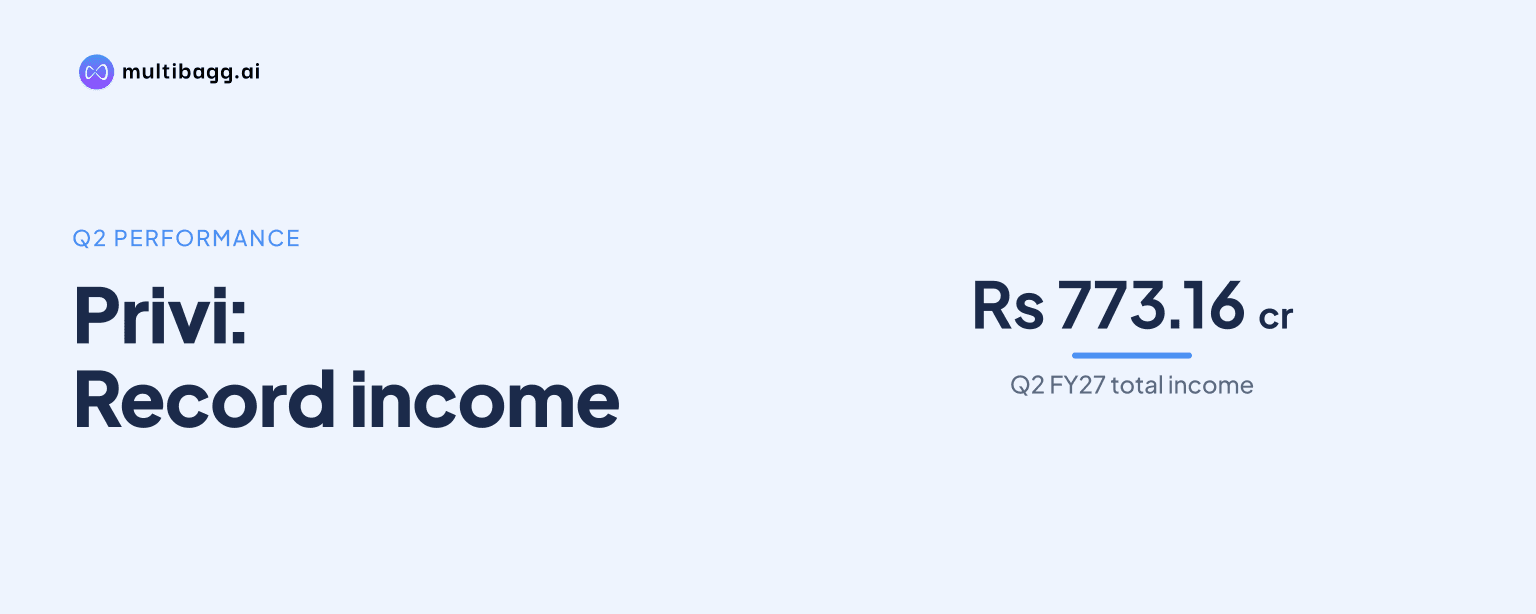
Privi Speciality Chemicals Limited reported record Q2 FY27 total income of Rs 773.16 crore and profit after tax of Rs 117.03 crore for the quarter ended September 30, 2026, while declaring its first interim dividend of 5 rupees per share. Total income rose 13.9% year on year and profit after tax rose 24.61%.
Know Privi Speciality Chemicals inside out
Results, valuation, peers and who's buying, in one view.
What did Privi report for Q2 FY27?
Privi reported its highest-ever quarterly total income, earnings before interest, tax, depreciation and amortisation (EBITDA), and profit after tax (PAT) in Q2 FY27. Total income was Rs 773.16 crore, EBITDA was Rs 212.49 crore and PAT was Rs 117.03 crore, with year-on-year increases of 13.9%, 16.66% and 24.61%, respectively.
The faster increase in PAT than total income was the key change in the quarter ended September 30, 2026. Management said broad-based demand in domestic and export markets supported performance, alongside its focus on reliable supply, raw-material sourcing, process efficiency and product mix amid freight, feedstock and geopolitical volatility.
Privi’s EBITDA margin was 27.48% in Q2 FY27. Management said raw-material consumption was about 52% of sales, versus 54% in Q1 and 51% in September 2025, while other expenses were 9.72% of sales as fixed costs were spread over a larger sales base.
Why did Privi’s profit rise faster than revenue?
Privi’s PAT rose faster than revenue because management cited lower expenses relative to sales, improved fixed-cost absorption and better conversion from EBITDA to PAT. The chief financial officer also said interest costs had declined and asset use had improved over the preceding four to five quarters, supporting the Rs 117.03 crore quarterly PAT.
State incentives were lower in the current period, affecting comparability with the previous year. Privi received Rs 1.62 crore of state incentives in the current year against Rs 9 crore in the previous year, and management said it expects additional receipts during the remaining six months of FY27.
Management estimated outstanding incentives of about Rs 12 crore to Rs 15 crore over the next two quarters. It said the expected total for FY27 should exceed the prior year’s amount, although the call did not specify a payment schedule or state-wise allocation.
For the first half of FY27, Privi reported PAT of Rs 201 crore, up about 29% year on year, and cash generated from operations of Rs 445 crore. Management attributed the cash-flow increase mainly to higher profits; an analyst mentioned Rs 360 crore, but management’s stated first-half figure was Rs 445 crore.
What dividend did Privi declare?
Privi declared its first-ever interim dividend of 5 rupees per equity share for FY27. The equity shares have a face value of 10 rupees each, and Chairman and Managing Director Mahesh Babani said the declaration reflected management’s confidence in the business and commitment to shareholder value creation.
The transcript did not disclose a record date, payment date, aggregate dividend outgo or dividend yield. The dividend was announced while Privi continues to allocate capital to capacity expansion, specialty products and operational improvements rather than after the completion of its wider investment programme.
As of September 30, 2026, Privi’s net debt was Rs 814.51 crore, its net debt-to-EBITDA ratio was 1.07 times and its net debt-to-equity ratio was 0.51 times. Return on capital employed was 24.30%, up 216 basis points year on year, while return on equity was 26.34%, up 134 basis points.
Privi also reduced its working-capital cycle to less than 100 days in Q2 FY27 from 124 days in the corresponding prior-year period. Management linked the shorter cycle and Rs 445 crore of first-half operating cash generation to its capacity to fund planned investments while maintaining balance-sheet discipline.
Got a follow-up? Ask IRIS
How is Privi expanding capacity and products?
Privi completed Phase 1 of its capacity programme by September 30, 2026, increasing installed capacity by 6,000 metric tonnes per annum to 54,000 metric tonnes per annum from 48,000 metric tonnes per annum. Management said part of the new capacity should contribute in Q3 FY27, with a larger impact expected in Q4 FY27 as annual customer contracts begin.
Management expects utilisation of the expanded capacity to reach about 85% to 90% in Q4 FY27. It clarified that the expansion itself is complete, and that the expected Q4 increase relates to volume ramp-up under new contracts rather than another debottlenecking project.
Privi’s planned product additions include maltol, ethyl maltol, ethyl vanillate, cyclopentanone and other specialty molecules. Management said development, sampling, customer qualification and commercialisation take time, meaning these products should not be treated as immediate revenue contributors.
Phase 2 covers furfural-based derivatives, including maltol, ethyl maltol and cyclopentanone, and management plans to complete it by June. After trial production, it expects commercial sales and additional revenue and margins from the second half of the next financial year.
Can Privi meet its FY27 growth target?
Privi maintained management’s target of 20% overall growth for FY27, despite an analyst’s observation that first-half growth was about 15%. The chief financial officer said the first half is usually lower than the second half for Privi and asked investors to assess progress on annual rather than quarterly performance.
Management did not give segment-wise guidance, but said plant utilisation across the portfolio was around 85% to 90%. Chairman Mahesh Babani cited increased aroma-chemical usage, higher pinene use and demand linked to African markets served by Privi’s customers as factors supporting the company’s outlook.
Privi said almost 70% of its revenue comes from non-petroleum-source raw materials. Management said this reduces its direct exposure to disruption from West Asia conflict-related freight and raw-material conditions, although it continued to identify feedstock and logistics costs as volatile.
Privi’s joint venture with Jeevadan, PRIGIV, reported a profit in Q2 FY27 after recording its first profitable quarter in Q4 FY26. Management said PRIGIV is focused on scaling its existing operations, improving consistency and developing higher-value products, while two potential strategic partnerships remain work in progress.
Conclusion
Privi’s Q2 FY27 performance combined record total income of Rs 773.16 crore with PAT of Rs 117.03 crore, and the 24.61% PAT increase exceeded the 13.9% growth in total income. Management attributed the outcome to operating efficiencies, fixed-cost absorption, improved EBITDA-to-PAT conversion and demand across domestic and export markets.
The next disclosures to watch are the Q4 FY27 volume ramp-up from the completed 6,000-metric-tonne capacity addition, for which management expects 85% to 90% utilisation, and the planned Phase 2 commercial contribution from the second half of the next financial year. Management also maintained its 20% FY27 growth target and expects Rs 12 crore to Rs 15 crore of additional state incentives over the next two quarters.