










PSP Projects Limited sees EBITDA margin potential of 7.5% to 8%
Key highlights
- H1 FY27 revenue rose 61% year on year to Rs 1,967 crore, while EBITDA margin was 6.30%.
- Management said EBITDA margin could potentially move towards 7.5% to 8% as projects enter MEP, finishing and interior stages.
- RCC represents about 30% of project scope, while the remaining 70% is MEP, finishing and other activities.
- Order book stood at Rs 12,872 crore on September 30, 2026, including about Rs 9,229 crore of group projects.
powered by IRIS
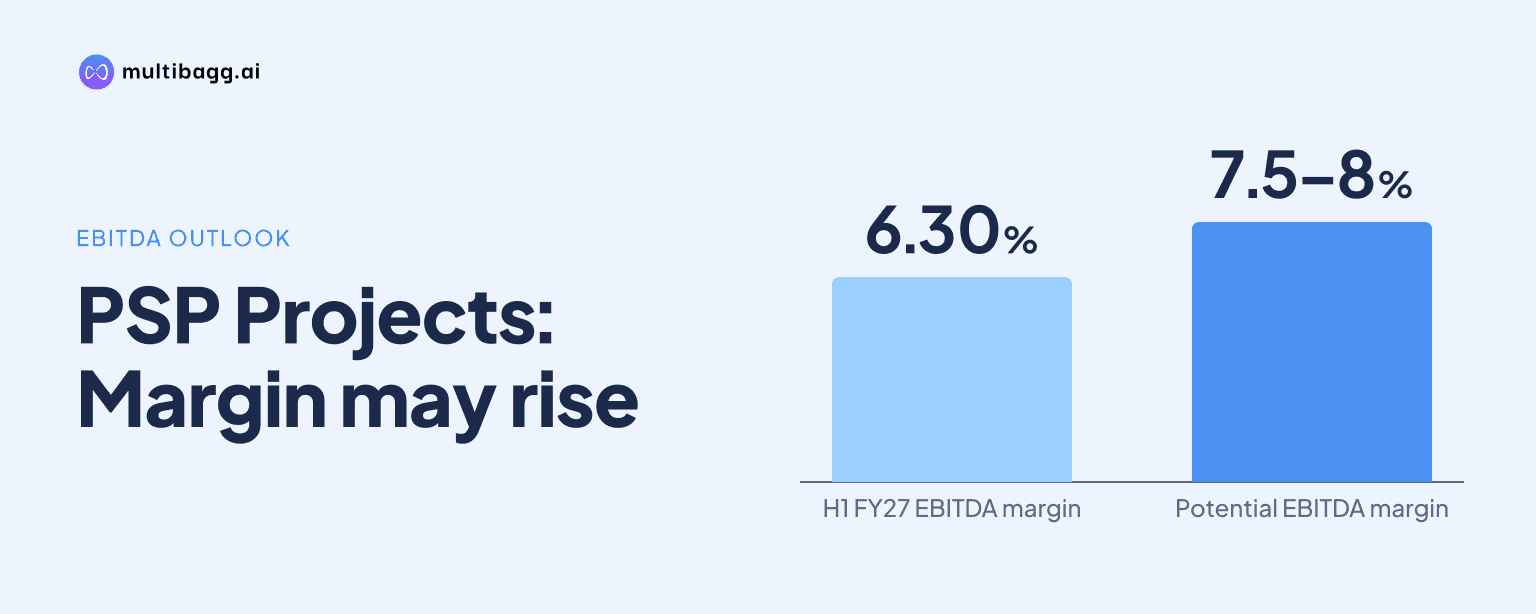
PSP Projects Limited said in the first half of fiscal year 2027 (H1 FY27) that earnings before interest, tax, depreciation and amortisation (EBITDA) margin could move towards 7.5% to 8% as more projects enter mechanical, electrical and plumbing (MEP), finishing and interiors work, after reporting a 6.30% H1 FY27 margin on revenue of Rs 1,967 crore.
Know PSP Projects inside out
Results, valuation, peers and who's buying, in one view.
What is PSP Projects' EBITDA margin outlook?
PSP Projects management said its current calculated expectation is for EBITDA margin of around 7%, while it sees potential for the figure to move towards 7.5% to 8% as projects progress. Chairman and Managing Director Prahaladbhai Patel did not commit to the higher range, saying project-level reconciliation, varying cost structures, overhead needs and execution challenges could affect the final outcome.
The near-term margin reference point is below that potential range. H1 FY27 EBITDA was Rs 124 crore on revenue of Rs 1,967 crore, producing a 6.30% margin, compared with 6.12% in H1 FY26. In the second quarter of FY27 (Q2 FY27), EBITDA rose 38% year on year to Rs 69 crore, but margin was 6.21%, versus 7.10% in Q2 FY26, as revenue grew 58% to Rs 1,113 crore.
Why could finishing work lift PSP Projects' margin?
PSP Projects said the mechanism is faster overhead absorption once projects move beyond reinforced cement concrete (RCC) structures. Management described RCC as about 30% of total project scope, with the remaining 70% comprising MEP, civil finishing and interior activities. The company expects this larger residual scope to generate revenue faster without a proportionate increase in project overheads.
Management said a structural portion can be completed in the first year, while the remaining 70% may be executed in the following seven to eight months. In a separate explanation, it said MEP, civil finishing and interiors can typically be completed within six to seven months of an overall 18- to 24-month project duration. Fixed project commitments, safety costs and overheads can therefore be spread across a faster revenue run rate, according to management.
Which PSP Projects projects are entering finishing stages?
PSP Projects identified several projects where structural work has been completed or is substantially advanced. At the Rs 613 crore SMC high-rise building, RCC work is complete, MEP work has reached the 15th floor, interiors are under way from the first to fifth floors, and façade work is progressing from the fifth to 10th floors. At the Rs 238 crore Human and Biological Science Gallery at Science City, major RCC and fabrication work is complete and MEP work is expected to start soon.
The company also cited Project Ninety as evidence of its precast execution model. The three-basement, ground-floor and 18-storey project had its RCC structure completed in 121 days during Q2 FY27, while the adjoining corporate house, including MEP and interior fit-out, was completed in 240 days. PSP Projects said it would begin operating from the corporate house on November 4, 2026.
Got a follow-up? Ask IRIS
How does PSP Projects' group-project mix affect margin?
PSP Projects had an order book of Rs 12,872 crore at September 30, 2026, with group projects accounting for about 72%, or Rs 9,229 crore, and external projects representing the remaining 28%. Management said much of its group business operates under a cost-plus percentage model, which reimburses material-cost differences and limits exposure to changes in input prices, but does not automatically create a higher margin during the early structural stage.
In the call, management described approximately 75% of its order book as Adani Group work and 25% as non-Adani work, a mix that differs slightly from the 72% group disclosure in the opening presentation. It said about 75% of bills in group business are cleared within seven to 10 days and the remaining 25% generally in the following month. Management also said workforce-related costs had been adjusted by about 10% for inflation and expected overall cost impact under current group models to be around 7%.
What could delay PSP Projects' margin improvement?
PSP Projects' 7.5% to 8% view remains conditional on project execution rather than a formal forecast. Management said every project has a different overhead requirement and execution complexity, and the projected 7% level incorporates roughly three years of overheads, safety requirements and other commitments. It also said certain legacy projects, including SMC and RVNL, had seen some impact from material-price increases during the war-related disruption cited on the call.
Working-capital timing is another operational variable. Net unbilled revenue stood at Rs 632 crore and trade receivables at Rs 809 crore on September 30, 2026, while management said certification delays on government-project bills can keep the final month's work unbilled. It gave a hypothetical example that if monthly revenue were Rs 400 crore, 70% could move to unbilled revenue pending certification and goods and services tax invoicing.
Conclusion
PSP Projects' margin case rests on the composition and timing of its Rs 12,872 crore order book: RCC represents about 30% of project scope, while MEP, finishing and interiors represent the remaining 70% that management expects to execute more quickly. That operating transition is intended to improve overhead absorption from the 6.30% H1 FY27 EBITDA margin towards management's uncommitted 7.5% to 8% potential range.
The next markers are execution in the second half of FY27 and the pace at which identified projects enter finishing stages. Management maintained market guidance of 30% to 35% year-on-year revenue growth for FY27, expects more than Rs 5,000 crore of full-year order inflow, and said additional FY27 capital expenditure after Rs 91 crore in H1 could be around Rs 100 crore.