










Kaynes curbs smart-meter sales to target Rs 750 crore dues
Key highlights
- Kaynes reported smart-meter receivables of Rs 1,091 crore at the end of Q2 FY27, down from Rs 1,402 crore at the end of Q1 FY27.
- Kaynes cut Q2 FY27 smart-meter revenue to Rs 54 crore from Rs 228 crore in Q2 FY26.
- Kaynes said additional smart-meter sales depend on reducing receivables below Rs 750 crore.
- Core EMS revenue rose 34% year on year to Rs 799 crore in Q2 FY27 from Rs 595 crore.
powered by IRIS
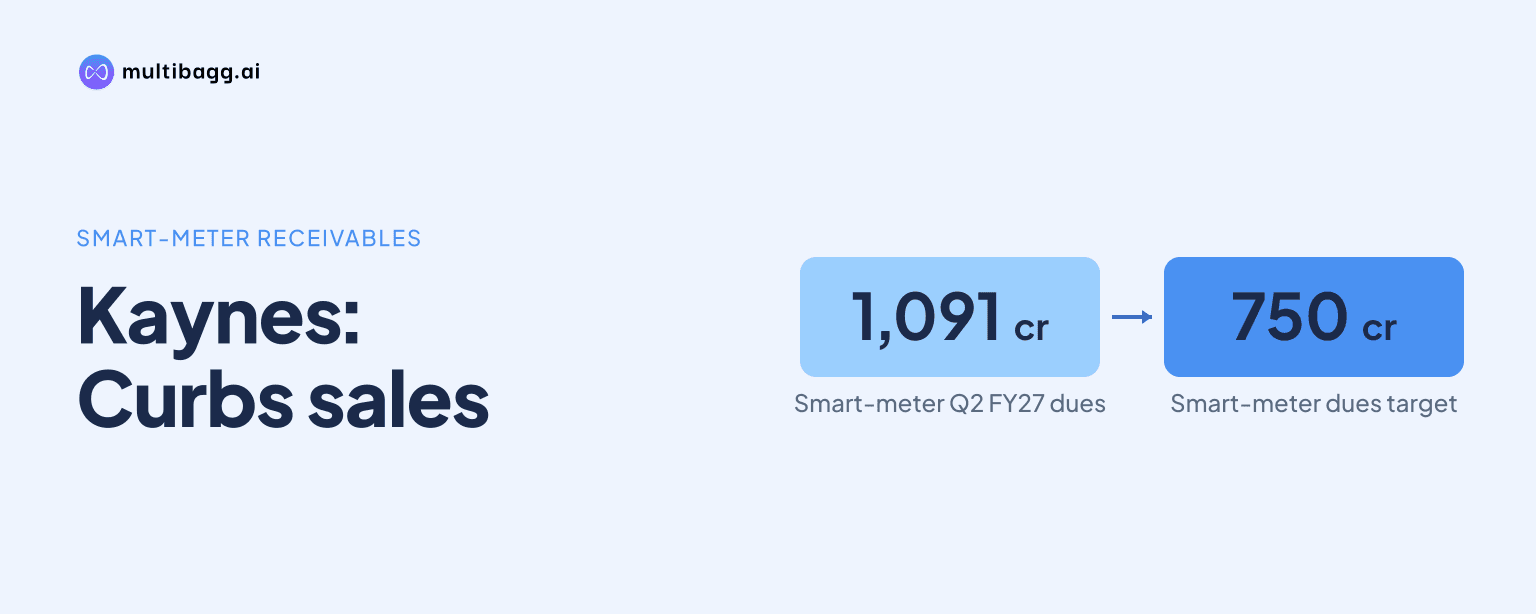
Kaynes Technology India Limited cut smart-meter revenue to Rs 54 crore in Q2 FY27 from Rs 228 crore a year earlier to prioritise collections, reducing total smart-meter receivables to Rs 1,091 crore from Rs 1,402 crore at the end of Q1 FY27. Kaynes said further sales depend on receivables falling below Rs 750 crore.
Know Kaynes Technology India inside out
Results, valuation, peers and who's buying, in one view.
Why did Kaynes reduce smart-meter revenue?
Kaynes reduced smart-meter revenue because management chose collections, installations and balance-sheet discipline over near-term supplies. Management said smart-meter revenue declined about 12% in Q1 FY27 and 80% in Q2 FY27, although orders, production capacity and materials remained available. It said installation progress had slowed and it did not want to increase supplies before pending dues were collected.
The effect was clear in the Q2 FY27 sales mix. Core electronics manufacturing services, or EMS, revenue rose 34% year on year to Rs 799 crore from Rs 595 crore, while smart-meter revenue declined to Rs 54 crore from Rs 228 crore. Management said it shifted capacity that had supported metering into EMS production, leaving overall revenue growth at around a single-digit rate despite the expansion in core EMS.
Management described the decision as a trade-off because smart meters had historically carried a higher margin than EMS work. It said smart metering accounted for about 33% of FY26 revenue under one presentation of the prior-year mix, but less than 10% of overall revenue in Q2 FY27. Consolidated earnings before interest, tax, depreciation and amortisation, or EBITDA, margin was 14.1% in H1 FY27, compared with the restated FY26 margin of 14.2%.
How much have Kaynes smart-meter receivables declined?
Kaynes reported combined current and non-current smart-meter receivables of Rs 1,091 crore at the end of Q2 FY27, a reduction of Rs 311 crore from Rs 1,402 crore at the end of Q1 FY27. Management said it was reporting the aggregate amount rather than separating current and non-current dues. Receivables had stood at Rs 1,252 crore at the start of FY27.
The reduction occurred while Kaynes recorded Rs 270 crore of smart-meter revenue in H1 FY27, compared with approximately Rs 960 crore in FY26. Management said collections exceeded Rs 400 crore during the first half when measured against the opening receivable balance and H1 sales. It had initially cited Rs 290 crore of H1 smart-meter revenue during the call, but the transcript correction identifies Rs 270 crore as the reported figure.
The wider working-capital position remained affected by inventory. Rolling 12-month net working capital was 169 days in Q2 FY27, compared with 163 days in Q1 FY27. Management said strategic inventory remained elevated, referring to about Rs 150 crore in one comment and a Rs 200 crore to Rs 250 crore build during April amid supply-chain conditions.
Got a follow-up? Ask IRIS
What must happen before Kaynes adds smart-meter sales?
Kaynes said it will consider additional smart-meter sales only after total receivables fall below Rs 750 crore. That condition requires collections of more than Rs 341 crore from the Rs 1,091 crore reported at the end of Q2 FY27, assuming no further additions to the receivable balance. Management did not provide a fixed H2 FY27 smart-meter revenue target because it linked supply decisions to collections.
Management said it would continue to emphasise EMS until smart-meter dues reached what it considered a reasonable level. It also said faster meter installation, supported by government action, could permit further supplies. Kaynes described itself as the leading installer among relevant suppliers and said the second-ranked installer was 40% lower by its measure, though it did not provide installation volumes.
Kaynes also described a proposed restructuring of the business model. Management said it intends to retain smart-meter manufacturing while moving installation and operations and maintenance, or O&M, to a third party. The prospective partner would initially have the right to buy meters from Kaynes, while later procurement could be opened to other suppliers if they were competitive.
Management said it was at an advanced stage of discussions with potential partners and expected to set out a plan at the next-quarter investor call. The proposed transfer has not been completed, and management did not disclose a transaction value, partner name or timetable for closing. Manufacturing, installation and O&M were identified as the three elements of the existing smart-meter model.
How has the metering reset changed Kaynes earnings mix?
Kaynes reported Q2 FY27 consolidated revenue of Rs 952.5 crore, EBITDA of Rs 125.6 crore and profit after tax of Rs 39.8 crore. H1 FY27 revenue was Rs 1,898.7 crore and EBITDA was Rs 268.1 crore. Management attributed the quarterly margin effect to lower smart-meter contribution, commodity and crude-linked costs, and the initial ramp-up of outsourced semiconductor assembly and test, or OSAT, and printed circuit board operations.
Management said value analysis and value engineering, or VAVE, actions in EMS partly offset the mix shift. It said the prior-year smart-meter business had EBITDA margin of around 22%, compared with around 10.5% for EMS, based on management’s description of the business. Management also said H1 FY27 EBITDA margin of 14.1% was achieved with metering at roughly 10% of revenue, but it did not issue a standalone margin target for EMS.
The quarter included restated comparative figures following a review by a new auditor. Kaynes said restated FY26 profit after tax was Rs 392 crore, compared with Rs 364 crore previously reported, while restated FY26 EBITDA margin was 14.2%, down from 15.8% originally reported. Management said bank-funded receivable and supplier-financing lines were reclassified as borrowings and that no significant accounting policies changed.
Outside metering, management said OSAT revenue had started and printed circuit board Unit 1 would begin revenue generation in Q3 FY27. It also said aerospace revenue had grown more than 70% and railway revenue more than 50%, without disclosing segment revenue. These businesses form part of management’s plan to increase product sales within EMS to about 25% to 30% and reduce dependence on smart-meter product sales.
Conclusion
Kaynes has accepted lower smart-meter revenue to reduce a concentrated receivables balance and protect cash discipline. The Q2 FY27 outcome shows the scale of that choice: smart-meter revenue fell to Rs 54 crore from Rs 228 crore a year earlier, while receivables declined by Rs 311 crore sequentially to Rs 1,091 crore. Core EMS growth to Rs 799 crore from Rs 595 crore partly offset the metering reduction.
The next disclosed milestones are collections that take smart-meter receivables below Rs 750 crore, an update on the proposed installation and O&M partner arrangement at the next-quarter investor call, and printed circuit board revenue beginning in Q3 FY27. Management has also linked a stronger H2 FY27 to OSAT customer validations, printed circuit board operations and continued EMS value-engineering measures.