










Kaynes restatement raises FY26 PAT by Rs 28 crore after auditor review
Key highlights
- Kaynes restated FY26 profit after tax at Rs 392 crore, compared with Rs 364 crore previously reported.
- FY26 revenue was restated to Rs 3,680 crore from Rs 3,620 crore, while EBITDA margin was revised to 14.2% from 15.8%.
- Smart-meter receivables were Rs 1,091 crore at September 30, down from Rs 1,402 crore after Q1 FY27.
- Q2 FY27 core EMS revenue rose 34% to Rs 799 crore while smart-meter revenue declined about 80%, management said.
powered by IRIS
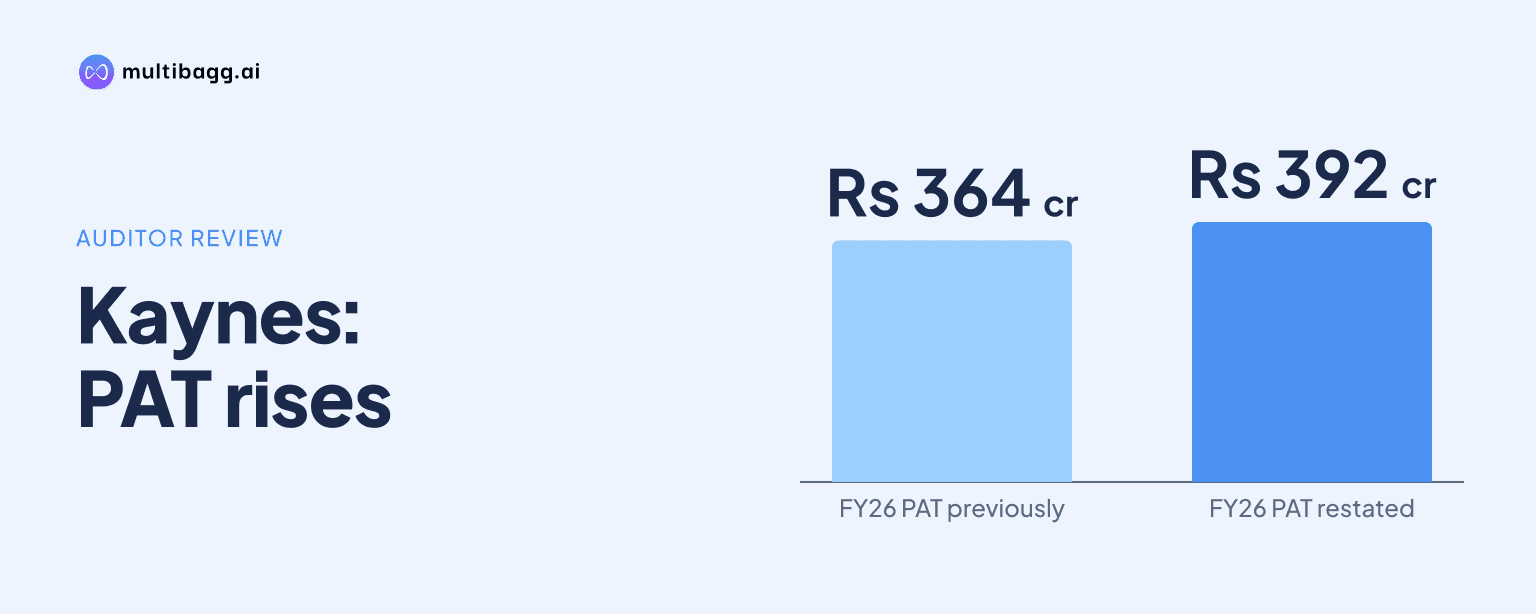
Kaynes Technology India Limited restated FY26 profit after tax at Rs 392 crore, Rs 28 crore above the previously reported Rs 364 crore, following its new auditor’s review, which also increased revenue to Rs 3,680 crore and reclassified bank-funded receivable and supplier financing as borrowings.
Know Kaynes Technology India inside out
Results, valuation, peers and who's buying, in one view.
Why did Kaynes restate its FY26 accounts?
Kaynes restated prior-period accounts after moving to Walker Chandiok & Co LLP and completing its first quarterly limited review in Q2 FY27. Management said the auditor’s review of earlier figures, followed by discussions with the audit committee, led it to use Ind AS 8, the Indian Accounting Standard governing accounting policies, estimates and errors.
The restatement covered Q1 FY27, Q2 FY26, H1 FY26, FY26 and the opening balance sheet on April 1, 2025. Management said no significant accounting policies changed and described the exercise as a revised interpretation and presentation of Ind AS requirements intended to improve governance and compliance.
Both the standalone and consolidated review reports included an emphasis-of-matter paragraph referring to the restatement, but management said the review conclusions were not modified on that basis. It also said about 75% of the changes were judgemental, while controls were tightened where the review identified genuine errors.
How did the FY26 restatement change Kaynes’s revenue and profit?
Kaynes’s FY26 revenue rose by Rs 60 crore to Rs 3,680 crore, while reported profit after tax increased by Rs 28 crore to Rs 392 crore. Management said the principal revenue adjustment related to a West Bengal smart-meter contract that had previously been accounted for under a capital-expenditure model rather than as a service concession arrangement.
Management said the revised treatment added Rs 41.8 crore of revenue for the West Bengal smart-meter contract. By contrast, it said the major PCGL smart-meter contract, which represented about Rs 870 crore of roughly Rs 970 crore smart-meter revenue in FY26, required no revision to revenue or receivable recognition.
The higher revenue did not produce a higher EBITDA margin. Management attributed the reduction from 15.8% to 14.2% to timing errors, inventory provisions and inventory-overhead validation, while saying the effect narrowed to a 0.4-percentage-point decline at profit-before-tax level and became a 0.9-percentage-point increase at profit-after-tax level.
What changed in Kaynes’s borrowings and financing presentation?
Kaynes reclassified bank-funded receivable and supplier financing as borrowings instead of showing receivable discounting on a separate line item. Management said bill discounting had previously been presented separately, and the revised classification is why loans appear higher in the restated accounts.
The reclassification changes the visibility of financing used against receivables but was not described by management as a new borrowing event. Management also said consolidated net worth was marginally higher after the restatement, while smart-meter contract accounting, accruals and provisions were the main profit-and-loss adjustments.
The revised presentation is relevant because smart-meter collections remained a focus in FY27. Management reported combined current and non-current smart-meter receivables of Rs 1,091 crore at September 30, compared with Rs 1,402 crore after Q1 FY27 and Rs 1,252 crore at the start of the financial year.
Got a follow-up? Ask IRIS
How is Kaynes managing smart-meter receivables and business mix?
Kaynes moderated smart-meter revenue to prioritise collections and balance-sheet management, while shifting capacity into its core electronics manufacturing services, or EMS, business. Management said H1 FY27 smart-meter revenue was Rs 270 crore, corrected from the Rs 290 crore figure initially stated on the call, and said collections exceeded Rs 400 crore.
In Q2 FY27, core EMS revenue grew 34% year on year to Rs 799 crore from Rs 595 crore, while smart-meter revenue declined about 80%, according to management. It said capacity formerly used for metering was redeployed to EMS, helping overall revenue remain around single-digit growth despite the sharp metering reduction.
Management said FY26 EMS EBITDA margin was about 10.5%, compared with roughly 22% in smart metering, where the company sells a product rather than an EMS service. It attributed H1 FY27’s 14.1% consolidated EBITDA margin partly to value analysis and value engineering initiatives in EMS, but did not give a separate current-period EMS margin.
What does the restatement mean for Kaynes’s current financial position?
Kaynes reported Q2 FY27 consolidated revenue of Rs 952.5 crore, EBITDA of Rs 125.6 crore and profit after tax of Rs 39.8 crore. For H1 FY27, revenue was Rs 1,898.7 crore and EBITDA was Rs 268.1 crore, resulting in a 14.1% EBITDA margin, close to the restated FY26 margin of 14.2%.
Net working capital was 169 days on a rolling 12-month basis in Q2 FY27, up from 163 days in the preceding quarter. Management said inventory included strategic stock of about Rs 200 crore to Rs 250 crore built in April amid supply-chain conditions, and it planned to assess easing that inventory by the end of December if conditions permitted.
Management said it aims to reduce smart-meter receivables below Rs 750 crore before increasing additional sales more fully. It also said it was considering a structure under which Kaynes retains smart-meter manufacturing while a third party takes responsibility for installation and operations and maintenance.
Conclusion
The restatement gives a revised base for assessing Kaynes’s FY26 performance: revenue increased to Rs 3,680 crore and profit after tax to Rs 392 crore, but EBITDA margin fell to 14.2% and receivables financing is now presented within borrowings. The changes were concentrated in smart-meter contract accounting, accruals, provisions and the classification of financing facilities.
Next, investors should watch whether smart-meter receivables fall below management’s Rs 750 crore threshold and the plan for installation and operations and maintenance, which management said it would disclose by the next quarter’s investor call. Management also said PCB Unit 1 would begin revenue generation in Q3 FY27, while definitive terms of the Vishay semiconductor partnership were expected within two to three months.