










Kaynes H1 profit falls 53.3% as key costs outpace sales
Key highlights
- Kaynes reported H1 FY27 revenue of Rs 1,898.7 crore, up 17.9% year on year.
- Kaynes’ H1 FY27 net profit fell 53.3% to Rs 85.2 crore.
- Kaynes’ H1 FY27 EBITDA margin declined 200 basis points to 14.1%.
- Kaynes’ H1 FY27 order book increased to Rs 10,563.5 crore.
powered by IRIS
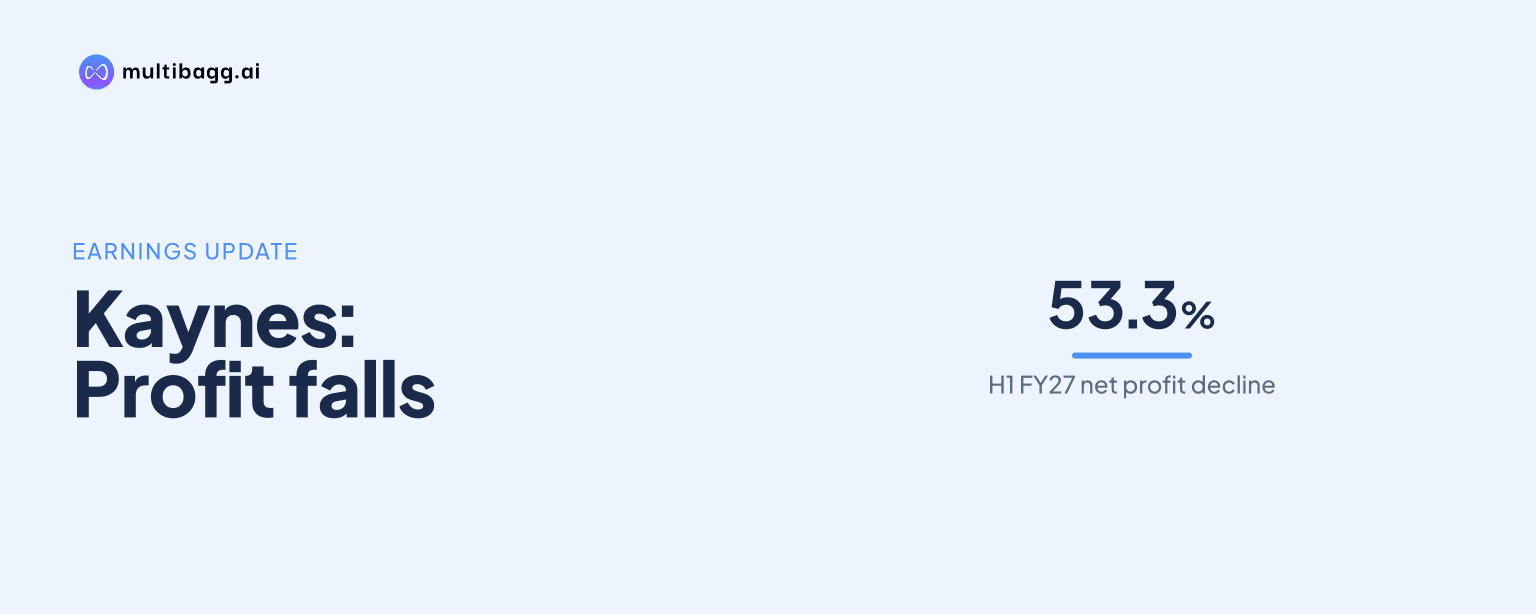
Kaynes Technology reported H1 FY27 net profit of Rs 85.2 crore, down 53.3% year on year, despite revenue rising 17.9% to Rs 1,898.7 crore, as EBITDA margin declined 200 basis points to 14.1% and depreciation and finance costs increased sharply.
Know Kaynes Technology India inside out
Results, valuation, peers and who's buying, in one view.
Why did Kaynes’ H1 FY27 profit decline despite revenue growth?
Kaynes’ H1 FY27 profit declined because faster growth in raw-material and employee costs, higher depreciation and amortisation, higher finance costs, and lower other income outweighed the increase in revenue. Revenue from operations rose from Rs 1,610.9 crore in H1 FY26 to Rs 1,898.7 crore in H1 FY27, while net profit after tax fell from Rs 182.4 crore to Rs 85.2 crore.
The gap began at the operating level. Earnings before interest, tax, depreciation and amortisation, or EBITDA, increased 3.4% to Rs 268.1 crore, far below revenue growth of 17.9%. EBITDA margin consequently fell to 14.1% from 16.1%, a decline of 200 basis points, where 100 basis points equal one percentage point.
The cost mix changed materially over the period. Raw-material cost rose 24.9% to Rs 1,335.5 crore, exceeding the 17.9% increase in revenue, while employee expenses rose 40.5% to Rs 191.3 crore. Other expenses declined 12.4% to Rs 166 crore, but that reduction did not offset the faster increases in material and employee costs.
How did depreciation, finance cost and other income affect Kaynes’ earnings?
Kaynes’ profit before tax fell 39.7% to Rs 142 crore in H1 FY27 because depreciation and amortisation nearly doubled, finance cost more than doubled, and other income declined. These items widened the difference between the 3.4% EBITDA increase and the 53.3% decline in profit after tax.
Depreciation and amortisation expense rose 93.3% from Rs 38.8 crore in H1 FY26 to Rs 75 crore in H1 FY27. The balance sheet shows gross block of tangible assets increased from Rs 1,335.6 crore to Rs 2,381.9 crore over the same comparison, while net block rose from Rs 1,122.5 crore to Rs 2,098.7 crore.
Finance cost increased 135.7% to Rs 75.9 crore from Rs 32.2 crore. Borrowings classified as non-current rose from Rs 343 crore to Rs 570.9 crore, while short-term borrowings increased from Rs 786.8 crore to Rs 1,238.9 crore. Net debt-to-equity was 0.3 in H1 FY27, compared with 0.2 in FY26.
Other income declined 33.0% to Rs 35.1 crore, from Rs 52.4 crore a year earlier. Tax expense rose 6.8% to Rs 56.7 crore even as profit before tax dropped to Rs 142 crore from Rs 235.5 crore, resulting in net profit margin falling 680 basis points to 4.5%.
Got a follow-up? Ask IRIS
What changed in Kaynes’ Q2 FY27 performance?
Kaynes’ Q2 FY27 revenue rose 4.4% year on year to Rs 952.5 crore, but EBITDA fell 16.2% to Rs 125.6 crore and net profit fell 65.6% to Rs 39.8 crore. Quarterly EBITDA margin fell to 13.2% from 16.4%, while net profit margin fell to 4.2% from 12.7%.
Compared with Q1 FY27, revenue increased from Rs 946.2 crore to Rs 952.5 crore in Q2, but EBITDA declined from Rs 142.5 crore to Rs 125.6 crore. The EBITDA margin therefore moved from 15.1% in Q1 to 13.2% in Q2, and net profit declined from Rs 45.4 crore to Rs 39.8 crore.
Q2 employee expenses rose 33.5% year on year to Rs 103.2 crore, compared with revenue growth of 4.4%. Raw-material cost increased 3.7% to Rs 665.5 crore, while other expenses decreased 1.8% to Rs 75.7 crore. Depreciation and amortisation increased 74.4% to Rs 34.7 crore and finance cost increased 191.0% to Rs 38.7 crore.
The quarterly comparison also shows lower other income. Q2 other income was Rs 18.6 crore, down 45.5% from Rs 34.1 crore in Q2 FY26. Profit before tax therefore fell 56.3% to Rs 64.7 crore, followed by an 850-basis-point decline in net profit margin to 4.2%.
What do Kaynes’ order book, revenue mix and operating ratios show?
Kaynes’ order book increased to Rs 10,563.5 crore in H1 FY27 from Rs 8,099.4 crore in H1 FY26, while the mix shifted toward original equipment manufacturer, or OEM, turnkey box-build work. The order book was also higher than Rs 8,903.8 crore at Q1 FY27 and Rs 8,366.3 crore in FY26.
OEM turnkey box-build accounted for 60% of H1 FY27 revenue, versus 22% in FY26. OEM turnkey printed circuit board assembly, or PCBA, represented 25%, down from 49%, while original design manufacturer, product engineering and Internet of Things, or IoT, solutions represented 15%, down from 28%.
By vertical, industrial including electric vehicles accounted for 50% of H1 FY27 revenue, down from 55% in FY26, while automotive increased to 28% from 25%. Railways represented 10%, compared with 6% in FY26, and aerospace, outer-space and strategic electronics represented 3%, compared with 2%.
Working-capital and return measures moved in the opposite direction to the order book. Net working-capital days, calculated on a rolling 12-month basis and adjusted for unutilised initial public offering and qualified institutional placement proceeds, increased to 169 in H1 FY27 from 137 in FY26. Asset turnover declined to 1.8 from 2.0, and return on capital employed, or ROCE, declined to 8.4% from 10.1%.
Conclusion
Kaynes combined higher H1 FY27 revenue and a larger order book with lower profitability because EBITDA growth lagged sales growth and below-EBITDA costs rose substantially. Revenue increased Rs 287.8 crore year on year, but net profit decreased Rs 97.2 crore as EBITDA margin fell to 14.1%, depreciation and amortisation reached Rs 75 crore, and finance cost reached Rs 75.9 crore.
What to watch next is whether the higher Rs 10,563.5 crore order book converts into revenue without further pressure on operating margin, working capital and borrowing costs. The presentation also states that trial production at the circuits facility started on 1 October 2026, with machine installation in its final stage and the quality management system certification process at Phase 1 completion.