










Kaynes retains meter manufacturing, seeks installation and O&M partner
Key highlights
- Kaynes reported Rs 270 crore of smart-meter revenue in the first half, compared with about Rs 960 crore in the previous year.
- Smart-meter receivables declined to Rs 1,091 crore after reaching Rs 1,402 crore following first-quarter sales.
- Kaynes plans to retain meter manufacturing while placing installation and O&M with a third party.
- Management said additional smart-meter sales depend on receivables falling below Rs 750 crore.
powered by IRIS
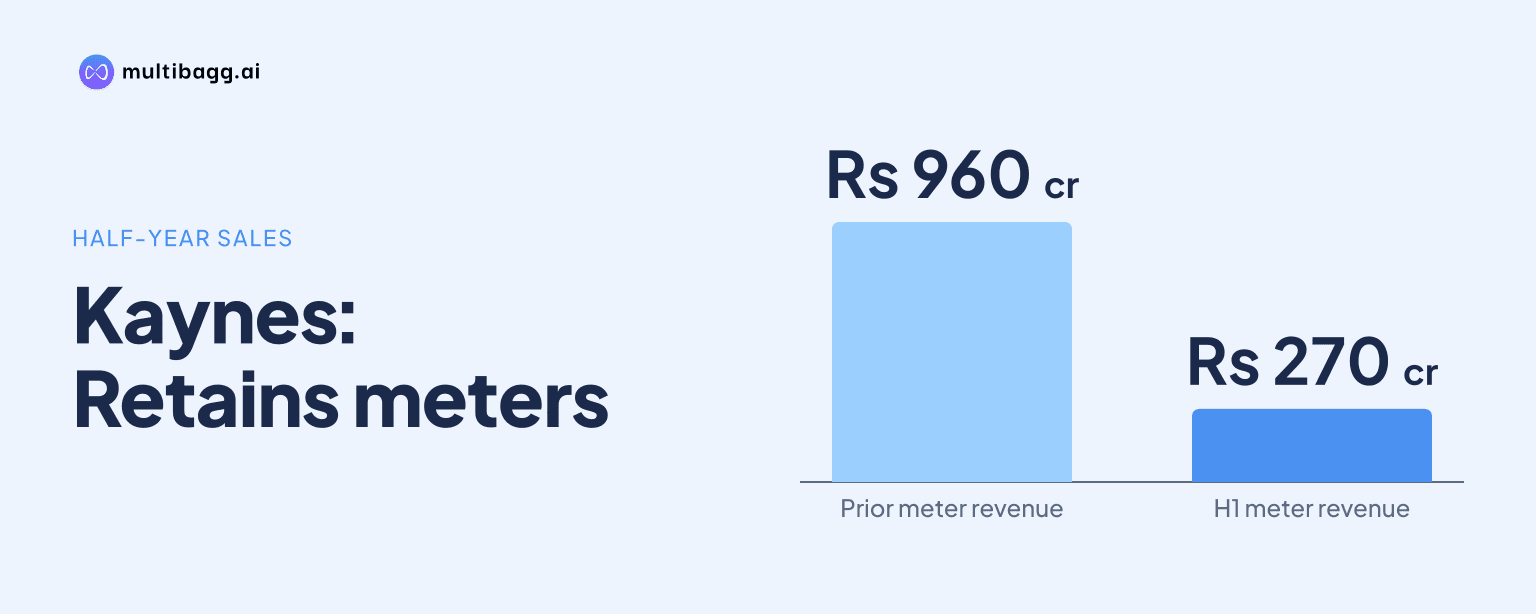
Kaynes Technology will retain smart-meter manufacturing while seeking a third party for installation and operations and maintenance, or O&M, after reporting Rs 270 crore of smart-meter revenue in the first half, compared with approximately Rs 960 crore in the previous year. Management linked further meter sales to reducing receivables below Rs 750 crore.
Know Kaynes Technology India inside out
Results, valuation, peers and who's buying, in one view.
What will Kaynes retain in smart metering?
Kaynes will retain smart-meter manufacturing and proposes to hive off installation and O&M to a third party. Management described smart metering as a three-part model comprising meter manufacturing, installation and O&M, and said it would keep manufacturing because it views itself as a product company with manufacturing capability.
The proposed partner would initially have the right to buy meters from Kaynes. Management said the partner could later source meters from other suppliers if they were competitive, while Kaynes expects to remain price-competitive. The disclosed plan therefore separates manufacturing sales from the installation and operating work rather than exiting smart metering.
Management said Kaynes was the number one installer in the relevant government programme, despite being the number two or three supplier of meters. It said the next installer was 40% below Kaynes in installation volumes, but added that its installation capacity needed improvement relative to its manufacturing capability.
Why is Kaynes restructuring its smart-meter business?
Kaynes is restructuring the business while installation progress has slowed and total smart-meter receivables stood at Rs 1,091 crore at the reported first-half point. Management said orders, manufacturing capacity and materials were available, but it did not want to continue supplies until installation progress was cleared and was working with the government to accelerate installations.
The reported receivables movement shows the working-capital issue behind the sales constraint. Management said total current and non-current smart-meter receivables were Rs 1,252 crore at the start of the financial year, rose to Rs 1,402 crore after Rs 220 crore of first-quarter sales, and then declined to Rs 1,091 crore. It said collections exceeded Rs 400 crore while first-half meter revenue was Rs 270 crore.
Management said second-half smart-meter revenue would depend on collections and on bringing receivables below Rs 750 crore. If that target is met over the next two quarters and installation activity improves, it said additional sales could resume because supply capacity and materials are already in place.
Got a follow-up? Ask IRIS
How has lower meter revenue changed Kaynes’ business mix?
Kaynes’ mix has moved toward electronics manufacturing services, or EMS, as smart-meter production was reduced. Management said EMS generated about Rs 2,700 crore and smart metering about Rs 900 crore last year, while describing the precise revenue mix as 67% EMS and 33% metering. In the second quarter, EMS represented more than 92% of revenue and metering was below 10%.
Kaynes reported first-half earnings before interest, tax, depreciation and amortisation, or EBITDA, of about 14.1% despite the lower meter share. Management attributed this to value analysis and value engineering, or VAVE, in EMS and to converting printed circuit board assembly work into box-build products, which are more complete manufactured systems.
Management’s mix illustration compared the first-half 90% EMS and 10% metering composition with a 75% EMS and 25% metering composition. It said EBITDA would have been about 17.5% under the earlier mix, without other changes, versus the reported 14.1%. This was management’s arithmetic comparison rather than a margin forecast.
The company’s stated response is to increase product sales outside metering. Management reiterated an aspiration for product sales to account for 25% to 30% of sales beyond metering, citing box-build opportunities. It also said railway and aerospace activity had increased and was mainly box-build work, while reduced meter production contributed to a lower printed circuit board assembly share.
What details of the Kaynes partner plan remain unresolved?
Kaynes has not identified the proposed smart-meter partner or disclosed commercial terms, ownership arrangements or a completion date. When asked about a solution by February, management set out only the broad structure of retaining manufacturing and transferring installation and O&M to a third party.
Management presented the proposed separation as one element of cash management. It said inventory had increased by Rs 250 crore because of global market conditions and was expected to start easing from December. Management also cited smart-meter collections, the planned restructuring and the Vishay transaction when saying it did not expect to pursue a qualified institutions placement, or QIP, over the next year.
Capital expenditure also remains selective, according to management. It reported Rs 221 crore of incremental capital expenditure between the first and second quarters on a net-of-subsidy basis, including Rs 59 crore in semiconductors, Rs 140 crore in circuits and Rs 21 crore in EMS. Management said the Vishay and smart-meter restructuring measures were intended to support cash and balance-sheet management.
Conclusion
Kaynes is seeking to retain the product-led part of smart metering while moving installation and O&M to a specialist third party. The plan follows a first-half meter revenue figure of Rs 270 crore and smart-meter receivables of Rs 1,091 crore, while EMS became more than 92% of second-quarter revenue and first-half EBITDA was about 14.1%.
The next disclosed milestone is progress toward management’s below-Rs 750-crore receivables threshold over the next two quarters, since it has linked additional meter sales to that level. Readers should also watch for the unnamed partner’s terms and structure, as well as management’s expectation that the Rs 250 crore inventory build will begin easing from December.