










Kaynes Plans to Allocate 75%-90% of Semicon Capacity to Vishay
Key highlights
- Kaynes plans to allocate 75%-90% of existing semiconductor capacity to Vishay.
- Kaynes intends to reserve 10%-25% of semiconductor capacity for validated existing customers.
- Vishay’s proposed 49% participation in Kaynes’s semiconductor business remains subject to definitive agreements.
- Kaynes said semiconductor validation and application engineering typically take 12-14 months before commercial production.
powered by IRIS
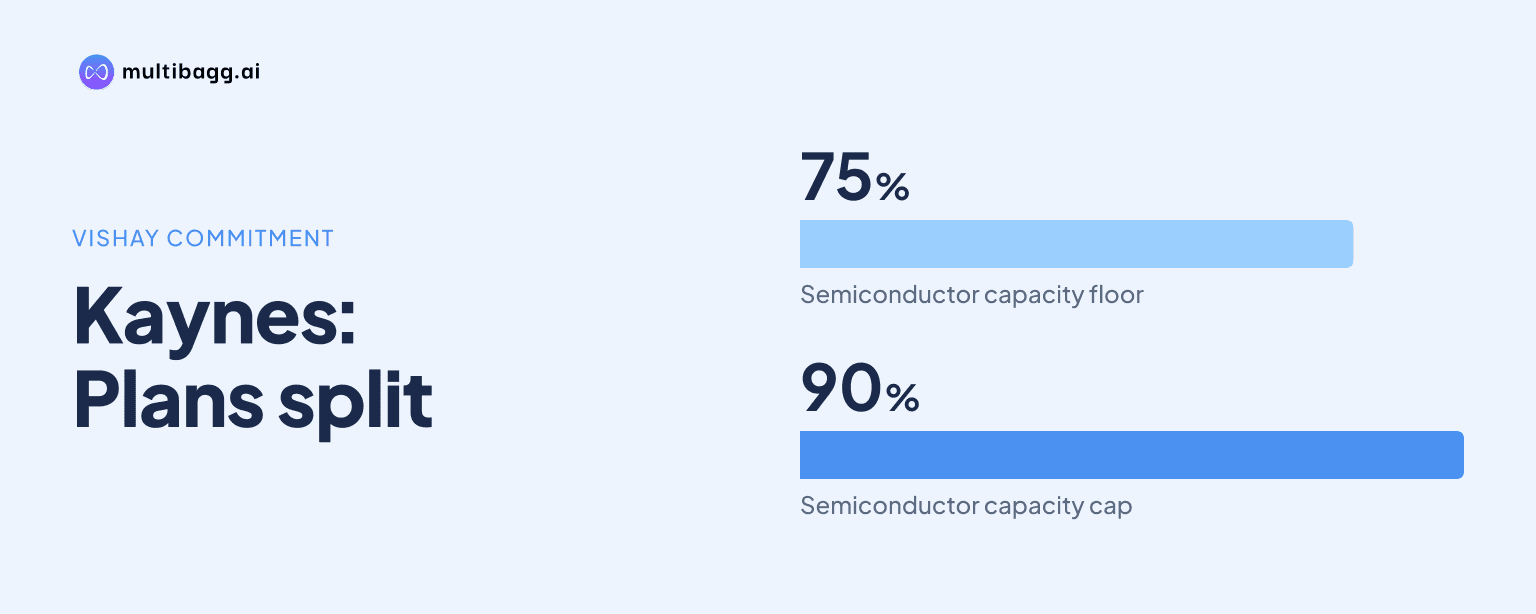
Kaynes Technology India Limited plans to allocate 75%-90% of its existing semiconductor capacity to Vishay under a proposed partnership, retaining 10%-25% for existing customers with validated products. Management said the arrangement could accelerate commercial scale because semiconductor application engineering and end-customer validation typically take 12-14 months.
Know Kaynes Technology India inside out
Results, valuation, peers and who's buying, in one view.
What capacity will Kaynes allocate to Vishay?
Kaynes plans to allocate about 75%-90% of its current semiconductor capacity to Vishay, while reserving about 10%-25% for existing validated customers. Management said the Vishay allocation would come from capacity already created, rather than from a separate incremental facility, subject to the definitive agreement.
Kaynes said the allocation does not reduce prior commitments to existing customers. The company had earlier discussed capacity with several customers, and management said the retained 10%-25% reflects products already validated and agreed for supply. It added that it could bring additional capital expenditure if demand from those customers requires more capacity.
The proposed split gives Vishay most of the currently available semiconductor output because management expects a faster route to market through the partner. Kaynes said Vishay can help move products through validation and application work more quickly, while validation for other customer products continues. Management did not disclose capacity in units, product-level volumes, pricing or minimum purchase commitments.
Why is Kaynes giving Vishay most of its semiconductor capacity?
Kaynes is giving Vishay 75%-90% of capacity because management expects the partnership to speed up scale and provide access to global markets outside China. The company said Vishay has a global presence across active and passive components, which it believes can support customer qualification and commercialisation after the manufacturing facility has been established.
Kaynes said outsourced semiconductor assembly and test, or OSAT, products must pass customer and end-product validation before repeat commercial production begins. Management described application engineering from validation to commercial production as a 12-14 month process. It said some customers have qualification practices that can add time, including annual validation cycles cited for Japanese companies.
The company said Kaynes Semicon Unit 2 is operational and multiple products are receiving customer approvals. That development follows the build-out of the semiconductor manufacturing base and is distinct from the remaining end-customer product validation process. Management said it was keeping “fingers crossed” on that validation, while expressing confidence in the targets it has set.
Kaynes presented the global-market channel as a strategic rationale, rather than as booked revenue. Management said Vishay could give Kaynes access to markets other than China and add credibility through association with an established global component supplier. The Q2 FY27 call did not disclose expected Vishay revenue, contract duration, product mix, volumes or margins.
Got a follow-up? Ask IRIS
Will Vishay own 49% of Kaynes Semicon?
Vishay is proposed to take a 49% interest in Kaynes’s semiconductor business, but the final legal structure was not decided during the Q2 FY27 call. Management said the parties had signed an initial agreement or term sheet and would determine through definitive documentation whether the investment sits at the semiconductor business or in a separate subsidiary.
Kaynes said definitive agreements may take the next two to three months, with more details expected in the next-quarter update. Management also said it had received approvals from relevant government organisations to pursue the partner model after seeking permission to bring in a global semiconductor player.
The contemplated structure includes a Vishay-focused entity and a production line separated for Vishay because of intellectual-property concerns, according to Kaynes’s finance leadership. Management said one line could be “firewalled” for Vishay, while another line could support other businesses. It did not confirm whether the wider OSAT business would be transferred to a joint venture.
Kaynes said it is considering a structure that can accommodate potential future joint ventures with other global players. That is a management objective, not a completed arrangement. The company said the proposed Vishay structure remains under development and asked investors to await the definitive agreement for details on ownership, entity structure and operations.
How will the Vishay plan affect Kaynes’s existing customers and ramp-up?
Kaynes says existing semiconductor customers will continue to be served through the 10%-25% capacity reserved for validated products. Management said the larger Vishay allocation reflects Vishay’s expected speed to market, not a reduction in existing customer commitments. It said it would expand capacity if those customers require additional supply.
The concentration of 75%-90% of current capacity with one strategic partner means Kaynes’s near-term semiconductor ramp will depend substantially on the proposed Vishay arrangement. However, management said the remaining capacity is explicitly blocked for customers whose products have already been validated. The company did not identify those customers or disclose their contract values.
The semiconductor plan sits alongside a separate printed circuit board, or PCB, ramp-up. Kaynes said PCB Unit 1 would begin generating revenue in Q3 FY27, while OSAT revenue had started and both OSAT and PCB businesses were expected to move toward full operations by Q4 FY27. The Vishay proposal concerns semiconductor capacity rather than replacing the PCB programme.
Management also linked faster semiconductor utilisation to its wider business-mix transition. Core electronics manufacturing services revenue increased 34% year on year to Rs 799 crore in Q2 FY27 from Rs 595 crore, while smart-meter revenue fell to Rs 54 crore from Rs 228 crore. Kaynes said it moderated smart-meter activity to improve collections and balance-sheet discipline while expanding other electronics manufacturing activity.
Conclusion
The proposed Vishay arrangement would allocate most of Kaynes’s existing semiconductor capacity to one partner while preserving 10%-25% for customers with validated products. Management’s stated aim is to reduce the time and commercial risk involved in taking new semiconductor products through customer qualification, while opening markets outside China and retaining capacity for established commitments.
The next item to watch is the definitive agreement that management expects within two to three months and plans to discuss in its next-quarter update. That disclosure should address unresolved matters including the entity receiving Vishay’s proposed 49% stake, the investment terms, the scope of the firewalled production line, and capacity, governance and commercial arrangements.