










Puravankara projects ₹18,566 crore surplus over 3-5 years
Key highlights
- Puravankara projects ₹18,566 crore of estimated surplus over the next three to five years.
- Reported net debt was ₹2,366 crore at September 30, 2026, down ₹470 crore from June 30, 2026.
- Launch-pipeline projects account for ₹8,725 crore of projected surplus, compared with ₹8,149 crore from ongoing projects.
- ₹1,616 crore, or 43%, of reported gross debt is scheduled for repayment within one year.
powered by IRIS
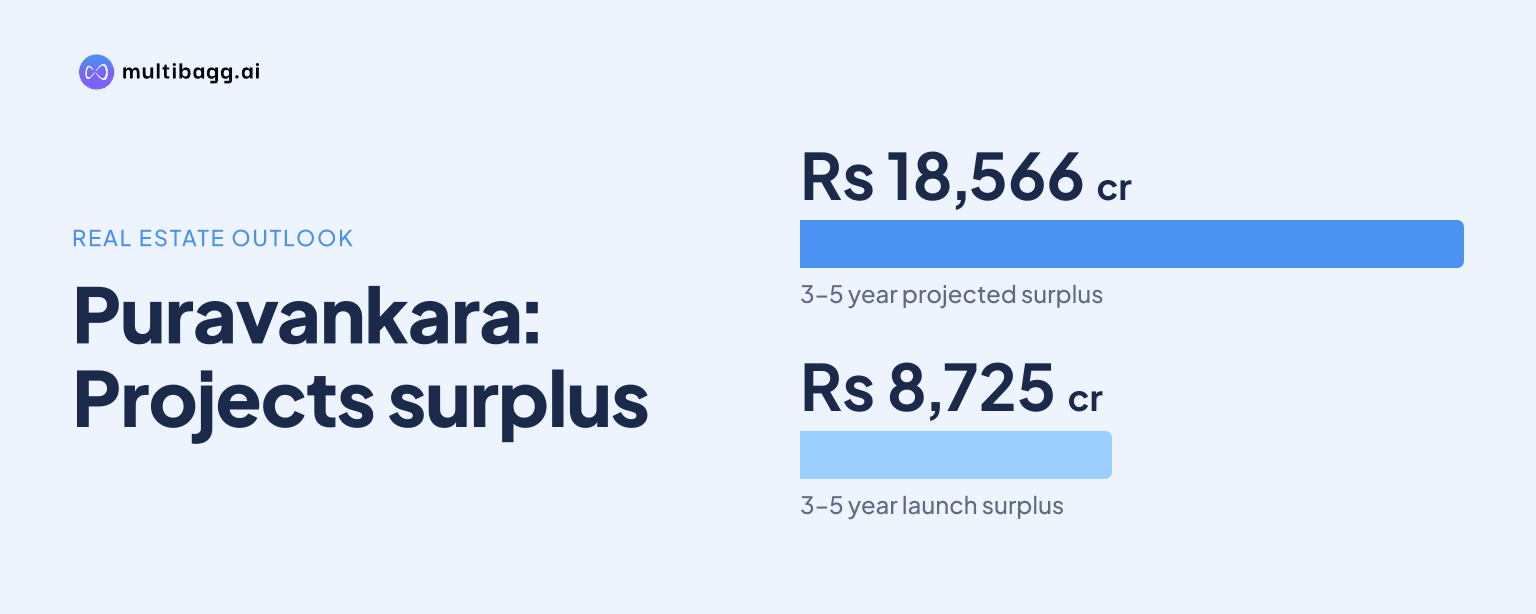
Puravankara Limited projects ₹18,566 crore of estimated project surplus over the next three to five years, compared with reported net debt of ₹2,366 crore at September 30, 2026. The estimate comprises ₹8,149 crore from ongoing projects, ₹8,725 crore from launch-pipeline projects and ₹1,692 crore from commercial projects, while excluding several costs.
Know Puravankara inside out
Results, valuation, peers and who's buying, in one view.
What makes up Puravankara’s ₹18,566 crore estimated surplus?
Puravankara’s ₹18,566 crore estimate combines ₹8,149 crore from ongoing projects, ₹8,725 crore from projects in the launch pipeline and ₹1,692 crore from commercial projects. Pipeline projects are the largest component, ahead of ongoing projects by ₹576 crore, and represent future potential rather than a reported cash balance.
For ongoing projects, Puravankara calculates ₹8,149 crore of surplus as ₹21,606 crore of balance customer collections less ₹13,457 crore of balance cost to go. The company says this category includes projects not launched for sale, while the collection value includes debtors, unbilled amounts and inventory valued at current selling rates.
Within the ongoing portfolio, ₹5,808 crore of surplus is attributed to inventory open for sale and ₹2,342 crore to inventory not open for sale. Puravankara also identifies ₹6,585 crore of balance collections from sold units, which it says covers about 67% of the ₹9,838 crore balance cost to complete in its regional cash-flow presentation.
Which costs are excluded from Puravankara’s surplus calculation?
Puravankara excludes sales and marketing costs, corporate overheads, income tax and future debt repayment from its projected-surplus and balance-cost estimates. The ₹18,566 crore measure is therefore a project-level estimate, not a stated post-tax cash balance after overheads and future debt service.
The company says inventory values are based on current selling rates and that balance cost to go is estimated and subject to periodic review. Its regional ongoing-project calculation includes ₹300 crore of contingencies for potential increases in cement, steel and other construction costs, split equally at ₹150 crore each between South and West.
The South region contributes ₹5,027 crore of the ₹8,149 crore ongoing-project surplus estimate, compared with ₹3,122 crore from West. South has ₹4,676 crore of balance collections from sold units and ₹5,966 crore of inventory open for sale, while West has ₹1,909 crore of sold-unit collections but ₹4,537 crore of inventory not open for sale.
Commercial projects add ₹1,692 crore to the total estimate, based on ₹2,540 crore of capital value and ₹848 crore of balance cost to go. Puravankara applies the three-to-five-year horizon to the ₹18,566 crore total and does not provide a project-by-project completion timetable in this presentation.
Got a follow-up? Ask IRIS
How does Puravankara’s projected surplus compare with debt?
Puravankara’s ₹18,566 crore projected surplus exceeds its reported ₹2,366 crore net debt by ₹16,200 crore at September 30, 2026. Net debt is calculated as ₹3,763 crore of gross debt less ₹1,397 crore of cash and cash equivalents, bank balances and non-current fixed deposits included in the company’s cash measure.
Reported net debt declined by ₹470 crore during Q2 FY27, as gross debt fell ₹180 crore and cash increased ₹291 crore. Net debt was ₹2,321 crore at March 31, 2026, so the June-to-September reduction followed an increase in the first quarter of FY27.
The reported debt metric excludes ₹1,385 crore of debt described as payable when able, including ₹996 crore of non-convertible debentures, or NCDs, issued to HCARE Fund, ₹275 crore to 360 One and ₹114 crore to Purva Excellence Fund. It also excludes ₹217 crore of unamortised processing fees, accrued interest and other items; management says estimated surplus is sufficient to cover obligations including payable-when-able debt.
What do Puravankara’s cash flows and maturities show?
Puravankara reported ₹524 crore of operating surplus after tax and interest in H1 FY27, up from ₹237 crore in H1 FY26. Operating inflows increased 51% to ₹3,236 crore, while operating outflows rose 54% to ₹2,295 crore, producing operating surplus before interest and tax of ₹941 crore versus ₹651 crore a year earlier.
Land payments including advances and deposits increased to ₹701 crore in H1 FY27 from ₹176 crore in H1 FY26. Along with ₹136 crore of fixed-asset purchases, investing activity used ₹787 crore, compared with ₹371 crore a year earlier, contributing to a ₹297 crore negative net operating surplus for the half year against a positive ₹6 crore in H1 FY26.
Closing cash and bank balances were ₹1,397 crore at the end of Q2 FY27, compared with ₹872 crore at Q2 FY26 and ₹1,106 crore at Q1 FY27. Puravankara notes that its direct-cash-flow figures have been regrouped and reclassified and do not strictly conform to the audited Indian Accounting Standard 7 cash-flow format.
Of ₹3,763 crore of reported gross debt at September 30, 2026, ₹1,616 crore, or 43%, is scheduled for repayment within one year. Another ₹757 crore, or 20%, is due in the second year, ₹631 crore, or 17%, in the third year, and ₹759 crore, or 20%, after more than three years; residential debt was ₹2,753 crore, land debt ₹458 crore and commercial-development debt ₹551 crore.
Conclusion
Puravankara’s presentation sets out an estimated ₹18,566 crore project surplus against ₹2,366 crore of reported net debt, with the launch pipeline supplying ₹8,725 crore and ongoing projects ₹8,149 crore. The comparison supports management’s stated debt-coverage position, but the projection excludes sales and marketing, overheads, income tax and future debt repayment.
The next measures to watch are conversion of the ₹21,455 crore launch-pipeline inventory value into launches and sales, progress against the three-to-five-year horizon, and repayment of ₹1,616 crore due within one year. Changes in selling rates, periodically reviewed completion-cost estimates and the excluded ₹1,385 crore of payable-when-able debt will affect how estimated surplus translates into cash.