










Quick Heal sees enterprise share above 80% in three years
Key highlights
- Quick Heal expects enterprise cybersecurity to contribute more than 80% of revenue within three years.
- Enterprise revenue was Rs 35 crore in Q2 FY 2027, up 18% quarter on quarter and down 4% year on year.
- Consolidated revenue was Rs 65 crore in Q2 FY 2027, up 44% quarter on quarter but down 22% year on year.
- Receivables declined to Rs 98 crore from Rs 176 crore in Q2 FY 2026.
powered by IRIS
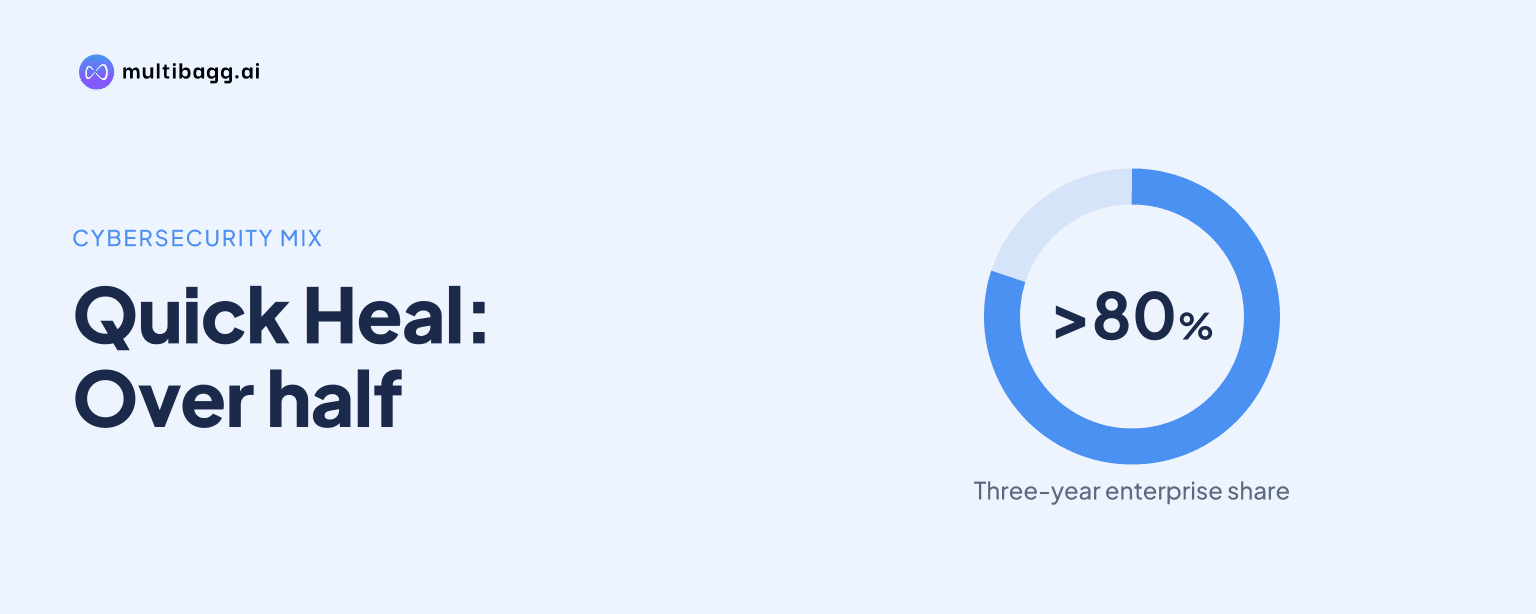
Quick Heal Technologies Limited expects enterprise cybersecurity to contribute more than 80% of revenue within three years, following Q2 FY 2027 enterprise revenue of Rs 35 crore, up 18% sequentially but down 4% year on year. Management said the shift reflects declining consumer antivirus demand and investment in endpoint, detection and response, and data-privacy products.
Know Quick Heal Technologies inside out
Results, valuation, peers and who's buying, in one view.
Why does Quick Heal expect enterprise revenue above 80%?
Quick Heal expects enterprise revenue to exceed 80% of total revenue within three years because management sees enterprise cybersecurity, rather than consumer antivirus, as its principal growth market. Joint Managing Director Sanjay Katkar said enterprise revenue contribution was almost 56%, while consumer contribution had declined to about 50%, describing a transition that has developed since the company’s 2015 listing.
The enterprise plan centres on endpoint protection platform, or EPP, endpoint detection and response, or EDR, extended detection and response, or XDR, and data privacy. Quick Heal said it has started gaining market share in small and medium businesses through EPP, EDR and XDR, while its data-privacy offering, launched in the prior year, is intended to add another enterprise revenue stream.
Management presented the 80%-plus enterprise mix as an expectation rather than formal guidance. When asked on the October 28, 2026 call for revenue and margin targets over the next three to four years, Quick Heal declined to provide them. Chief Executive Officer Harish Kumar said investment in newer offerings would scale as customer validation and references strengthen, while established endpoint products would focus on renewals, installed-base protection and profitability.
Why is Quick Heal reducing reliance on consumer antivirus?
Quick Heal is reducing reliance on consumer antivirus because management says the consumer market has declined in India and globally as operating-system providers offer default free protection. Katkar identified Microsoft, a prominent personal-computer operating-system provider, as a major challenge because its policies can include free protection by default and removal of expired antivirus versions.
Consumer revenue was Rs 36 crore in Q2 FY 2027, up 86% from Q1 FY 2027 but down 40% from Q2 FY 2026. The sequential improvement was larger than the 18% increase in enterprise revenue, yet consumer revenue remained the more sharply declining business on a year-on-year basis. Management said it had tightened credit and commercial controls, accepting that the measures could moderate near-term consumer volumes.
Quick Heal does not expect artificial-intelligence-related threats to create a near-term consumer-demand tailwind. Katkar said on the Q2 FY 2027 call that consumer demand had not changed, except potentially where attacks target individuals. Management instead sees increased awareness among enterprises and the mid-market as companies adopt artificial-intelligence agents and face potentially more sophisticated attacks.
Got a follow-up? Ask IRIS
How did Quick Heal perform in Q2 FY 2027?
Quick Heal returned to positive EBITDA in Q2 FY 2027 after an EBITDA loss in Q1, as consolidated revenue increased 44% sequentially while expenditure excluding depreciation was unchanged. Consolidated revenue was Rs 65 crore, down 22% from Q2 FY 2026, and EBITDA improved to Rs 2.3 crore from a loss of Rs 17.6 crore in Q1 FY 2027.
Profit after tax, or PAT, was Rs 5.8 crore in Q2 FY 2027, compared with a Rs 5.3 crore loss in Q1 FY 2027, producing a PAT margin of 9%. Total expenditure excluding depreciation was Rs 63 crore, flat from Q1. Chief Financial Officer Ankit Maheshwari attributed the change from negative to positive EBITDA to higher revenue and a lower operating-cost base.
Receivables fell to Rs 98 crore at the end of Q2 FY 2027 from Rs 107 crore at the end of Q1 and Rs 176 crore in Q2 FY 2026. Quick Heal linked the Rs 78 crore year-on-year reduction to tighter credit controls with partners. Deferred revenue was Rs 48 crore against Rs 52 crore in Q1 FY 2027, while the enterprise order book remained above Rs 57 crore.
Which enterprise products and customers are central to Quick Heal’s plan?
Quick Heal is targeting micro, small and medium businesses with endpoint security, EDR, XDR and data-loss prevention, or DLP, instead of attempting to serve every cybersecurity category. Management said it is not active in firewall, networking or security service edge markets. Katkar said cybersecurity spending among Indian small and mid-sized organisations remains lower than in other markets but is developing as awareness and budget allocation increase.
During H1 FY 2027, Quick Heal reported strategic wins for new-generation products in defence, banking, financial services and insurance, or BFSI, and a large information-technology services company. It also reported continuing momentum in government business. Management said these deployments can validate products in complex operating environments, improve deployment models and create references for similar customer segments.
Data privacy is the newer adjacent category in the enterprise portfolio. Quick Heal said it is engaging enterprise and public-sector customers on data-protection and compliance requirements related to the Digital Personal Data Protection, or DPDP, law. Kumar did not quantify prospective product revenue, but said management believes the data-privacy business should match the endpoint-security business very soon.
Quick Heal is also taking a selective international approach, despite being present in more than 70 countries. Management identified Italy, the Philippines and South America as markets generating continuing revenue, but did not disclose domestic and international revenue shares. The stated plan is to build meaningful positions in fewer countries rather than spread resources across many geographies.
Conclusion
Quick Heal’s Q2 FY 2027 performance illustrates its strategic transition: enterprise revenue rose 18% sequentially to Rs 35 crore, while consumer revenue rose 86% sequentially to Rs 36 crore but remained 40% below the prior-year quarter. Management’s stated path is to expand enterprise revenue through endpoint, EDR, XDR and data-privacy offerings rather than rely on a recovery in consumer antivirus.
The next measures to watch are conversion of the enterprise order book above Rs 57 crore, recurring deployments from H1 FY 2027 wins, and customer adoption of the data-privacy portfolio. Management has not set revenue or margin guidance, but it has disclosed a plan to scale investment in newer offerings as customer references and validation develop, alongside its three-year expectation for enterprise to exceed 80% of revenue.