










Raymond Lifestyle garmenting revenue rose 36% in H1 FY27
Key highlights
- Raymond Lifestyle's garmenting revenue rose 36% year on year to Rs 635 crore in H1 FY27.
- Raymond Lifestyle reported Rs 47 crore of H1 FY27 garmenting EBITDA at a 7.4% margin.
- Raymond Lifestyle moved to Rs 69 crore of net cash in September 2026 from Rs 246 crore of net debt a year earlier.
- Raymond Lifestyle's consolidated H1 FY27 EBITDA margin was 11.0%, down 40 basis points year on year.
powered by IRIS
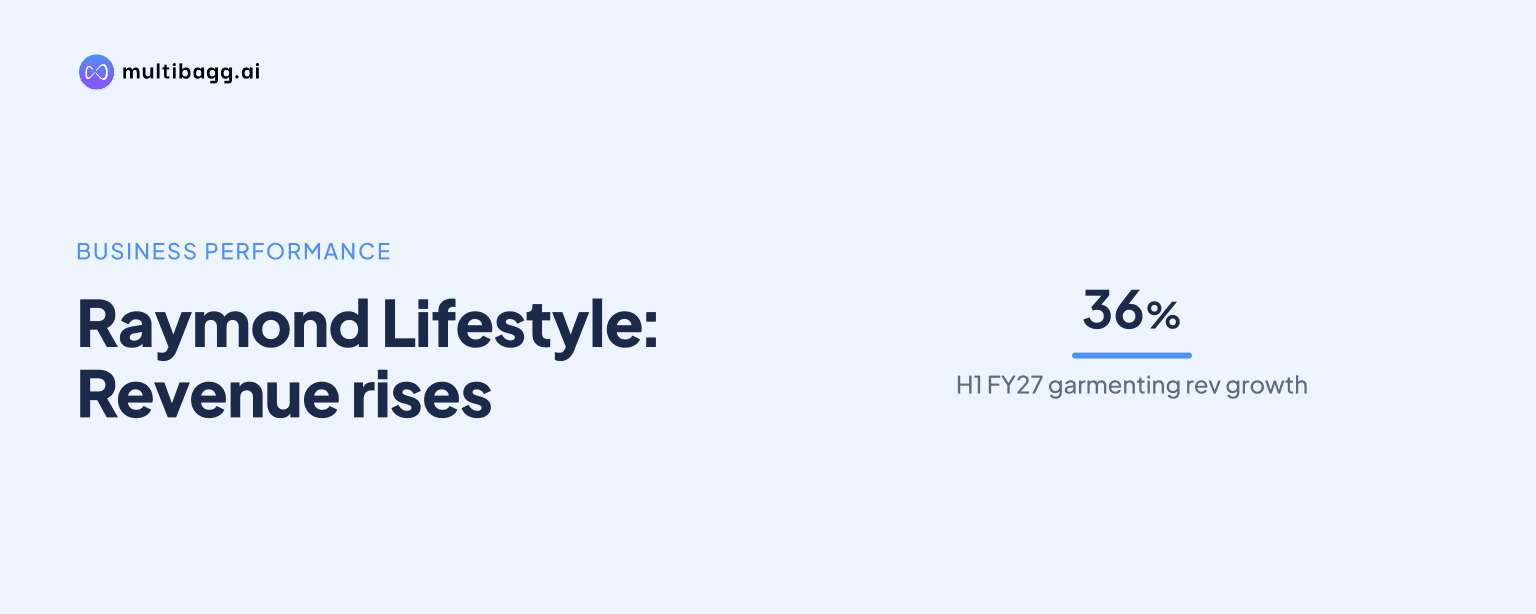
Raymond Lifestyle Limited increased garmenting revenue by 36% year on year to Rs 635 crore in H1 FY27 and reported Rs 47 crore of positive EBITDA, equal to a 7.4% margin. Consolidated total income rose 10% to Rs 3,685 crore, while EBITDA margin declined 40 basis points to 11.0%.
Know Raymond Realty inside out
Results, valuation, peers and who's buying, in one view.
How did Raymond Lifestyle's garmenting business perform in H1 FY27?
Raymond Lifestyle's garmenting segment delivered Rs 635 crore of revenue in H1 FY27, up from Rs 466 crore in H1 FY26, and recorded Rs 47 crore of EBITDA at a 7.4% margin. The presentation identifies garmenting as a key growth driver and describes the result as a turnaround in the segment.
The H1 growth rate exceeded the 26% year-on-year increase reported for Q2 FY27, when garmenting revenue reached Rs 339 crore from Rs 269 crore in Q2 FY26. Q2 EBITDA was Rs 25 crore and the segment margin was also 7.4%, indicating the same reported margin across the quarter and first half.
Management attributed export garmenting momentum to conversion of order books following US-India tariff rationalisation. The update does not quantify the order book, identify customers, or provide a breakdown of garmenting revenue between export markets.
Which segments drove Raymond Lifestyle's H1 FY27 revenue increase?
Garmenting made the largest reported revenue increase, adding Rs 169 crore over H1 FY26, followed by Branded Apparel, which added Rs 108 crore. Branded Textile remained the largest segment at Rs 1,654 crore, but its 3% growth was below garmenting's 36% rise and Branded Apparel's 14% increase.
Raymond Lifestyle said premiumisation and casualisation were lifting average selling prices, or ASPs, in Branded Textile and Branded Apparel. High Value Shirting was nearly unchanged at Rs 417 crore against Rs 416 crore a year earlier, while Emerging Business increased 12% to Rs 179 crore but had a negative 23.3% margin.
The Q2 FY27 comparison showed a similar revenue pattern. Branded Apparel rose 20% to Rs 559 crore, garmenting grew 26% to Rs 339 crore, and Branded Textile increased 7% to Rs 971 crore; Emerging Business reported a negative 23.0% margin on Rs 100 crore of revenue.
Why did Raymond Lifestyle's consolidated EBITDA margin decline?
Raymond Lifestyle reported H1 FY27 EBITDA of Rs 404 crore, up 6% from Rs 381 crore, but its EBITDA margin declined to 11.0% from 11.4% in H1 FY26. Total income grew faster than EBITDA, rising 10% to Rs 3,685 crore from Rs 3,340 crore.
Management attributed the 40-basis-point margin decline to increased marketing investment and elevated raw-material and freight costs. In Q2 FY27, consolidated EBITDA increased 4% to Rs 270 crore from Rs 259 crore, while margin declined by 120 basis points to 12.7% from 13.9%.
Profit before tax, or PBT, fell despite the increase in revenue and EBITDA. H1 FY27 PBT was Rs 53 crore, down 37% from Rs 83 crore in H1 FY26, while Q2 FY27 PBT declined 16% to Rs 91 crore from Rs 108 crore; the update provides no detailed PBT bridge.
Got a follow-up? Ask IRIS
How did Raymond Lifestyle move from net debt to net cash?
Raymond Lifestyle reported a Rs 69 crore net cash surplus in September 2026, compared with Rs 246 crore of net debt in September 2025. The company described the year-on-year movement as a turnaround of more than Rs 300 crore.
Management credited disciplined working-capital management and operational free cash flow for the September 2026 net cash position. The presentation does not disclose gross debt, cash balances, inventory, receivables, payables, or a detailed cash-flow reconciliation.
The same Rs 69 crore September 2026 position appears in both the Q2 FY27 and H1 FY27 updates. It was reported alongside H1 FY27 EBITDA of Rs 404 crore and Q2 FY27 EBITDA of Rs 270 crore, making it a period-end balance-sheet measure rather than separate quarterly cash generation.
What has Raymond Lifestyle changed in its retail network?
Raymond Lifestyle opened 24 high-traffic locations and made strategic net closures of 29 stores since September 2025. The company described these actions as network rationalisation and rebalancing, but did not disclose the resulting total store count.
The network actions occurred as Branded Apparel revenue rose to Rs 908 crore in H1 FY27 from Rs 800 crore, while Branded Textile revenue reached Rs 1,654 crore from Rs 1,605 crore. The update links branded-category momentum to premiumisation, casualisation and higher ASPs, without separately quantifying the sales or profit effect of openings and closures.
Conclusion
Raymond Lifestyle's H1 FY27 figures show garmenting becoming the fastest-growing reported segment, with Rs 169 crore of additional revenue and Rs 47 crore of EBITDA at a 7.4% margin. Branded Apparel added Rs 108 crore of revenue, while the balance sheet moved from Rs 246 crore of net debt to Rs 69 crore of net cash; however, consolidated EBITDA margin fell 40 basis points and PBT declined 37%.
The next updates will show whether export order-book conversion continues to support garmenting revenue and whether marketing, raw-material and freight pressures persist. Raymond Lifestyle has also disclosed a network-rationalisation programme involving 24 new locations and 29 net closures since September 2025, but has not provided a numerical FY27 revenue, margin or store-network target.