










Raymond Realty targets 20% pre-sales CAGR over five years
Key highlights
- Raymond Realty expects Thane to stabilise at annual pre-sales of about Rs 1,500 crore to Rs 1,600 crore.
- Raymond Realty’s existing portfolio carries Rs 52,000 crore of GDV and could generate more than Rs 10,000 crore of pre-tax cash flow over roughly four to five years.
- Raymond Realty expects to launch one Mahim project in the third quarter and another in the fourth quarter.
- Mumbai’s annual real estate sales are about Rs 2.5 lakh crore, while Raymond Realty said its participation remains small.
powered by IRIS
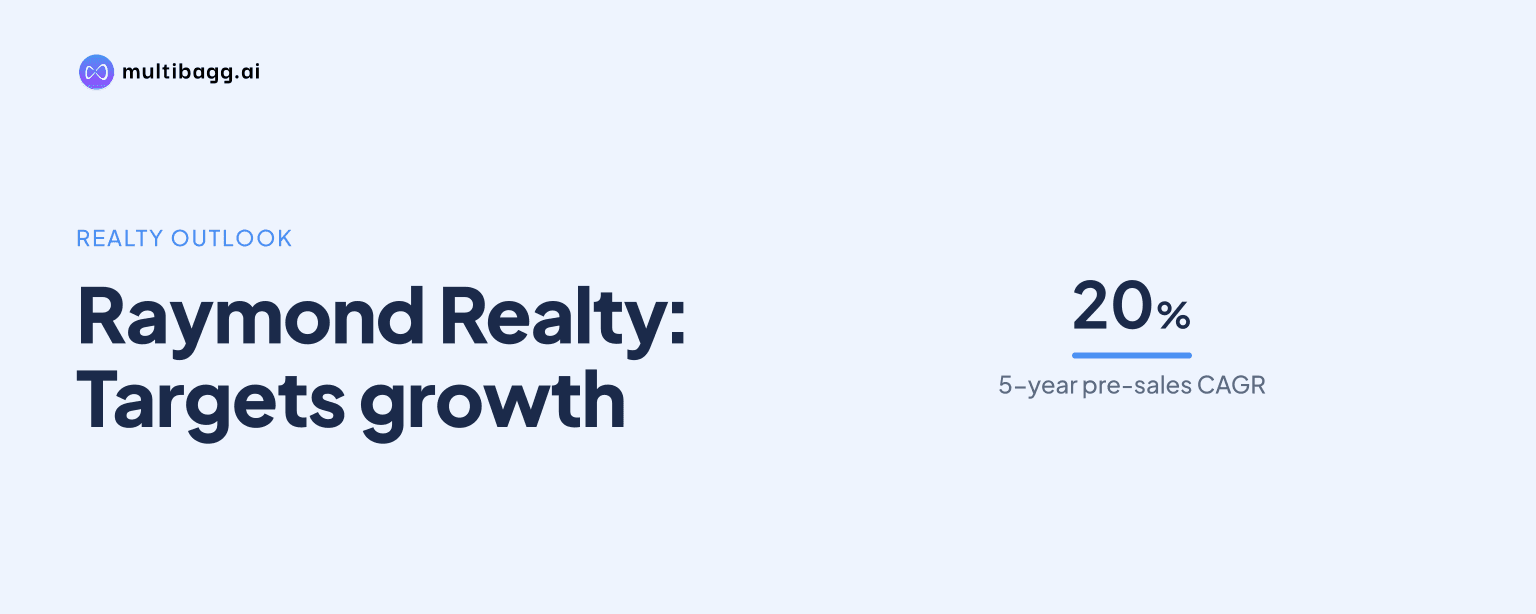
Raymond Realty Limited has set a target of approximately 20% compound annual growth rate, or CAGR, in pre-sales over the next five years, supported by annual additions of Rs 8,000 crore to Rs 10,000 crore in gross development value, or GDV. Management said the plan may require Rs 500 crore to Rs 600 crore of additional equity.
Know Raymond Realty inside out
Results, valuation, peers and who's buying, in one view.
What is Raymond Realty’s five-year pre-sales target?
Raymond Realty is targeting approximately 20% CAGR in pre-sales for the next five years. Harmohan Sahni disclosed the target on the October 28, 2026 call after the company completed its long-range planning exercise, as its previous long-range plan is due to finish by the end of the year. The figure is management’s medium-term target, not a forecast based on a stated market-growth assumption.
Management said Raymond Realty would need to add Rs 8,000 crore to Rs 10,000 crore of GDV each year to support that objective. GDV is the expected value of a project’s saleable development. Management said this annual pace of business-development additions should enable the target because Raymond Realty has already established a project base over the past few years.
Where does Raymond Realty expect growth to come from?
Raymond Realty expects growth to come from earlier-stage projects, new launches, new micro-markets and new product lines rather than primarily from further growth in Thane. Management said Thane began with annual sales of Rs 400 crore to Rs 500 crore and now contributes between Rs 1,500 crore and Rs 2,000 crore annually.
Management expects Thane to stabilise at about Rs 1,500 crore to Rs 1,600 crore a year and does not anticipate significant growth beyond that level from the location. This means the five-year pre-sales plan depends more on other projects, new micro-markets and product categories than on the Thane business, whose annual contribution has already risen by roughly Rs 1,000 crore from its initial range.
Management said Raymond Realty’s participation in Mumbai real estate remains small compared with the market’s annual sales of about Rs 2.5 lakh crore. It said growth could therefore come from entering a new micro-market, starting a new project or introducing a product line, without depending on a broad expansion in market demand. Management identified delivery of those projects, rather than finding growth avenues, as the larger challenge.
Will Raymond Realty buy land or use joint development agreements?
Raymond Realty’s stated business-development strategy is to use joint development agreements, or JDAs, rather than buy land and hold it. Management said buying land and sitting on it is not its current strategy. If Raymond Realty acquired an attractive parcel, management said it would seek to bring the project to market as quickly as possible.
The company remains open to opportunities that meet its financial criteria and commitments to stakeholders, but management said it would not take speculative bets. Its current geographic focus remains the Mumbai Metropolitan Region, or MMR. Management said it could consider an opportunity outside the MMR only where the project met its financial metrics and Raymond Realty had the execution capability to deliver it.
The JDA approach is the stated route through which Raymond Realty intends to pursue the annual Rs 8,000 crore to Rs 10,000 crore GDV-addition target. Management did not disclose a target number of JDAs, a city-by-city development pipeline or a timetable for entering markets beyond the MMR during the October 28 call.
Got a follow-up? Ask IRIS
How much equity and debt could Raymond Realty use?
Raymond Realty said it does not currently see a significant capital requirement beyond potentially Rs 500 crore to Rs 600 crore of additional equity. Management said a decision on any equity raising would be for the board and shareholders at an appropriate time. The amount is therefore a potential funding requirement, not an announced or approved fundraise.
Management later described the long-range-plan equity requirement as Rs 400 crore to Rs 600 crore, compared with the Rs 500 crore to Rs 600 crore range given in the specific five-year planning response. The lower bound was not consistent across the two answers. In both cases, management indicated it did not expect to need a significant equity raise while continuing to add projects.
Debt is expected to remain part of the capital structure. Management said gross debt of about Rs 1,200 crore would not decline for at least the next one or two years as Raymond Realty grows and adds projects. It indicated a range of Rs 1,200 crore to Rs 1,500 crore, which management said could remain within its stated 1:1 threshold.
Management also said an ICICI investment in a Mahim project would be treated as equity rather than debt under the agreed terms. The investment is structured as optionally convertible preference shares for cash-flow movement, according to management, but it said the instrument would not be classified as debt on Raymond Realty’s balance sheet.
What existing portfolio supports Raymond Realty’s plan?
Raymond Realty said its current portfolio carries Rs 52,000 crore of GDV and could generate project-level cash flow of around Rs 14,375 crore as projects are executed. Management cited selling and marketing expenses of about 5% to 6% and corporate overhead of around 5%, while adding that the overhead ratio may reduce as the business increases in scale.
For unsold and unlaunched inventory of Rs 38,800 crore, management said a 10% deduction would equal about Rs 3,800 crore. On that basis, it estimated pre-tax cash flow of more than Rs 10,000 crore from the current portfolio over roughly four to five years as projects are executed. The Rs 14,375 crore figure is project-level cash flow, while the Rs 10,000 crore-plus estimate reflects the selling, marketing and corporate costs cited by management.
Management said execution is the principal requirement for converting this portfolio into the planned growth. At Mahim, it said one project would be launched in the third quarter and another in the fourth quarter. The volume of inventory opened for sale has not been decided and will be determined closer to launch based on market conditions and feedback from participants.
Conclusion
Raymond Realty’s five-year blueprint combines an approximately 20% pre-sales CAGR target with annual additions of Rs 8,000 crore to Rs 10,000 crore in GDV. The plan shifts the expected source of expansion from a stabilising Thane contribution towards earlier-stage projects, new micro-markets and product lines, while retaining JDAs as the stated business-development strategy.
The next disclosures to watch are the pace of annual GDV additions, the third- and fourth-quarter Mahim launches, and any board and shareholder decision on additional equity. Management also said gross debt is likely to remain around Rs 1,200 crore to Rs 1,500 crore for at least the next one or two years as Raymond Realty adds projects.