










Raymond Realty says new JDAs turn cash-positive in year three
Key highlights
- New Raymond Realty JDA projects are typically cash-flow negative for 2 years before turning positive in the third year or mid-third year.
- Raymond Realty had net debt of Rs 912 crore and gross debt of about Rs 1,200 crore at the end of Q2 FY27.
- JDAs represented about 52% of Raymond Realty’s approximately Rs 52,000 crore GDV portfolio, while non-Thane projects contributed 57% of H1 FY27 pre-sales.
- Raymond Realty expects cash flows to become more stable within 2 years as 8 to 10 projects outside Thane mature.
powered by IRIS
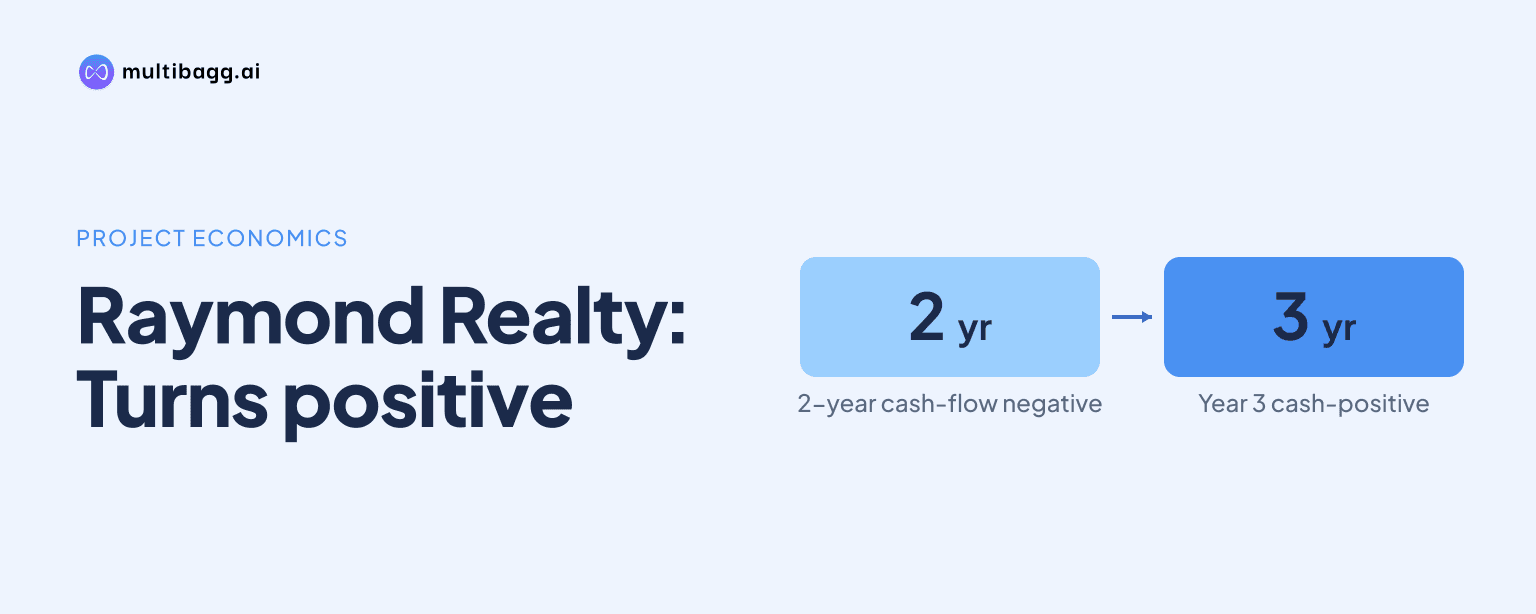
Raymond Realty Limited said on October 28, 2026, that a newly launched joint development agreement, or JDA, project is typically cash-flow negative for its first two years because of upfront investment, then turns positive from the third year or mid-third year. Management expects more stable portfolio cash flows within two years as 8 to 10 projects outside Thane mature.
Know Raymond Realty inside out
Results, valuation, peers and who's buying, in one view.
How long do Raymond Realty’s new JDA projects remain cash-negative?
Raymond Realty said a new JDA project normally remains cash-flow negative for the first two years, before becoming cash-flow positive from the third year or the middle of that third year. Management attributed the initial deficit to upfront investment, describing this progression as the typical cycle for a project moving from the early stage through the mid-stage and later phase.
The company separated its first-half FY27 cash-flow discussion between mature projects and recently launched or yet-to-be-launched projects to show that timing difference. Mature projects are generating operating cash flow that is being reinvested in new projects, while the early-stage JDA pipeline requires capital before it begins producing positive cash flow. Management said this is why cash-flow results can vary during the current growth phase.
Raymond Realty’s JDA strategy has expanded over the past 2.5 to 3 years, during which four projects in Bandra, BKC, Wadala and Sion were launched. Those four projects had generated cumulative sales value of Rs 3,432 crore and collections of Rs 857 crore by the date of the Q2 FY27 call, but management did not provide individual project-level cash-flow timing.
Which projects are currently funding Raymond Realty’s expansion?
Raymond Realty said its existing mature projects are providing operating cash flows that are being reinvested into recently launched and planned developments. It also said its Thane business is already net cash positive, making it an established source of cash generation while newer JDA projects pass through their initial two-year investment phase.
The Thane land parcel has a total revenue potential of Rs 25,000 crore, of which about 65 acres were under development, representing Rs 16,500 crore of revenue potential. Of that under-development potential, the company said it had sold Rs 9,770 crore over the years and collected Rs 7,977 crore since the business began. This contrasts with the four launched JDA projects, where collections have started to build but projects are at earlier stages.
JDA projects represented about 52% of Raymond Realty’s total gross development value, or GDV, portfolio of approximately Rs 52,000 crore at current prices. In H1 FY27, projects outside the legacy Thane land contributed 57% of pre-sales, compared with 43% from Thane, showing that sales contribution from the diversified JDA-led portfolio had moved ahead of the legacy land contribution.
Got a follow-up? Ask IRIS
Why has Raymond Realty’s debt risen during the expansion phase?
Raymond Realty closed Q2 FY27 with net debt of Rs 912 crore and gross debt of about Rs 1,200 crore, as new projects launched toward the end of Q4 of the prior year entered their early capital-requirement stage. Management said the preceding year’s debt base was unusually low because the portfolio then comprised mature projects and only one or two early-stage developments.
The company reported a debt-to-equity ratio of 0.8 times and said net debt-to-equity was closer to 0.5 times, below its 1:1 ceiling. It also reported a Rs 308 crore liquidity buffer and a 9.6% cost of debt, which management said funded construction requirements for the current year. These figures describe the financing capacity management cited while cash from mature projects is being deployed into new developments.
Interest cost in Q2 FY27 was Rs 44 crore, comprising Rs 27 crore on bank borrowings and Rs 17 crore paid to government authorities for approval-related payments. Management said the authorities included BMC, TMC and MHADA, and that such approval costs can be paid over time with nominal interest. An analyst noted that interest expense had reached Rs 91 crore in the first half, but the supplied call excerpt did not contain management’s answer on the full-year interest-cost outlook.
Management said debt could stabilize in a range of Rs 1,200 crore to Rs 1,400 crore, compared with an average of roughly Rs 300 crore to Rs 400 crore in the prior year. This was management’s illustration of how year-on-year debt comparisons may become less pronounced after the enlarged project pipeline moves beyond the initial launch stage; it was not a formal debt target.
When does Raymond Realty expect portfolio cash flows to stabilize?
Raymond Realty estimates that cash flows will become more stable within two years, once 8 to 10 projects outside Thane are under execution and begin generating cash, alongside Thane’s already net cash-positive position. Management said both cash-flow stability and quarter-on-quarter financial stability should improve as the current hyper-growth phase settles.
The company’s H1 FY27 operating figures indicate the scale of the expansion occurring before that expected steady state. Customer collections rose 67% year on year to Rs 682 crore in Q2 FY27, while cumulative first-half collections reached Rs 1,233 crore. Booking value increased 111% year on year to Rs 1,602 crore in H1 FY27, and management said non-Thane projects accounted for 57% of the period’s pre-sales.
Raymond Realty also reported total income of Rs 757 crore in Q2 FY27, up 7% year on year, and earnings before interest, tax, depreciation and amortisation, or EBITDA, of Rs 115 crore. EBITDA margin rose to 15% from 14% a year earlier. Management said margins can fluctuate by project phase because of upfront marketing and construction set-up costs and are expected to normalise as more projects enter the mid-stage.
The funding plan includes Rs 210 crore raised by a subsidiary from an alternative investment fund promoted by ICICI Prudential AMC Limited, as well as approximately Rs 410 crore of promoter equity that management said had been committed. For the ICICI-backed redevelopment project, the fund is to provide 60% of required capital up to Rs 210 crore, while Raymond Realty provides 40%; management said it will receive a fee equal to about 5% of project turnover and share remaining profit equally.
Conclusion
Raymond Realty’s stated cash-flow trade-off is that mature assets, particularly the net cash-positive Thane business, support investment in newer JDAs that are expected to consume cash for two years. The portfolio has shifted toward those newer developments, with JDAs forming 52% of Rs 52,000 crore of GDV and non-Thane projects supplying 57% of H1 FY27 pre-sales, so project maturity will increasingly shape reported cash flow.
The next disclosed milestones are two Mahim launches in H2 FY27 with combined GDV of about Rs 4,100 crore. Management maintained its FY27 guidance of at least 20% pre-sales growth, 20% return on capital employed, EBITDA margin of 17% to 19%, and profit-after-tax margin of 9% to 10%; progress toward those measures and the expected two-year cash-flow stabilisation are the stated items to watch.