










Raymond Realty retains half of Mahim redevelopment residual profit
Key highlights
- Raymond Realty will contribute 40% of Mahim project capital while an ICICI Prudential AMC-backed AIF provides nearly 60% through Rs 210 crore of OCPRS funding.
- Raymond Realty will charge a 5% project-turnover fee and receive 50% of residual profit from the Mahim redevelopment.
- Raymond Realty reported Q2 FY27 total income of Rs 757 crore, EBITDA of Rs 115 crore and customer collections of Rs 682 crore.
- Raymond Realty maintained FY27 targets of at least 20% pre-sales growth, 17% to 19% EBITDA margin and 9% to 10% profit-after-tax margin.
powered by IRIS
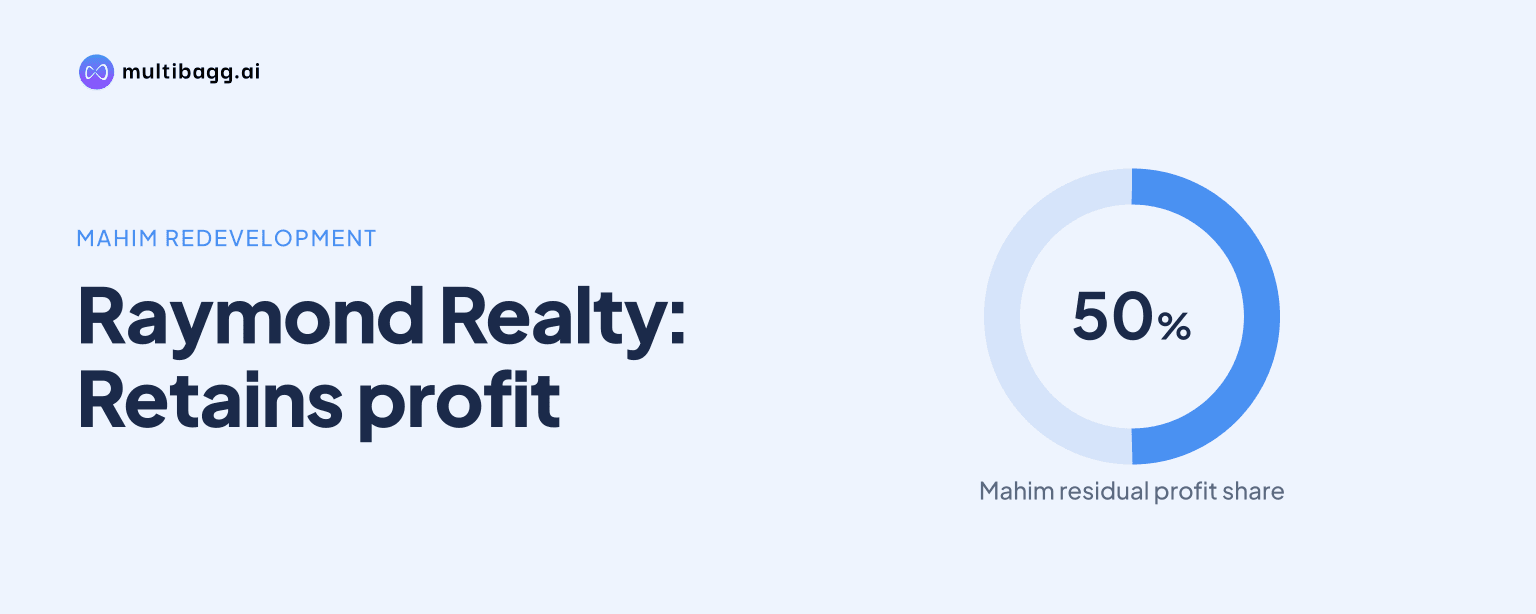
Raymond Realty Limited has agreed a Rs 210 crore Mahim redevelopment funding structure under which an alternative investment fund promoted by ICICI Prudential AMC Limited will provide nearly 60% of peak project capital. Raymond Realty will provide 40%, charge a 5% fee on project turnover and receive 50% of residual profit, management said on October 28, 2026.
Know Raymond Realty inside out
Results, valuation, peers and who's buying, in one view.
How is Raymond Realty’s Mahim AIF deal structured?
Raymond Realty’s subsidiary will receive Rs 210 crore through optionally convertible preference shares, or OCPRS, from the ICICI Prudential AMC Limited-promoted AIF. Management said this amount represents nearly 60% of the peak capital required for the Mahim redevelopment, with Raymond Realty contributing the other 40%.
Raymond Realty is the project’s execution partner and will charge a fee equal to 5% of total project turnover, management said. The profit remaining after that arrangement will be divided equally between Raymond Realty and the AIF, giving Raymond Realty a 50% share of residual profit despite its 40% capital contribution.
Management did not disclose the project’s total peak-capital requirement, turnover, gross development value, or expected profit. It also did not provide the OCPRS conversion terms, although it said the Rs 210 crore would be treated as equity rather than debt under the agreed accounting terms.
What does the funding change in Raymond Realty’s capital model?
The AIF funding adds external project equity to Raymond Realty’s asset-light expansion model. Management said the structure shares risk with another market participant, provides capital for faster growth and creates a 5% execution-fee income stream that was not previously part of its revenue model.
The project funding sits alongside promoter equity. Management said the promoter had committed about Rs 400 crore, while a later response put the infusion at approximately Rs 410 crore. The first promoter tranche was scheduled shortly after the October 28 call, with the balance proceeding under shareholder-approved arrangements.
Raymond Realty’s debt increased as it launched newer projects. At the end of Q2 FY27, gross debt was about Rs 1,200 crore and net debt was Rs 912 crore, compared with management’s stated Rs 300 crore to Rs 400 crore average debt range in the prior year. Management attributed the rise to projects launched toward the end of the preceding Q4, which required upfront capital.
Management said it intends to remain within its 1:1 debt-to-equity ceiling and expects debt to remain broadly between Rs 1,200 crore and Rs 1,500 crore for the next one to two years. Q2 FY27 interest cost was Rs 44 crore, including Rs 27 crore on bank borrowings and Rs 17 crore on payments to government authorities, while the reported liquidity buffer was Rs 308 crore.
How does Mahim compare with Raymond Realty’s portfolio?
Mahim forms part of a portfolio where joint-development agreement projects, or JDAs, account for about 52% of Raymond Realty’s Rs 52,000 crore gross development value, or GDV. JDA projects have Rs 27,000 crore of revenue potential at current prices, exceeding the Rs 25,000 crore potential of the Thane land parcel.
Projects outside the legacy Thane land contributed 57% of booking value in H1 FY27, compared with 43% from Thane. Management said the non-Thane contribution should increase because it expects most future growth to come from projects outside Thane.
Raymond Realty plans two Mahim launches in H2 FY27, with one scheduled for Q3 and one for Q4. Their combined GDV is about Rs 4,100 crore. Management confirmed that the Rs 210 crore AIF investment is currently against a Mahim project, but did not identify which launch it supports or state the amount of inventory to be opened for sale.
Four launched JDA projects in Bandra, BKC, Wadala and Sion generated sales value of Rs 3,432 crore and collections of Rs 857 crore over the past 2.5 to three years. In comparison, the 100-acre Thane parcel had sold about Rs 9,770 crore and collected Rs 7,977 crore since the business began, from its Rs 25,000 crore revenue potential.
Got a follow-up? Ask IRIS
When will Raymond Realty receive the AIF funding?
Raymond Realty expects the AIF money in tranches. Management said the first part of the Rs 210 crore was expected within 30 days of the October 28, 2026 call, while the balance was expected by the end of the financial year in March.
The funding timing coincides with the early cash requirements of new JDA projects. Management said a new JDA is typically cash-flow negative for its first two years because of upfront investment, before becoming cash-flow positive from the third year or the middle of the third year.
Management said mature projects are generating operating cash flows that are being reinvested in recently launched and yet-to-be-launched projects. It expects a steadier cash-flow position in around two years, when eight to 10 projects outside Thane are under execution and generating cash, while Thane is already net cash positive.
Raymond Realty said it would consider similar institutional arrangements for suitable projects. Management described the AIF structure as beneficial to internal rate of return, or IRR, and said project-level institutional capital would remain part of its strategy where the opportunity is appropriate.
What are Raymond Realty’s financial targets for FY27?
Raymond Realty maintained its FY27 guidance for at least 20% pre-sales growth, return on capital employed of 20%, earnings before interest, taxes, depreciation and amortisation, or EBITDA, margin of 17% to 19%, and profit-after-tax margin of 9% to 10%. Management did not issue formal revenue-growth guidance because percentage-of-completion accounting across more projects creates multiple variables in reported turnover.
In Q2 FY27, total income increased 7% year on year to Rs 757 crore, while EBITDA reached Rs 115 crore and the EBITDA margin rose to 15% from 14% in the corresponding quarter. Raymond Realty said it nearly doubled quarterly pre-sales without new launches, attributing the result to sales velocity and steady realisations from existing projects.
Customer collections increased 67% year on year to Rs 682 crore in Q2 FY27, and H1 collections reached Rs 1,233 crore. H1 booking value rose 111% year on year to Rs 1,602 crore, with the 57% non-Thane contribution exceeding Thane’s 43% share.
For its next five-year planning period, management expects approximately 20% compound annual growth in pre-sales. It said annual GDV additions of Rs 8,000 crore to Rs 10,000 crore could support that target, and estimated additional equity needs of Rs 500 crore to Rs 600 crore beyond funds already raised.
Conclusion
The Mahim arrangement shows Raymond Realty using institutional project capital while retaining 50% of residual profit and earning a 5% turnover-based execution fee. The deal supplies nearly 60% of peak project capital from the AIF while Raymond Realty contributes 40%, fitting management’s stated effort to expand JDAs without relying entirely on balance-sheet funding.
The next developments to watch are the first AIF tranche within 30 days of October 28, 2026, receipt of the balance by March, and the two Mahim launches planned for Q3 and Q4 FY27. Management had not decided how much inventory to release at launch, while maintaining its target of at least 20% FY27 pre-sales growth.