








RBZ targets Rs 150 crore GML and near-full inventory hedge
MAX Plan at ₹4,999/yr

Find your next multibaggerBe a Pro Investor
Research stocks and track your picks on the go. Download the app.
Key highlights
- RBZ targets Rs 100 crore to Rs 150 crore of GML by its Q1 FY28 earnings-call timeframe.
- Management said GML typically costs 3.5% to 4%, compared with 9% for cash-credit funding.
- RBZ aims to reduce unhedged inventory to zero or a very low level within about two years.
- RBZ expects new-store inventory turnover of 1 to 1.2 times in year one and 2 to 2.5 times by year three.
powered by IRIS
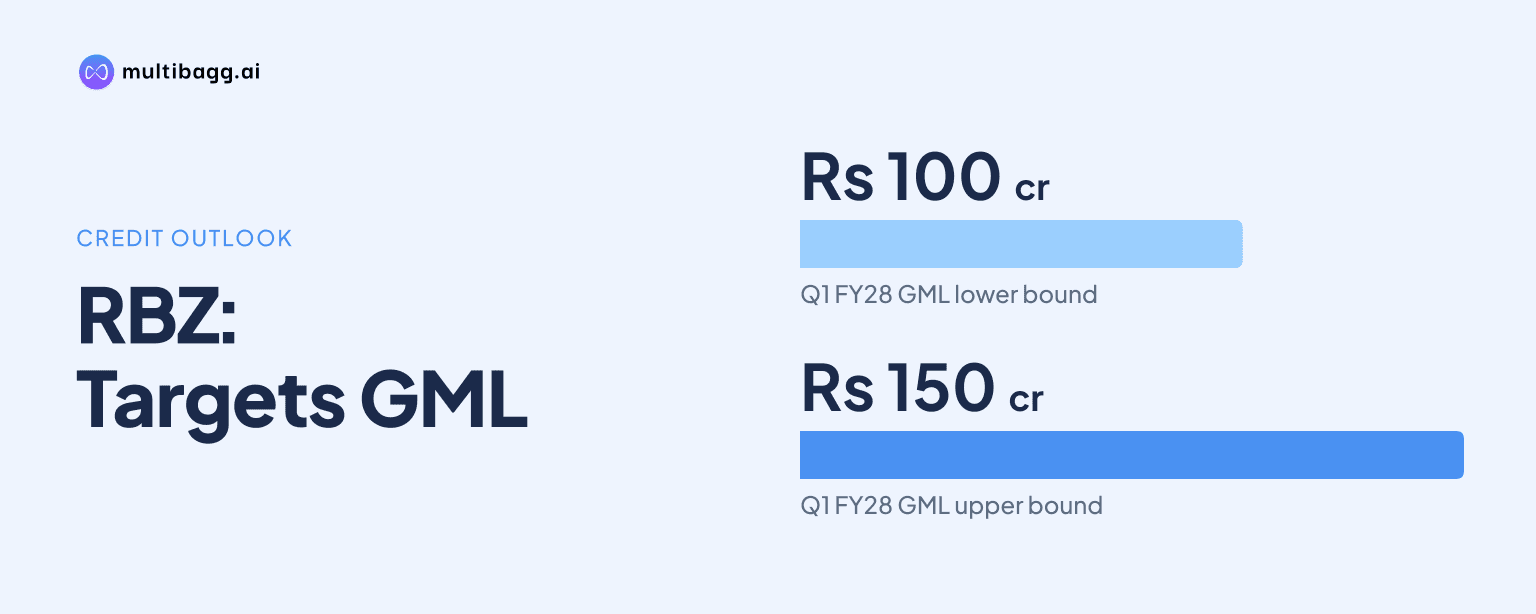
RBZ Jewellers Limited plans to build Rs 100 crore to Rs 150 crore of gold-metal loans, or GML, by its Q1 FY28 earnings call and bring unhedged inventory to zero or a very low level within about two years. Management said GML typically costs 3.5% to 4%, compared with 9% for cash-credit facilities.
Know RBZ Jewellers inside out
Results, valuation, peers and who's buying, in one view.
How much gold-metal lending does RBZ plan by Q1 FY28?
RBZ plans a minimum Rs 100 crore to Rs 150 crore of GML within the next two quarters, or six months, which management linked to the Q1 FY28 earnings-call timeframe. Management said this would represent more than 100 kilograms of GML. The target is a change in working-capital funding rather than a plan to liquidate inventory.
GML is part of working capital, according to management. In this arrangement, lenders provide gold-linked funding that RBZ can use in its operating cycle. Management used an example of GML accounting for about 2% to 3% of total borrowings, while an investor referred to a 6% to 6.5% share; management did not confirm a precise current proportion.
Management said it will review the GML mix month by month, considering gold-price conditions and lenders' willingness to extend the facility. Not all lenders offering cash-credit, or CC, limits also offer GML, but RBZ said it is seeking higher GML limits from lenders that do. The company said the change should become visible in its books over upcoming quarters.
Why is RBZ increasing gold-metal loan funding?
RBZ says the principal purpose is to hedge the gold commodity component of inventory and make profit and loss outcomes more predictable. Management said unhedged inventory can be retained when a company is not trying to predict short-term profit, but described hedging as the appropriate long-term practice for improving financial visibility.
The funding-cost difference is also central to the plan. Management said GML generally costs 3.5% to 4%, compared with 9% for CC funding. It said the lower rate could support more working capital for the same interest payout and potentially enable additional stores without reducing physical inventory.
Management described gold as moving by around 13% annually in its broad framework, comprising approximately 7% from the gold commodity, custom duty that can range from around 6% to 15%, and dollar appreciation of around 6%. RBZ said GML hedges the commodity component, rather than every part of this price movement. These figures were management's explanation of the mechanism, not a formal gold-price forecast.
RBZ also said it does not intend to sell inventory and simply use the proceeds to reduce debt. Instead, it expects a cycle of paying for GML and taking GML again while retaining inventory for operations. Management said a 2:1 debt-ratio scenario could permit more working capital because lower-cost GML would reduce the interest burden relative to CC funding.
Got a follow-up? Ask IRIS
When will RBZ hedge nearly all of its inventory?
RBZ expects its inventory to be hedged within a maximum of 2 to 2.5 years, while management said unhedged inventory should reach zero or a very low level in the next two years. It also said the unhedged proportion should decline continuously each year rather than falling only at the end of the programme.
The plan is intended to retain or increase inventory, not cut it. When asked whether inventory could double, management said that was the right understanding, while adding that inventory would increase first. RBZ did not disclose a starting inventory value, an annual hedge-ratio target or a detailed schedule beyond the two-year to 2.5-year horizon.
This distinction matters because the proposed change is to the funding and risk profile of inventory. Management described GML as a recurring funding cycle against gold stock, with the stock remaining available for retail expansion, wholesale activity and job work. RBZ said its business-to-business, or B2B, operations would remain stable on a gross merchandise value, or GMV, basis, while business-to-consumer growth would be the main driver.
How does the GML plan support RBZ's store expansion?
RBZ said lower-cost GML could provide working capital for more stores without a matching increase in interest expense. Management discussed four new stores in its expansion plan and scheduled Rajkot for November 21 to November 25, with Maninagar expected in December and Gandhinagar in January. The company said additional showrooms require more inventory.
The Surat store recorded about Rs 50 lakh of jewellery sales in its first month, excluding bullion and coin sales, while average ticket sizes were about Rs 3.5 lakh to Rs 4 lakh. RBZ expects new showrooms to achieve inventory turnover of around 1 to 1.2 times in year one, rising to 2 to 2.5 times by the end of three years.
Retail was the leading growth driver among wholesale, job work and retail, management said, although it did not disclose a retail growth percentage. Management said wholesale grew 31%. It also said retail gross margin can rise with a larger studded-jewellery mix, whereas higher bullion sales reduced reported gross margin because bullion has a different margin profile.
RBZ budgeted Rs 20 crore to Rs 25 crore for marketing during the year, with management placing the likely outlay near the higher end because of store openings. The plan includes potential celebrity launches, hoardings, above-the-line and below-the-line marketing. The GML strategy therefore sits alongside planned spending on retail rollout and branding.
Conclusion
RBZ's funding plan combines a near-term target of Rs 100 crore to Rs 150 crore of GML by Q1 FY28 with a longer aim to hedge nearly all inventory within up to 2.5 years. Management's stated rationale is the typical 3.5% to 4% GML cost against 9% for CC funding, together with reduced exposure to the commodity portion of gold-price movements while retaining stock for operations.
The next disclosures to watch are the GML balance in upcoming quarterly books, the pace of reduction in the unhedged share and the availability of higher GML limits from lenders. Operationally, management scheduled Rajkot for November 21 to November 25, followed by Maninagar in December and Gandhinagar in January, while targeting 2 to 2.5 inventory turns for new stores by their third year.

