








RBZ Jewellers: Q2 margins squeezed despite 55% revenue growth
MAX Plan at ₹4,999/yr

Find your next multibaggerBe a Pro Investor
Research stocks and track your picks on the go. Download the app.
Key highlights
- RBZ Jewellers' Q2 FY27 revenue rose 55% year-on-year to Rs 225 crore.
- Retail revenue increased 72% year-on-year to Rs 148 crore in Q2 FY27.
- Finance cost rose from Rs 2.55 crore to Rs 5.54 crore as Surat inventory was carried before opening.
- The Surat store averaged approximately Rs 50 lakh in daily sales during October, according to management.
powered by IRIS
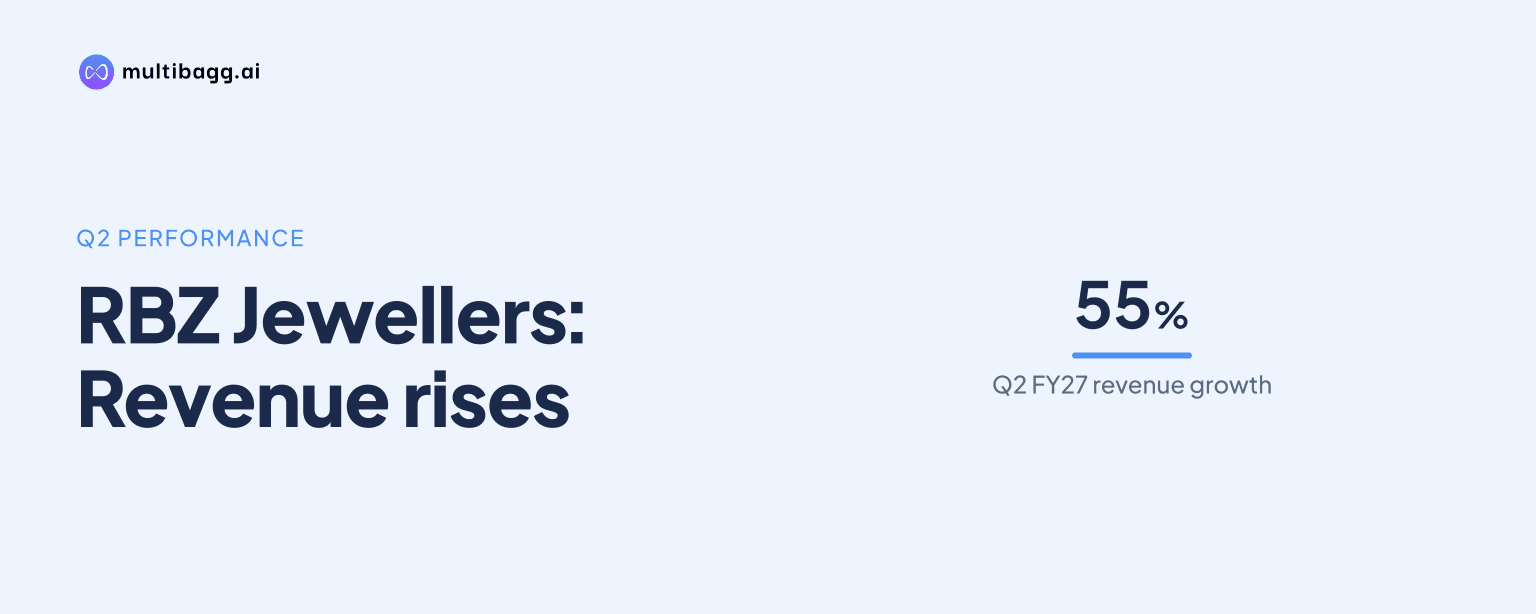
RBZ Jewellers Limited reported 55% year-on-year revenue growth to Rs 225 crore in Q2 FY27, but earnings before interest, tax, depreciation and amortisation (EBITDA) rose only 3.5% to Rs 29 crore and profit after tax was Rs 16 crore, as Surat launch timing, carrying costs, promotion and bullion sales reduced profitability.
Know RBZ Jewellers inside out
Results, valuation, peers and who's buying, in one view.
Why did RBZ Jewellers' Q2 FY27 margin decline?
RBZ Jewellers' margin declined because costs associated with the Surat store launch rose before the outlet began selling, while a portion of B2B transactions included lower-margin bullion sales. Q2 FY27 EBITDA was Rs 29 crore, up 3.5% year-on-year, but its EBITDA margin was 13%. Profit after tax, or PAT, was Rs 16 crore, equivalent to a 7.3% margin, compared with a 12% PAT margin a year earlier.
Management identified three cost movements below the gross-margin line: higher finance cost, higher depreciation and promotional spending. Finance cost rose from Rs 2.55 crore to Rs 5.54 crore because inventory had been built for Surat before the store opened. Depreciation increased from Rs 86 lakh to Rs 1.70 crore, while management said promotional or one-time expenses had risen by about Rs 5 crore to Rs 6 crore.
How did revenue and segment sales change in Q2 FY27?
RBZ Jewellers grew revenue 55% year-on-year to Rs 225 crore in Q2 FY27, led by retail, which increased 72% to Rs 148 crore. Wholesale revenue grew 31%, while Job Work revenue was about Rs 3.30 crore, up 19%. The result therefore showed growth across all three reported businesses, but retail was the largest disclosed revenue contributor in the quarter.
Volume disclosures show that Job Work remained the largest activity by gold weight, even though retail led reported sales growth. Retail volume was 96 kg, wholesale volume was 47 kg and Job Work volume was 219 kg, for a total of 363.58 kg in Q2 FY27. Management did not provide a PAT contribution by segment, so the transcript does not establish how much profit Job Work generated relative to retail or wholesale.
The difference between sales growth and profit growth also reflects the sales mix cited by management. RBZ Jewellers said gold shifted from B2B to B2C and that vendor payments led to some bullion sales being included in B2B business. Bullion transactions carry lower margins than jewellery-led transactions, according to management's explanation, contributing to the decline in gross margin even as total revenue reached Rs 225 crore.
Did falling gold prices create an inventory loss for RBZ Jewellers?
RBZ Jewellers said it had no inventory loss in Q2 FY27, despite management describing gold as having depreciated during the fiscal year rather than appreciated. The company said gross margin had declined and that gold gains were limited, but it explicitly rejected the suggestion that falling prices had produced an inventory loss at the time of the call.
That distinction matters because management attributed the finance-cost increase to inventory carrying rather than a write-down in the value of stock. Finance cost rose by Rs 2.99 crore year-on-year, from Rs 2.55 crore to Rs 5.54 crore, after inventory for the Surat outlet was held for longer than expected. The company said the store opening was delayed, which extended the period during which the stock carried interest cost.
Management also separated bullion-related mix effects from price-related inventory effects. It said the lower gross margin partly reflected bullion sales connected to the B2B-to-B2C shift and vendor payments, whereas the absence of inventory loss meant it did not report a loss on stock valuation. The transcript does not quantify the share of Q2 FY27 revenue represented by bullion or the precise gross-margin change.
Got a follow-up? Ask IRIS
What did the Surat store launch cost RBZ Jewellers?
The Surat launch increased Q2 FY27 costs because the store opened near the end of September after inventory had been carried for about two and a half months. Management said the opening occurred around September 24 and sales began on September 25. The earlier planned opening had been expected to reduce the period for which financing costs were incurred on store inventory.
Besides the increase to Rs 5.54 crore in finance cost, depreciation climbed to Rs 1.70 crore from Rs 86 lakh. Management also described roughly Rs 5 crore to Rs 6 crore of promotional spending as a one-time expense. It said the cumulative effect of those costs was visible in PAT, which stood at Rs 16 crore and a 7.3% margin in Q2 FY27.
The launch nevertheless produced early sales data, though management characterised it as approximate and affected by the Shraadh and Navratri periods. RBZ Jewellers said the Surat outlet averaged around Rs 50 lakh of sales a day in October, its first full month of operation. Management tracks walk-ins, conversion ratio, sales and ticket size, as well as individual salesperson performance, to assess the store's progress.
Can the Surat store improve profitability after its opening phase?
Management expects the Surat store's capital expenditure to break even within a maximum of one year, excluding inventory. It put capital expenditure for a large-format store at about Rs 10 crore to Rs 15 crore and said typical inventory can be about Rs 150 crore. These are management expectations and examples, not reported Q2 FY27 profitability for Surat.
For a mature store, management said it expects inventory turns of about 2.5 times. It described a progression of about one turn on a trailing-12-month basis, then 1.75 and 2.25, while cautioning that these were forward-looking assumptions. The only current operating indication disclosed on the call was the approximate Rs 50 lakh daily sales average in October.
At the company level, management said consolidated EBITDA margin could be sustained at 11% to 12% if services remained at the same level, adding that it had sustained this range for three years. It also said retail offers better profit potential than Job Work, although retail expansion can initially lower consolidated margins because of investment in brand and stores. This view is management commentary rather than guidance for a specific future quarter.
Conclusion
RBZ Jewellers' Q2 FY27 figures show that sales expansion did not translate proportionately into profit because the Surat rollout combined delayed inventory deployment, higher interest and depreciation, and promotional spending with a lower-margin bullion mix. Revenue rose 55% to Rs 225 crore and retail rose 72% to Rs 148 crore, while PAT margin declined from 12% to 7.3%.
The next items to watch are the Surat outlet's sales conversion and inventory turns after its October average of about Rs 50 lakh a day, and whether launch-related costs recede. Management plans to add four stores in the current year and said it could open around three to four stores annually, while expecting Surat capital expenditure, excluding inventory, to break even within one year.

