










Regaal sets FY28 EBITDA floor at Rs 4,500 per tonne baseline
Key highlights
- Regaal reported EBITDA of Rs 6,000 per tonne in the quarter ended 30 September 2026 and Rs 5,300 per tonne in H1.
- Management said Rs 4,500 per tonne is an easily sustainable FY28 EBITDA baseline.
- Regaal held about 90% of its H2 maize requirement in inventory for use through about 15 March.
- Net debt was Rs 880.8 crore at 30 September 2026, including Rs 350.6 crore of working-capital borrowings.
powered by IRIS
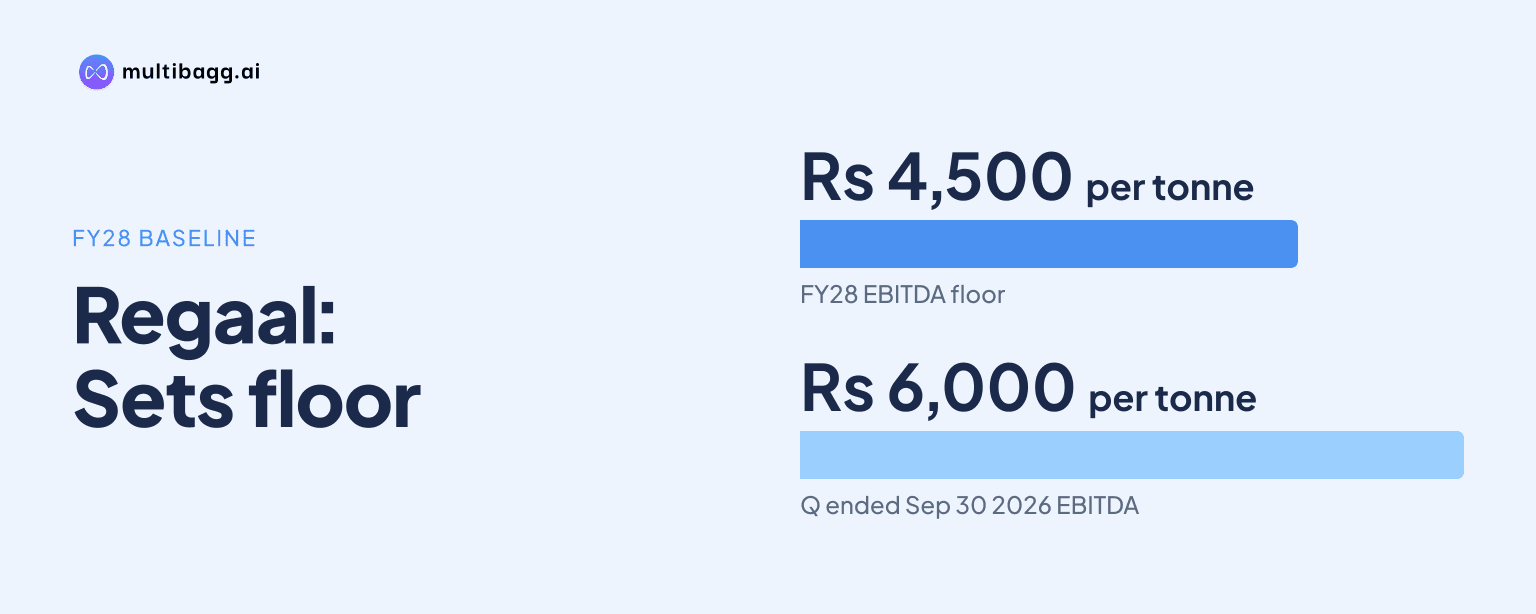
Regaal said Rs 4,500 per tonne is its FY28 EBITDA floor, compared with Rs 6,000 per tonne in the quarter ended 30 September 2026, as about 90% of its H2 maize requirement was already held in inventory. Management said the quarterly result reflected higher selling prices, capacity utilisation and product-mix progress, but cautioned that commodity spreads fluctuate.
Know Regaal Resources inside out
Results, valuation, peers and who's buying, in one view.
What is Regaal’s FY28 EBITDA-per-tonne baseline?
Regaal’s FY28 baseline is Rs 4,500 of earnings before interest, tax, depreciation and amortisation (EBITDA) per tonne, which management said was “easily sustainable.” Management did not commit to a higher FY28 outcome because maize costs and prices of starch and other outputs can move materially in a commodity business.
Management said EBITDA per tonne, rather than EBITDA margin as a percentage of revenue, is the appropriate measure for its operations. It described Rs 4,500 per tonne, with a variation of roughly 5% above or below that amount, as the operating reference point. In the quarter ended 30 September 2026, EBITDA per tonne was Rs 6,000, while the H1 figure was Rs 5,300.
The FY28 baseline is below the latest reported run rate. Management said the quarter’s Rs 6,000 per tonne should not be treated as a fixed outcome because finished-product pricing and maize procurement costs change through the cycle. It characterised any performance above its operating reference point as an upside from prevailing market conditions rather than a guaranteed result.
Why did Regaal reach Rs 6,000 EBITDA per tonne in Q2?
Regaal said its Rs 6,000-per-tonne Q2 result was driven principally by higher sales realisations, new markets and exports, alongside operating leverage from expanded capacity. Management said higher plant utilisation reduced fixed cost per unit, while the spread between maize and starch widened and value-added products began to be introduced in stages.
The financial results reflected higher manufacturing activity. Operating income for the quarter ended 30 September 2026 was Rs 316.6 crore, while core manufacturing revenue increased 64% year on year to Rs 314.1 crore from Rs 191.6 crore in Q2 FY26. Operating EBITDA increased 54.7% to Rs 54.2 crore, producing a 17.1% EBITDA margin, and profit after tax rose 38.7% to Rs 23.2 crore.
Management said maize prices had risen from about Rs 10 to Rs 15, an increase of more than 50%, but prices for an estimated 80% to 85% of finished products had also increased. It described the value-addition spread as moving from around 10% earlier to around 20%. This pricing movement, rather than fixed-cost absorption alone, was identified as the main contributor to the quarterly EBITDA outcome.
A like-for-like comparison is also affected by the lower role of trading. Management said Q2 FY26 included Rs 127 crore of trading sales, whereas trading sales in the latest quarter were negligible. It said trading margins are around 5% to 6% and that manufacturing-only EBITDA per tonne was Rs 4,000 in the prior financial year, rather than estimates derived using total sales.
Got a follow-up? Ask IRIS
How does Regaal’s maize inventory support H2 earnings?
Regaal said about 90% of its entire H2 maize requirement was in inventory at its plant, with the material expected to be used from around 15 October until about 15 March. Management said this stock was procured from the rabi crop, while much of the industry was using kharif-crop maize, and described rabi maize as having been bought at favourable prices.
The intended H2 benefit depends on the difference between the cost of stocked maize and current output prices. Management said starch was selling at Rs 49 to Rs 51, while germ prices had moved from Rs 60 to Rs 83 and fibre from Rs 16 to Rs 23. Gluten had risen less, from Rs 60 to Rs 66. These figures show that management expects several product streams, not starch alone, to contribute to H2 realisations.
The inventory build lifted working-capital funding at 30 September 2026. Net debt stood at Rs 880.8 crore, comprising Rs 535.7 crore of term loans and Rs 350.6 crore of working-capital borrowings. Management expects working-capital borrowings to fall by more than half, or potentially further, by 31 March as maize is consumed; the cash conversion cycle had improved to 123 days from 130 days in the previous quarter.
Management’s volume target for H2 is about 2.40 lakh tonnes, contributing to a full-year target of 4 lakh tonnes. It said a turbine incident closed the new plant for one month and resulted in at least 20,000 tonnes of lost output. The H2 volume target is therefore a management estimate that remains subject to plant operations and other disruptions.
Can value-added products change Regaal’s FY28 mix?
Regaal plans for value-added products excluding liquid glucose to account for more than 22% to 23% of its mix in FY28, compared with a management projection of about 10% to 11% for FY26-27. Management said the ramp-up began in August and September, with customer sampling, approvals and plant inspections completed for a number of products.
Management expects the contribution from these products to become clearer in Q3 and more fully visible in Q4 as orders build. Liquid glucose, maltodextrin powder and the modified-starch basket have entered production, although sampling was still under way. Management did not disclose a product-specific EBITDA-per-tonne figure because it wants a fuller period of operations before quantifying the earnings effect.
The company said it had achieved 1,600 tonnes per day of capacity, although operating throughput was then running between 1,500 and 1,575 tonnes per day. For FY28, management gave an output estimate of about 5.25 lakh to 5.50 lakh tonnes. That compares with the 4 lakh-tonne target for the current year and is contingent on stabilising the existing plant.
Management expects dextrose to arrive in the second quarter of FY28, around September 2028, with smaller projects also planned for completion in 2028. It said product demand is seasonal: dextrose sells from February to August or September, while liquid glucose has a different demand pattern. The final margin effect will therefore depend on the eventual production and sales mix.
Conclusion
Regaal’s central message is that Rs 4,500 per tonne is management’s FY28 operating floor rather than its current earnings run rate. The Rs 6,000-per-tonne quarterly outcome and Rs 5,300 H1 figure reflect a combination of higher product prices, expanding capacity, exports and the planned use of maize inventory that covers about 90% of H2 requirements.
The next results to watch are Q3 and Q4, when management expects stocked rabi maize, H2 production of about 2.40 lakh tonnes and value-added product orders to have a clearer effect. Management also plans for working-capital debt to decline by 31 March as inventory is consumed, while dextrose is scheduled to begin contributing around September 2028.