










Regaal replaces trading sales with 64% manufacturing growth
Key highlights
- Regaal reported about Rs 313 crore of manufacturing sales in the current Q2, with management stating 64% growth from the prior-year quarter.
- Regaal's Rs 127 crore of prior-year Q2 maize trading sales fell to negligible or zero in the current quarter.
- Regaal reported total sales of about Rs 317 crore in the current Q2 versus about Rs 320 crore in the prior-year Q2.
- Management said EBITDA was about Rs 5,300 to Rs 5,400 per tonne and described Rs 4,500 per tonne as sustainable for FY28.
powered by IRIS
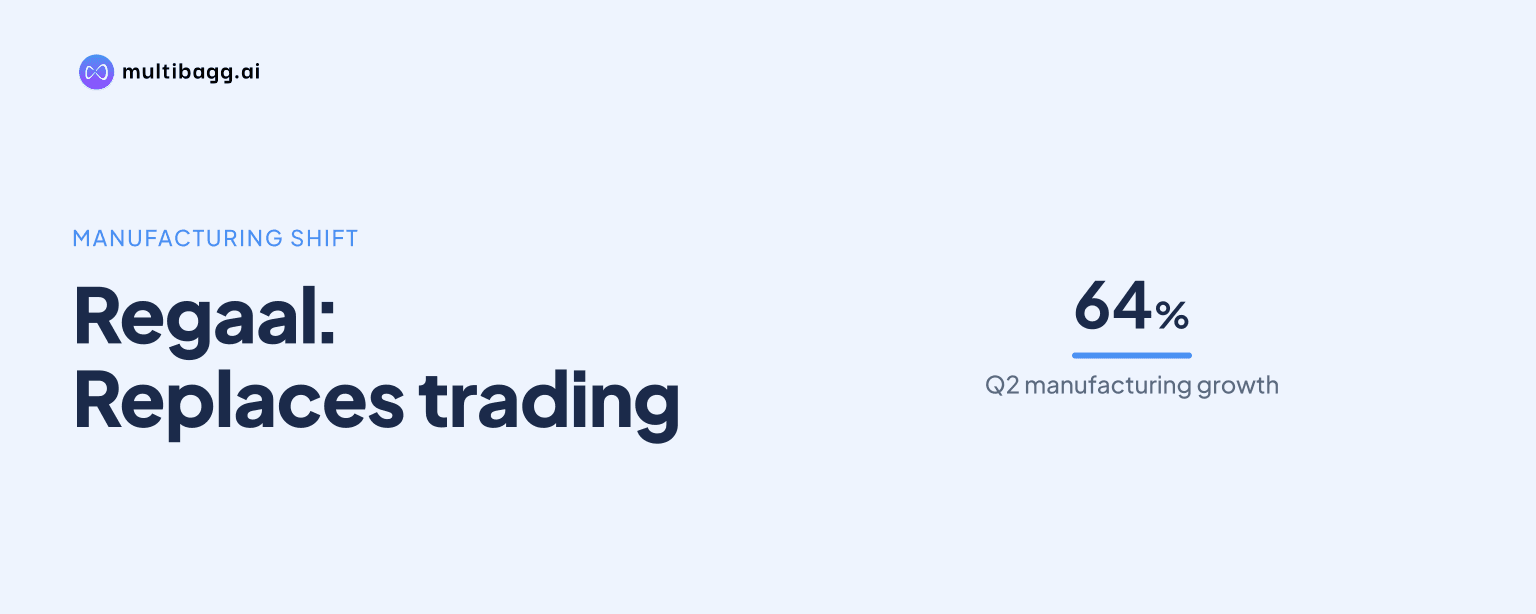
Regaal Resources Limited replaced Rs 127 crore of prior-year Q2 maize trading sales with about Rs 313 crore of manufacturing sales in the current Q2, which management said rose 64%. Total sales were about Rs 317 crore versus about Rs 320 crore a year earlier, showing that Regaal changed its revenue mix rather than materially expanding headline turnover.
Know Regaal Resources inside out
Results, valuation, peers and who's buying, in one view.
Why did Regaal stop routine maize trading?
Regaal stopped routine maize trading because management considers it a low-margin activity outside its manufacturing-led strategy. Asked about traded sales in the current Q2, management described them as negligible or zero, compared with Rs 127 crore in the same quarter a year earlier. It said trading margins are typically around 5% to 6% at most.
Regaal may still make occasional transactions when inventory quality or logistics make a sale more practical than moving maize to its plant. In October, management said it traded about Rs 8.5 crore of maize against Rs 160 crore of manufacturing turnover because earlier-procured maize was high quality and transport to the factory had become costly. Management described such transactions as opportunistic, rather than a continuing business line.
The company said any future opportunistic trading could be about Rs 10 crore to Rs 40 crore out of Rs 1,500 crore of turnover. That is materially different from the Rs 127 crore of traded sales reported in the prior-year Q2. The stated approach is to process most maize into starch and co-products, while selling inventory only when a specific commercial situation justifies it.
How did manufacturing sales replace Regaal's trading revenue?
Manufacturing sales largely replaced the removed trading revenue, with Regaal reporting about Rs 313 crore in the current Q2 versus about Rs 190 crore to Rs 192 crore in the prior-year quarter. Management characterised the increase as 64%, while trading sales declined from Rs 127 crore to zero.
Total sales changed little because the increase in manufacturing turnover broadly offset the discontinued trading contribution. Regaal reported total sales of about Rs 317 crore in the current Q2, compared with about Rs 320 crore in the prior-year Q2. The figures indicate a shift from a mixed manufacturing-and-trading model to sales that are almost entirely manufacturing-led.
Management called the change a manufacturing-led gain. The current-quarter difference between about Rs 313 crore of manufacturing sales and about Rs 317 crore of total sales was not separately explained in the call. However, the comparison shows why total sales were broadly flat despite the withdrawal from routine maize resale.
Got a follow-up? Ask IRIS
What could the new mix mean for Regaal's profitability?
Regaal said the new mix should focus assessment on manufacturing economics because trading generated margins of only around 5% to 6%. Management said earnings before interest, tax, depreciation and amortisation, or EBITDA, was about Rs 5,300 to Rs 5,400 per tonne at the time of the call. It added that it had not sold any order at Rs 5,100 per tonne.
Management said Rs 4,500 per tonne was easily sustainable for FY28, but did not commit to performance above that level. It said prior-year manufacturing-only EBITDA was Rs 4,000 per tonne, and cautioned that calculations using total EBITDA divided by manufacturing volume could incorporate trading activity. The distinction matters as Regaal removes a revenue source that had a different margin structure.
Raw-material and product prices remain important to the manufacturing outcome. Management said maize cost was around Rs 30 to Rs 31 per kilogram, compared with Rs 34 earlier, while starch was selling at Rs 49 to Rs 51 per kilogram. It also cited germ at Rs 83 per kilogram versus Rs 60, fibre at Rs 23 versus Rs 16, and gluten at Rs 66 versus Rs 60.
Regaal said its maize inventory could support production until about March 7 to March 15. Management plans to assess Rabi crop arrivals from Assam, Bihar and Bengal before buying further maize, and did not disclose the stock volume or procurement cost. This leaves the future manufacturing spread dependent on new-crop maize prices and product realisations after existing inventory is used.
Which projects are intended to support Regaal's manufacturing mix?
Regaal said liquid glucose, maltodextrin powder and its modified-starch basket had moved into production or sampling. Management said the modified-starch operations had been delayed by turbine-related work and the availability of specialised operators, but that these personnel had joined. These projects are intended to add processing options rather than restore routine trading turnover.
Dextrose is the remaining major project in the disclosed schedule, with management indicating an expected arrival around September FY28. It also said smaller projects should be completed during 2028. Management had previously introduced two products and referred to another four or five products in development, although it did not give individual sales targets for them.
At a stated maize crushing capacity of 1,650 tonnes per day, Regaal said it can produce roughly 1,500 tonnes of finished output. About 25%, or 375 tonnes, would be co-products such as germ, fibre and gluten, leaving around 1,100 tonnes of starch. Management's working plan is for 20% of that starch to become glucose and another roughly 20% to become pure value-added products.
Management said current value addition is about 10% to 15% of starch, or around 17% of total volume when other output is included. Its eventual objective is around 30% value addition in starch excluding liquid glucose. It said value addition can range from 50% to 70% by product, but declined to specify an EBITDA-margin range because demand, volumes and selling prices are still being established.
Conclusion
Regaal's current Q2 sales profile shows a deliberate replacement of low-margin maize trading with manufacturing revenue. About Rs 127 crore of prior-year trading sales fell to negligible or zero, while manufacturing sales rose to about Rs 313 crore from about Rs 190 crore to Rs 192 crore. As a result, total sales remained near Rs 317 crore rather than rising sharply, but the source of that revenue changed substantially.
The next disclosed milestones are management's FY28 production expectation of about 5,25,000 to 5,50,000 tonnes, the targeted dextrose launch around September FY28 and completion of smaller projects during 2028. Management also said planned capital expenditure totals Rs 665 crore, with about Rs 275 crore yet to be capitalised, while further efficiency or manufacturing projects would be disclosed if added.