










Reliance reports ₹12,000 crore NCD issue, no ₹15,000 crore approval
Key highlights
- Reliance issued ₹12,000 crore of listed unsecured redeemable NCDs through private placement during the quarter ended September 30, 2026.
- Reliance had ₹39,389 crore of group NCDs outstanding at September 30, 2026, including ₹20,000 crore of secured NCDs.
- Reliance’s cash and cash equivalents increased to ₹1,81,723 crore at September 30, 2026 from ₹1,45,977 crore at March 31, 2026.
- Reliance reported quarterly EBITDA of ₹61,224 crore and profit after tax and share of associates and joint ventures of ₹29,550 crore for the September 2026 quarter.
powered by IRIS
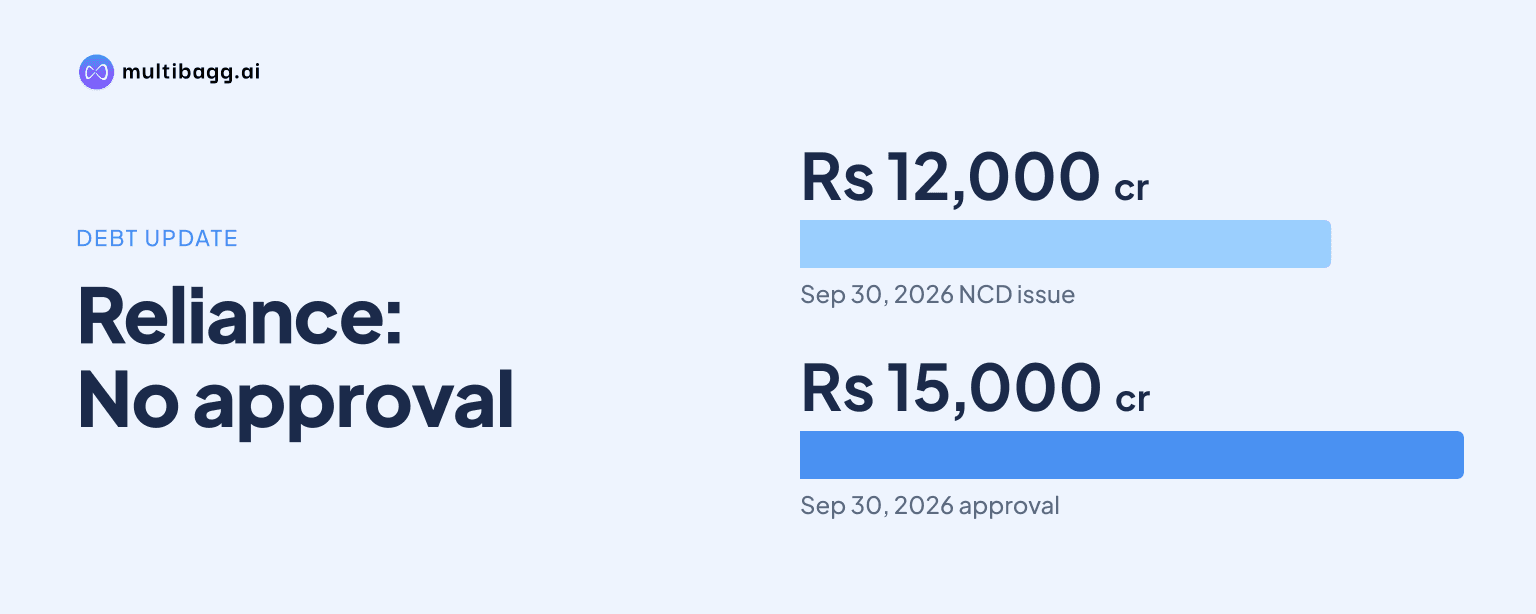
Reliance Industries Limited reported issuing ₹12,000 crore of listed unsecured redeemable non-convertible debentures during the quarter ended September 30, 2026, while total outstanding non-convertible debentures stood at ₹39,389 crore. The supplied filing does not disclose a board authorisation to raise up to ₹15,000 crore through private-placement debentures.
Know Reliance Industries inside out
Results, valuation, peers and who's buying, in one view.
Did Reliance approve ₹15,000 crore of debentures?
No. Reliance's filing says its Audit Committee reviewed, and its Board of Directors approved, the results and their release at meetings held on October 30, 2026; it does not state that the board authorised a ₹15,000 crore private-placement debenture programme. The disclosed board action therefore concerns the financial results, not the debt-raising approval described in the topic.
The distinction matters because the filing separately identifies an actual issue of ₹12,000 crore during the quarter ended September 30, 2026. It provides neither a ₹15,000 crore ceiling nor terms such as tenure, coupon, allotment date, proposed use of proceeds, or a schedule for any additional private-placement issuance. On the supplied evidence, the reported ₹12,000 crore issue should not be treated as proof of a ₹15,000 crore authorisation.
What debt did Reliance issue during the quarter?
Reliance issued ₹12,000 crore of listed unsecured redeemable non-convertible debentures, or NCDs, on a private-placement basis during the quarter. The instruments were identified in the filing as PPD Series Q, and Reliance classified them as listed, unsecured and redeemable, which describes the issue rather than a broader new fundraising limit.
The reported issue was equivalent to about 30% of the ₹39,389 crore total NCDs outstanding at September 30, 2026, based on the figures in the filing. That comparison links the quarterly issuance with the balance outstanding at the reporting date, but does not establish whether all proceeds remained outstanding at quarter-end or specify how the ₹12,000 crore was deployed.
The filing records the NCD amount before netting off prepaid finance charges and fair-value impact. This accounting qualification means the ₹39,389 crore figure is a stated gross outstanding amount for the group, rather than a carrying value after those adjustments. It also separates secured NCDs of ₹20,000 crore from the ₹12,000 crore quarterly issue, which was expressly described as unsecured.
How much NCD debt did Reliance have at September 2026?
Reliance had ₹39,389 crore of group NCDs outstanding as of September 30, 2026, including ₹20,000 crore of secured NCDs. The secured portion represented roughly 51% of outstanding NCDs, while the remaining ₹19,389 crore was not identified in the note as secured NCDs.
The ₹20,000 crore secured NCDs were backed by a first charge on certain movable properties of the group. Reliance said the security cover was more than 1.25 times the principal and accrued interest on those secured debentures at September 30, 2026. The filing does not name the movable assets, quantify their valuation, or provide a security-cover figure for the listed unsecured PPD Series Q issue.
NCDs are only one component of the group’s reported funding obligations. Consolidated non-current borrowings were ₹2,89,744 crore at September 30, 2026, compared with ₹2,70,751 crore at March 31, 2026, while current borrowings were ₹95,208 crore, down from ₹1,03,670 crore. These balance-sheet categories cannot be added to NCDs without adjustment because the filing does not provide a reconciliation between the NCD note and borrowing line items.
Got a follow-up? Ask IRIS
How did Reliance's borrowings and cash change?
Reliance's non-current borrowings increased by ₹18,993 crore from March 31, 2026 to September 30, 2026, while current borrowings declined by ₹8,462 crore over the same period. Taken together, the two reported borrowing lines rose to ₹3,84,952 crore from ₹3,74,421 crore, a net increase of ₹10,531 crore.
Cash and cash equivalents rose to ₹1,81,723 crore at September 30, 2026 from ₹1,45,977 crore at March 31, 2026. In the half-year cash-flow statement, Reliance recorded ₹25,677 crore of proceeds from non-current borrowings, ₹9,070 crore of repayments of non-current borrowings, and a ₹8,542 crore net reduction in current borrowings.
Finance costs were ₹16,818 crore in the half year ended September 30, 2026, compared with ₹13,863 crore in the corresponding prior-year half year. The debt-service coverage ratio was 3.32 for the 2026 half year versus 2.59 a year earlier, while the interest-service coverage ratio was 5.12 versus 5.78. The filing defines the latter as earnings before interest and tax divided by interest expense.
Reliance also disclosed a debt-equity ratio of 0.41 at September 30, 2026, compared with 0.40 at September 30, 2025. Total debt to total assets remained 0.17 in both periods. Separately, Reliance said ₹27,500 crore of Jio Platforms Limited initial public offer net proceeds had been used to prepay certain external commercial borrowings of Reliance Jio Infocomm Limited in full or in part.
Which businesses generated Reliance's earnings during the quarter?
Reliance reported total segment earnings before interest, tax, depreciation, amortisation and depletion, or EBITDA, of ₹61,224 crore for the quarter ended September 30, 2026, up from ₹51,403 crore in the June 2026 quarter and ₹48,480 crore a year earlier. Oil to Chemicals, or O2C, supplied ₹25,203 crore, while Digital Services supplied ₹22,223 crore.
O2C EBITDA increased by ₹8,193 crore quarter on quarter from ₹17,010 crore, whereas Digital Services EBITDA increased by ₹968 crore from ₹21,255 crore. Retail EBITDA was ₹6,120 crore, lower than ₹6,309 crore in the preceding quarter and ₹6,817 crore in the September 2025 quarter. The filing says segment EBITDA includes interest income attributable to the respective segments.
Quarterly revenue from operations reached ₹3,32,861 crore, compared with ₹3,11,850 crore in the June 2026 quarter and ₹2,58,898 crore a year earlier. Profit after tax and share of profit or loss of associates and joint ventures was ₹29,550 crore, up from ₹23,196 crore in the prior quarter. These operating results offer context for the period in which the ₹12,000 crore NCD issue was recorded, but do not identify a direct use for its proceeds.
Conclusion
The filing supports a narrower conclusion than the stated ₹15,000 crore premise: Reliance issued ₹12,000 crore of listed unsecured redeemable NCDs through private placement during the September 2026 quarter and had ₹39,389 crore of NCDs outstanding at September 30. Of that outstanding amount, ₹20,000 crore was secured, and the reported security cover exceeded 1.25 times principal plus accrued interest.
What to watch next is the use of the remaining Jio Platforms Limited initial public offer proceeds, which Reliance said would be used for general corporate purposes after ₹27,500 crore was applied to prepay certain external commercial borrowings. The current filing supplies no future NCD target, private-placement approval limit, maturity schedule or further issuance plan.